格物
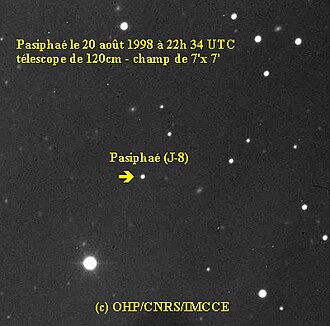
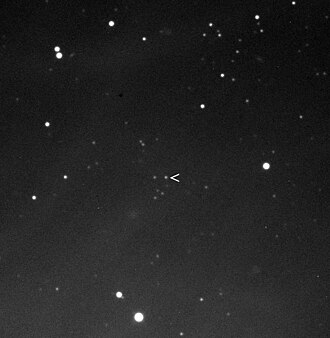
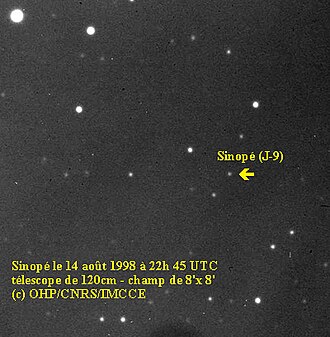
图:OHP (Observatoire de Haute-Provence) / CNRS (Centre national… · CC BY 3.0 · Wikimedia Commons
- 类型
- 不规则卫星
- 发现 / 发明时间
- 1908 年
- 发现者 / 提出者
- 菲利伯特·雅克·梅洛特
- 命名来源
- 帕西淮
- 学科
- 天文学
相关科学家
百科正文
概述
木卫八帕西法尔,直径68公里,是一颗逆行的不规则卫星,他是在1908年被菲利伯特·梅洛特发现,由希腊神话中的帕西法尔命名。
木卫八直到1975年才有正式的名称(帕西法尔),在那之前,人们只叫它木星VIII。
轨道
木卫八属于帕西法尔群,因此不但它的离心率很高而且轨道也极为的倾斜,帕西法尔群离木星距离22.8到24.1百万公里不等,而它们偏离黄道面144.5°到158.3°之间。
以上内容摘自维基百科「木卫八」,按 CC BY-SA 4.0 使用,去掉了参考文献、外部链接等尾部小节,公式改写成了纯文本。全文、配图和出处见原文。
英文维基百科补充中文条目比较短,下面是英文条目「Pasiphae (moon)」的原文
Pasiphae, formerly spelled Pasiphaë, also known as Jupiter VIII, is one of the biggest retrograde irregular satellites of Jupiter. As an irregular moon with an eccentric orbit, it gets as far as 35.9 million km from Jupiter.
Discovery and Naming
It was discovered in 1908 by Philibert Jacques Melotte.
The moon was first spotted on a plate taken at the Royal Greenwich Observatory on the night of 28 February 1908. Inspection of previous plates found it as far back as January 27. It received the provisional designation 1908 CJ, as it was not clear whether it was an asteroid or a moon of Jupiter. The recognition of the latter case came by April 10.
Later named after the mythological Pasiphaë, wife of Minos and mother of the Minotaur from Greek legend.
Pasiphae did not receive its present name until 1975; before then, it was simply known as Jupiter VIII. It was sometimes called "Poseidon" between 1955 and 1975.
Orbit
Pasiphae orbits Jupiter on a high eccentricity (0.490) and high inclination (about 157°) on a retrograde orbit with an average distance of 24.1 million km, but it gets as far as 35.9 million km from Jupiter. The orbital elements are continuously changing due to solar and planetary perturbations. In December 2023 the moon reached 0.2494 AU (37.31 million km; 23.18 million mi) from Jupiter, and in November 2024 approached within 0.0666 AU (9.96 million km; 6.19 million mi) of Jupiter.
It gives its name to the Pasiphae group, a group of retrograde moons of Jupiter with semi-major axes spread over 22–25 million km, inclinations between 141° and 158°, and higher eccentricities between 0.22 and 0.44.
Pasiphae is also known to be in a secular resonance with Jupiter (tying the longitude of its perijove with the longitude of perihelion of Jupiter).
Physical characteristics
With a diameter estimated at 58 km (Albedo 4.4%), Pasiphae is the largest retrograde and third largest irregular satellite after Himalia and Elara.
Spectroscopical measurements in infrared indicate that Pasiphae is a spectrally featureless object, consistent with the suspected asteroidal origin of the object.
The satellite appears pale red (colour indices V=17.22 B-V=0.74, R-V=0.38) though it falls into the grey color-class of C-type asteroids.
Origin
Pasiphae probably did not form near Jupiter but was captured by Jupiter later. Pasiphae is believed to be a fragment from a captured asteroid along with other Pasiphae group satellites.
以上内容摘自英文维基百科「Pasiphae (moon)」,按 CC BY-SA 4.0 使用,去掉了参考文献、外部链接等尾部小节,公式改写成了纯文本。全文、配图和出处见原文。