格物
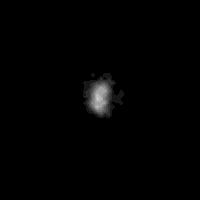
图:NASA/JPL · Public domain · Wikimedia Commons
- 类型
- 海王星的卫星、不规则卫星
- 发现 / 发明时间
- 1949 年
- 发现者 / 提出者
- 杰拉德·柯伊伯
- 命名来源
- 涅瑞伊得斯
- 学科
- 天文学
相关科学家

百科正文
它的离心率目前已发现卫星中是最大的,达0.7512。海卫二最接近海王星的距离是1,300,000公里,最远则是9,700,000公里,因此相信它是被海王星引力吸引的库伯带天体。
以上内容摘自维基百科「海卫二」,按 CC BY-SA 4.0 使用,去掉了参考文献、外部链接等尾部小节,公式改写成了纯文本。全文、配图和出处见原文。
英文维基百科补充中文条目比较短,下面是英文条目「Nereid (moon)」的原文
Nereid, or Neptune II, is the third-largest moon of Neptune. It was the second moon of Neptune to be discovered, by Gerard Kuiper in 1949. It is notable for its unusually eccentric orbit and relatively large size for an irregular satellite. Nereid also exhibits large brightness variations over long periods of time, the origin of which has yet to be conclusively explained.
Observational history
Discovery and naming
Nereid was discovered on 1 May 1949 by Gerard P. Kuiper using photographic plates taken with the 82-inch telescope at the McDonald Observatory. He proposed the name in the report of his discovery. It is named after the Nereids, sea-nymphs of Greek mythology and attendants of the god Neptune. It was the second moon of Neptune to be discovered, and the last before the arrival of Voyager 2 (not counting a single observation of an occultation by Larissa in 1981). In his original report, Kuiper estimated its apparent magnitude at 19.5, which stood as the only photometric information on Nereid until 1987.
Brightness variations
Since 1987 some photometric observations of Nereid have detected large variations of its brightness.
Physical characteristics
Nereid is the third-largest of Neptune's satellites, and has a mean radius of about 170 kilometres (110 mi), about the same size as Saturn's moon Mimas. It is by far the largest normal irregular moon known, having about two-thirds the mass of all irregular moons combined. (Triton is much larger, but is very unusual for an irregular satellite.) Nereid also accounts for about 98% of the mass of Neptune's entire irregular satellite system altogether (excluding Triton), which is similar to the situation of Phoebe at Saturn (the second-largest normal irregular moon in the Solar System).
Nereid's size is such that it may be large enough to have pulled itself into a sphere, or small enough that it has not; it lies directly within the grey area.
Orbit and rotation
Orbit
Nereid orbits Neptune in the prograde direction at an average distance of 5.51 million kilometres (3.42 million miles), roughly 15–16 times farther than that of Triton, and it takes almost one Earth year to complete an orbit. Its very high eccentricity of 0.75 takes it as close as 1.37 million kilometres (0.85 million miles) and as far as 9.65 million kilometres (6.00 million miles). Its orbit has a modest inclination of 7.1° to the Laplace plane, but the tilt is larger relative to Neptune's equator at 28.4°.
Even comparing to irregular satellites, Nereid's orbit is unusual. It has the second-most eccentric orbit of all known moons in the Solar System, after S/2023 S 38. No irregular moon has an inclination less than 26°, except for Nereid.
Origin and classification
There are two main competing theories to explain the origin of Nereid. It may be either a captured Kuiper belt object, or it was an inner moon in the past and was perturbed during the capture of Neptune's largest moon Triton. A study in 2026 found that Nereid's spectrum is markedly different from minor planets of the outer Solar System, suggesting that it formed around Neptune rather than being a captured body. If this conclusion is proven to be true, it would mean that Nereid is the last remaining intact original moon of Neptune to have survived Triton's destructive arrival.
Nereid is sometimes classified as an irregular satellite, because like all irregular satellites, Nereid has a distant, highly elliptical, and highly inclined orbit far away from Neptune's equatorial plane.
Exploration
The only spacecraft to visit Nereid was Voyager 2, which passed it while it was at the farthest point of its orbit. Its closest approach was at a distance of 4,700,000 km (2,900,000 mi) between 20 April and 19 August 1989. It obtained 83 images with observation accuracies of 70 km (43 mi) to 800 km (500 mi). Prior to Voyager 2's arrival, observations of Nereid had been limited to ground-based observations that could only establish its intrinsic brightness and orbital elements. Although the images obtained by it do not have a high enough resolution to allow surface features to be distinguished, Voyager 2 was able to measure the size of Nereid and found that it was grey in colour and had a higher albedo than Neptune's other small satellites.
以上节选摘自英文维基百科「Nereid (moon)」,按 CC BY-SA 4.0 使用,去掉了参考文献、外部链接等尾部小节,公式改写成了纯文本。篇幅所限,较长的小节只摘了开头一部分,有的小节没有收;全文、配图和出处见原文。