格物
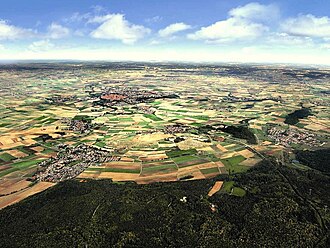
图:Stadt Nördlingen · CC BY-SA 3.0 · Wikimedia Commons
讷德林根-里斯1960
Nördlinger Ries
meteorite impact crater in Bavaria, Germany
The Nördlinger Ries is an impact crater and large circular depression in western Bavaria and eastern Baden-Württemberg. It is located north of the Danube in the district of Donau-Ries. The city of Nördlingen is located within the depression, about 6 kilometres (3.7 mi) south-west of its centre.
摘自英文维基百科「Nördlinger Ries」(英文维基百科,暂无中文条目),CC BY-SA 4.0
- 类型
- 壁垒撞击坑
- 发现 / 发明时间
- 1960 年
- 发现者 / 提出者
- 尤金·舒梅克
- 命名来源
- 拉埃提亚
- 学科
- 天文学
- 起因
- Ries-Steinheim impact event
相关科学家
百科正文
本条目暂无中文维基百科条目,下面是英文维基百科原文。
Etymology
Ries is derived from Raetia, since the tribe of Raetians lived in the area in pre-Roman times.
Description
The depression is a meteorite impact crater formed 14.808 ± 0.038 million years ago in the Miocene. The crater is most commonly referred to simply as the Ries crater or the Ries. The original crater rim had an estimated diameter of 24 km (15 mi). The present floor of the depression is about 100 to 150 m (330 to 490 ft) below the eroded remains of the rim.
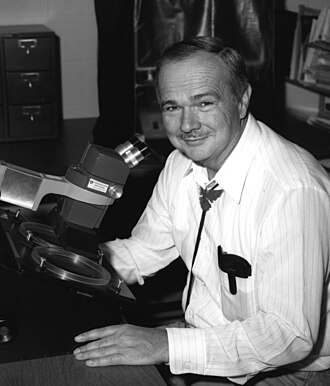
It was originally assumed that the Ries was of volcanic, glacial or tectonic origin. Oliver Sachs introduced, in this context, the term "pioneer era" (up to 1870) and marked the beginning of early modern research on the Ries (from 1870), meaning the period when the first detailed theories about the formation of the Nördlinger Ries became known. In 1960 Eugene Shoemaker and Edward C. T. Chao showed that the depression was caused by meteorite impact. The key evidence was the presence of coesite, which, in unmetamorphosed rocks, can only be formed by the shock pressures associated with meteorite impact. The coesite was found in suevite from Otting quarry, but even before, Shoemaker was encouraged by St. George's Church in Nördlingen, which is built of locally derived suevite. The suevite was formed from mesozoic sediments shocked by the bolide impact.
The Ries impact crater was a rampart crater, thus far a unique finding on Earth. Rampart craters have almost exclusively been found on Mars. Rampart craters exhibit a fluidized ejecta flow after the impact of the meteorite, most simply compared to a bullet fired into the mud, with the ejecta resembling a mudflow.
Another impact crater, the much smaller (3.8 km (2.4 mi) diameter) Steinheim crater, is located about 42 km (26 mi) west-southwest from the center of Ries.
Impact
The Ries impact (also known as the Ries event) was an asteroid impact that occurred approximately 15 million years ago in what is now southern Germany. The resulting impact crater, the Nördlinger Ries, has a diameter of about 24 km (15 mi), indicating the release of an enormous amount of energy. The nearby Steinheim Basin and a number of smaller craters on the Franconian Jura and in the Lake Constance area are, according to more recent findings, not contemporaneous with the Nördlinger Ries and are therefore not part of the Ries event.
Sequence
The Nördlinger Ries is one of the best-studied impact craters on Earth. Since 1960, when it was proven that the formation of the Ries crater resulted from the impact of an asteroid, scientists have developed a highly detailed understanding of the events that took place during its formation 14.6 ± 0.2 million years ago (during the Miocene Langhian stage). A recent geophysical study was able to demonstrate, based on the different impact rocks, that the Ries impactor struck from the north-northwest.
Asteroid
In just a few seconds, a celestial body — an asteroid approximately 1.5 km (0.93 mi) in diameter — travelling at 20 km/s (72,000 km/h or 45,000 mph) passed through the Earth's atmosphere. As a meteor whose apparent magnitude exceeded that of the Sun, it approached the Earth's surface almost undamped from a westerly direction. The much smaller Steinheim Basin, located about 40 km (25 mi) southwest and formed by a second body, is now known to be several hundred thousand years younger and thus not contemporaneous.
Fractions of a second before the asteroid hit the surface at an angle of about 30°, the air between the asteroid and the ground was compressed and heated.
Related craters
Steinheim crater
Approximately 40 km (25 mi) southwest of the Nördlinger Ries lies the Steinheim Basin (48°41′12″N 10°3′54″E), another impact crater that is also roughly 15 million years old. The older view held that it formed simultaneously with the Ries crater. The idea that the two neighbouring craters originated independently but at approximately the same time was long regarded as unlikely. According to the earlier hypothesis, the cosmic bodies responsible for the two craters consisted of one asteroid accompanied by a much smaller companion, whose separation already before entering the Earth's atmosphere roughly corresponded to the present-day distance between the Ries and the Steinheim Basin.
Contrary to this scenario, more recent studies based on various stratigraphic and palaeontological analyses suggest that the Steinheim Basin formed approximately 500,000 years after the Ries event.
The impact of the roughly 150 m meteorite that created the Steinheim Basin released only about one percent of the energy liberated during the formation of the Ries crater. Approximately two cubic kilometres of rock were displaced. A crater approximately 3.5 km in diameter, originally about 200 m deep and with a prominently developed central uplift, was produced.
Craters on the Franconian Jura
As early as 1969 — only a few years after the impact origin of both the Ries crater and the Steinheim Basin had been proven — the basin near Pfahldorf close to Kipfenberg, approximately 60 km east of the Ries (48°57′42″N 11°19′54″E), was proposed as another possible meteorite crater with a diameter of 2.5 km. In 1971 the Stopfenheimer Kuppel near Ellingen, about 30 km northeast of the Ries (49°4′18″N 10°53′24″E), with a diameter of 8 km, was interpreted as a possible crater.
History
On one edge of the Nördlinger Ries are the Ofnet Caves, where, at the beginning of the 20th century, archaeologists discovered thirty-three human skulls dating to the Mesolithic period.
The Ries was the site of the Battle of the Ries on 13 May 841.
The landing site for Apollo 14 is a heavily craterized terrain, and one of the science goals of the mission was to sample ejecta from the impact that formed Mare Imbrium. Nördlinger Ries is an easily accessible, large impact crater, making it a convenient analog for lunar craters. Because of this, it was used as a location to train Apollo 14 astronauts, so that they would be able to investigate lunar impact structures and related rocks. Astronauts Alan Shepard and Edgar Mitchell, as well as Apollo 14 backup astronauts Eugene Cernan and Joe Engle, trained here from August 10 to August 14, 1970. Apollo 17 astronauts also trained at Nördlinger Ries.
In popular culture
In Julian May's Saga of Pliocene Exile series of books, the Nördlinger Rieskessel is an impact crater caused by the crash-landing of an alien ship, setting up the society of humanoid aliens in Pliocene-era Europe.
以上节选摘自英文维基百科「Nördlinger Ries」,按 CC BY-SA 4.0 使用,去掉了参考文献、外部链接等尾部小节,公式改写成了纯文本。篇幅所限,较长的小节只摘了开头一部分,有的小节没有收;全文、配图和出处见原文。