格物
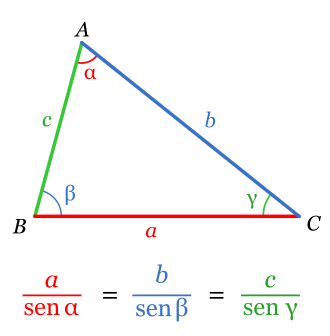
图:Drini · Public domain · Wikimedia Commons
- 类型
- 定理
- 研究学科
- 三角学、欧几里得几何
- 学科
- 数学
百科正文
正弦定理是三角学中的一个定理。它指出:对于任意 (公式略), a、 b、 c 分别为 ∠ A、 ∠ B、 ∠ C 的对边, R 为 (公式略) 的外接圆半径,则有 a/(sin ∠ A)=b/(sin ∠ B)=c/(sin ∠ C)=2R
证明
法一
做一个边长为 a, b, c 的三角形,对应角分别是 A, B, C。从角 C 向 c 边做垂线,得到一个长度为h的垂线和两个直角三角形。
- 显然: sin A=h/b
- 且: sin B=h/a
- 故: h=b sin A=a sin B
- 故: (sin A)/a=(sin B)/b
- 同理可证: (sin B)/b=(sin C)/c
法二
作 (公式略) 的外接圆,设半径为 R, BC=a
角A为锐角时
由于 ∠ A 与 ∠ D 所对的弧都为 BC,根据圆周角定理可了解到 ∠ A=∠ D
- 由于 BD 为外接圆直径, (公式略)
- 所以 (公式略)
- sin (公式略)
- (公式略)
角A为直角时
因为 BC=a=2R,可以得到 (公式略)
所以可以证明 (公式略)
角A为钝角时
- 线段 BD 是圆的直径
- 根据圆内接四边形对角互补的性质 ∠ D=π -∠ BAC
- 所以 sin ∠ BAC=sin ∠ D
- 因为 BD 为外接圆的直径 BD=2R。根据正弦定义 (公式略)
- 变形可得 (公式略)
根据以上的证明方法可以证明得到得到三角形的一条边与其对角的正弦值的比等于外接圆的直径,即 a/(sin ∠ A)=b/(sin ∠ B)=c/(sin ∠ C)=2R
运用
三面角正弦定理
若三面角的三个面角分别为 α、 β、 γ,它们所对的二面角分别为 A、 B、 C,则 (sin α)/(sin A)=(sin β)/(sin B)=(sin γ)/(sin C)
- 多边形的正弦关系: (公式略)
- sin (公式略)
- sin (公式略)
以上内容摘自维基百科「正弦定理」,按 CC BY-SA 4.0 使用,去掉了参考文献、外部链接等尾部小节,公式改写成了纯文本。全文、配图和出处见原文。
英文维基百科补充中文条目比较短,下面是英文条目「Law of sines」的原文
In trigonometry, the law of sines (sometimes called the sine formula or sine rule) is a mathematical equation relating the lengths of the sides of any triangle to the sines of its angles. According to the law, (公式略)
where a, b, and c are the lengths of the sides of a triangle, and α, β, and γ are the opposite angles (see figure 2), while R is the radius of the triangle's circumcircle. When the last part of the equation is not used, the law is sometimes stated using the reciprocals; (公式略)
The law of sines can be used to compute the remaining sides of a triangle when two angles and a side are known—a technique known as triangulation. It can also be used when two sides and one of the non-enclosed angles are known. In some such cases, the triangle is not uniquely determined by this data (called the ambiguous case) and the technique gives two possible values for the enclosed angle.
The law of sines is one of two trigonometric equations commonly applied to find lengths and angles in scalene triangles, with the other being the law of cosines.
The law of sines can be generalized to higher dimensions on surfaces with constant curvature.
Proof
With the side of length a as the base, the triangle's altitude can be computed as b sin γ or as c sin β. Equating these two expressions gives b/(sin β)=c/(sin γ),
and similar equations arise by choosing the side of length b or the side of length c as the base of the triangle. For a proof that these expressions are equal to 2R, see Relation to the circumcircle.
以上节选摘自英文维基百科「Law of sines」,按 CC BY-SA 4.0 使用,去掉了参考文献、外部链接等尾部小节,公式改写成了纯文本。篇幅所限,较长的小节只摘了开头一部分,有的小节没有收;全文、配图和出处见原文。