格物
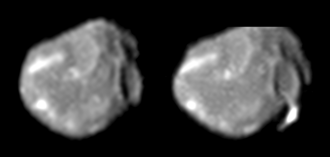
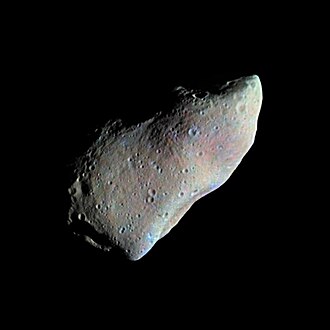
图:NASA / JPL · Public domain · Wikimedia Commons
- 类型
- 规则卫星
- 发现 / 发明时间
- 1892 年
- 发现者 / 提出者
- 爱德华·爱默生·巴纳德
- 命名来源
- 阿玛尔忒娅
- 学科
- 天文学
相关科学家
百科正文
概述
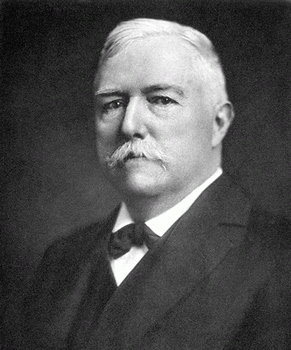
木卫五是已知的离木星第三近的天然卫星,1892年9月9日爱德华·埃默森·巴纳德用利克天文台的一台36英寸(91厘米)折射望远镜发现了它,它是最后一颗直接用肉眼观测发现的卫星(后来的发现一般都是使用照片或其它方式),它也是伽利略·伽利莱1610年发现的四颗木星卫星后第一颗被发现的木星卫星。木卫五与其它三颗木星的内层卫星被归于同一个族。木卫五是其中最大的。
国际天文联会将它授名为Amalthea(阿马尔塞)。在希腊神话中,阿马尔塞是一个仙女,她用一只山羊的奶养育了宙斯(木星)。请注意除木卫五外,羊神星(113号小行星)也被称为Amalthea。
表面特征
木卫五是太阳系内最红的一个天体,它甚至比火星还要红。它的红色来自木卫一上火山喷发出来的硫。在木卫五主要的斜坡上还有一块块绿色的地方,这些颜色的来由现在还不清楚。
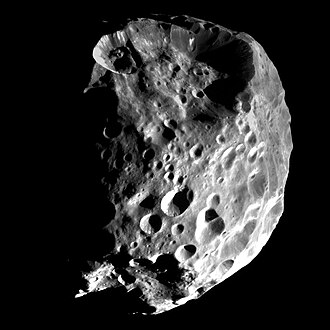
木卫五的外形不规则,它的三个轴的长度分别是250×146×128公里,它的长轴指向木星。它的表面上有许多撞击坑,与它的大小相比,它们有些非常大。其中最大的潘撞击坑的直径达100公里,深8公里;另一个环形山(盖亚撞击坑)直径80公里,深度比潘可能深一倍。木卫五上还有两座山,它们比其它部分高出20公里。
木卫五的大小和它的不规则的形状可能说明它是一块非常坚固的物体,否则的话它的外形随时间的变化会变得更圆。它可能是一颗被木星俘获的小行星。与木星的其它卫星一样,木卫五的公转和自转周期相同。和木卫一一样,木卫五辐射出的热量比它接受到的太阳光的能量要高,这可能是它内部在木星的磁场中感应的电流导致的。
撞击坑与光斑
木卫五的撞击坑,以希腊神话的神祇命名。
以上内容摘自维基百科「木卫五」,按 CC BY-SA 4.0 使用,去掉了参考文献、外部链接等尾部小节,公式改写成了纯文本。全文、配图和出处见原文。
英文维基百科补充中文条目比较短,下面是英文条目「Amalthea (moon)」的原文
Amalthea is a moon of Jupiter. It has the third-closest orbit around Jupiter among known moons and was the fifth moon of Jupiter to be discovered, so it is also known as Jupiter V. It is also the fifth-largest moon of Jupiter, after the four Galilean moons. Edward Emerson Barnard discovered the moon on 9 September 1892 and named it after Amalthea of Greek mythology. It was the last natural satellite to be discovered by direct visual observation; all later moons were discovered by photographic or digital imaging.
Amalthea is in a close orbit around Jupiter and is within the outer edge of the Amalthea Gossamer Ring, which is formed from dust ejected from its surface. Jupiter would appear 46.5 degrees in diameter from its surface. Amalthea is the largest of the inner satellites of Jupiter and is irregularly shaped and reddish in color. It is thought to consist of porous water ice with unknown amounts of other materials. Its surface features include large craters and ridges.
Close-range images of Amalthea were taken in 1979 by the Voyager 1 and 2 spacecraft, and in more detail by the Galileo orbiter in the 1990s.
History
Discovery
Amalthea was discovered on 9 September 1892 by Edward Emerson Barnard using the 36 inch (91 cm) refractor telescope at Lick Observatory. It was the last planetary satellite to be discovered by direct visual observation (as opposed to photographically) and was the first new satellite of Jupiter since Galileo Galilei's discovery of the Galilean satellites in 1610.
Name
Amalthea is named after the nymph Amalthea from Greek mythology, who nursed the infant Zeus (the Greek equivalent of Jupiter) with goat's milk.
Orbit
Amalthea orbits Jupiter at a distance of 181,000 km (2.54 Jupiter radii). The orbit of Amalthea has an eccentricity of 0.003 and an inclination of 0.37° relative to the equator of Jupiter.
Physical characteristics
The surface of Amalthea is the reddest in the Solar System. This color may be due to sulfur originating from Io or some other non-ice material. Bright patches of less-red tint appear on the major slopes of Amalthea, but the nature of this color is currently unknown. The surface of Amalthea is slightly brighter than surfaces of other inner satellites of Jupiter. There is also a substantial asymmetry between the leading and trailing hemispheres: the leading hemisphere is 1.3 times brighter than the trailing one.
Relationship with Jupiter's rings
Due to tidal force from Jupiter and Amalthea's low density and irregular shape, the escape velocity at its surface points closest to and furthest from Jupiter is no more than 1 m/s, and dust can easily escape from it after, for example, micrometeorite impacts; this dust forms the Amalthea gossamer ring.
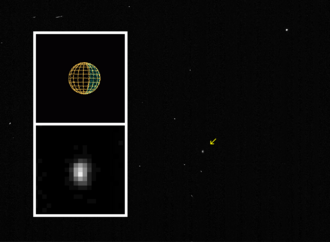
During its flyby of Amalthea, the Galileo orbiter's star scanner detected nine flashes that appeared to be small moonlets near the orbit of Amalthea.
Views to and from Amalthea
From Jupiter's "surface"—or rather, from just above its cloudtops—Amalthea would appear very bright, shining with a magnitude of −4.7, similar to that of Venus from Earth. At only 5 arcminutes across, its disc would be barely discernible. Amalthea's orbital period is only slightly longer than its parent planet's day (about 20% in this case), which means it would cross Jupiter's sky very slowly. The time between moonrise and moonset would be over 29 hours.
Exploration
In 1979, the unmanned Voyager 1 and Voyager 2 space probes obtained the first images of Amalthea to resolve its surface features. They also measured the visible and infrared spectra and surface temperature. Later, the Galileo orbiter completed the imaging of Amalthea's surface.
In fiction
Amalthea is the setting of several works of science fiction, including stories by Arthur C. Clarke, James Blish, and Arkady and Boris Strugatsky.
以上节选摘自英文维基百科「Amalthea (moon)」,按 CC BY-SA 4.0 使用,去掉了参考文献、外部链接等尾部小节,公式改写成了纯文本。篇幅所限,较长的小节只摘了开头一部分,有的小节没有收;全文、配图和出处见原文。