格物
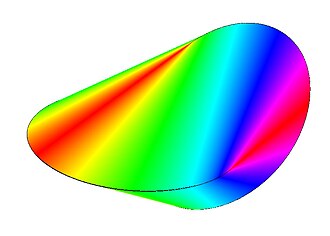
图:Xario · CC BY-SA 3.0 · Wikimedia Commons
- 发现 / 发明时间
- 1929 年
- 发现者 / 提出者
- 保罗·沙茨
- 学科
- 数学
- 上级概念
- solid figure
相关科学家
百科正文
构造
Oloid曲面可由下述方法构造:将两个全等的圆形在三维空间内互相垂直放置,并保持它们的圆心距等于 r (这时一个圆的圆周恰在另一个的圆心上)。构造一个凸曲面将上述骨架包裹,并使该凸曲面的面积最小,便得到一个Oloid曲面。可以证明Oloid曲面和圆的交集是两条2/3圆弧。
性质
表面积
Oloid曲面的表面积公式为(其中 r 为骨架圆的半径): A=4π r²
这和半径为 r 的球体的表面积恰好相等。
体积
一个闭合的Oloid曲面所围成的体积是: 2/3(2E(3/4)+K(3/4))r³
其中 r 为骨架圆的半径,而 E 和 K 是椭圆积分。
可展性
Oloid曲面是可展曲面,因此对于曲面上的任何一点,其高斯曲率恒等于0。这意味着Oloid曲面可以不经过压缩变形而展开为一平坦的欧几里德平面。同样,特定形状的平坦平面可以不经压缩而围成Oloid曲面。右图即是Oloid曲面的二维展开。
以上内容摘自维基百科「Oloid」,按 CC BY-SA 4.0 使用,去掉了参考文献、外部链接等尾部小节,公式改写成了纯文本。全文、配图和出处见原文。
英文维基百科补充中文条目比较短,下面是英文条目「Oloid」的原文
An oloid is a three-dimensional curved geometric object that was discovered by Paul Schatz in 1929. It is the convex hull of a skeletal frame made by placing two linked congruent circles in perpendicular planes, so that the center of each circle lies on the edge of the other circle. The distance between the circle centers equals the radius of the circles. One third of each circle's perimeter lies inside the convex hull, so the same shape may be also formed as the convex hull of the two remaining circular arcs each spanning an angle of 4π/3.
Surface area and volume
The surface area of an oloid is given by A=4π r²,
exactly the same as the surface area of a sphere with the same radius. In closed form, the enclosed volume is V=2/3(2E(3/4)+K(3/4))r³,
where K and E denote the complete elliptic integrals of the first and second kind respectively.
A numerical calculation gives V≈ 3.0524184684 r³.
Kinetics
The surface of the oloid is a developable surface, meaning that patches of the surface can be flattened into a plane. While rolling, it develops its entire surface: every point of the surface of the oloid touches the plane on which it is rolling, at some point during the rolling movement, making it a developable roller. Unlike most axial symmetric objects (cylinder, sphere etc.), while rolling on a flat surface, its center of mass performs a meandering motion rather than a linear one. The distance h between the oloid's center of mass and the rolling surface is given by (公式略),
where t∈ (-(2π)/3;(2π)/3) is the arc-length of one of the circles and r is the radius of the circle.
This distance has two minima and two maxima in each rolling cycle.
The difference between maxima and minima is (公式略).
Since this difference is fairly small, the oloid's rolling motion is relatively smooth.
At each point during this rolling motion, the oloid touches the plane in a line segment. The length of this segment stays unchanged throughout the motion, and is given by: l=√3r.
Related shapes
The sphericon is the convex hull of two semicircles on perpendicular planes, with centers at a single point. Its surface consists of the pieces of four cones. It resembles the oloid in shape and, like it, is a developable surface that can be developed by rolling. However, its equator is a square with four sharp corners, unlike the oloid which does not have sharp corners.
A more general object called the two-circle roller was described in 1966. It was defined from joined two perpendicular circular discs. If the distance between their centers is √2 times their radius, then its center of gravity stays at a constant distance from the floor, so it rolls more smoothly than the oloid.
Morton’s Rolling Knot or 'Rocking Knot' is a trefoil knot that has been parametrized in a way that leaves it tritangentless, e.g. with no plane that can be laid tangent to three distinct points. This distinct property means it never touches the ground in more than two places at once and is thus able to roll easily. Modern optimizations have been made to determine the optimum parameters for a homogenous rolling motion.
In popular culture
In 1979, modern dancer Alan Boeding designed his "Circle Walker" sculpture from two crosswise semicircles, forming a skeletal version of the sphericon, a shape with a similar rolling motion to the oloid. He began dancing with a scaled-up version of the sculpture in 1980 as part of an MFA program in sculpture at Indiana University, and after he joined the MOMIX dance company in 1984 the piece became incorporated into the company's performances. The company's later piece "Dream Catcher" is based around another Boeding sculpture whose linked teardrop shapes incorporate the skeleton and rolling motion of the oloid.
以上内容摘自英文维基百科「Oloid」,按 CC BY-SA 4.0 使用,去掉了参考文献、外部链接等尾部小节,公式改写成了纯文本。全文、配图和出处见原文。