格物
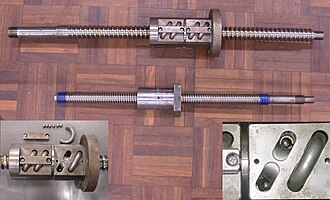
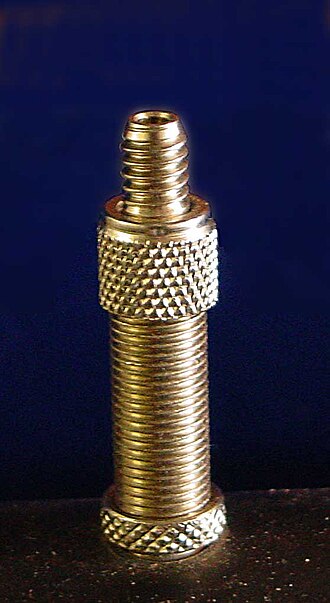
图:No machine-readable author provided. Graibeard assumed (base… · CC BY-SA 3.0 · Wikimedia Commons
- 发现 / 发明时间
- 1889 年
- 发现者 / 提出者
- H. M. Stevenson
- 上级概念
- 直线驱动器
百科正文
发展史
人们应用丝杠来做传动的历史其实不算很长,传统上的丝杠一直有定位不佳、易损害的情况。直到公元1898年人们首次尝试将钢珠置入螺帽及丝杠之间以滚动摩擦取代滑动摩擦,来改善其定位不佳及易损害的情况。1940年更将滚珠丝杠置于在汽车转向装置上,更为滚珠丝杠的应用上的巨大革命,并逐渐取代传统艾克姆丝杠(ACME)。直到近年来,滚珠丝杠已成为产业界使用最广的零组件之一。
结构
滚珠丝杠主要为丝杠、螺帽、钢珠、固定座、刮刷器及回流管所构成的,依其循环系统的不同更分为外循环式、内循环式、端塞循环式与端盖循环式滚珠丝杠。
应用产业
滚珠丝杠发展至今,已经广泛应用到各产业机械的定位精度控制上如精密机床 (Precision machine tools)、产业机械 (Industrial machinery)、电子机械 (Electronic machinery)、输送机械 (Transport machinery)的重要主角。除了上述所应用在机械之外更应用在电脑磁盘机起动器的传动、飞机机翼升降的调整、螺旋桨的倾斜角度控制、医疗用X射线透视摄影装置等等,所应用的范围极为广泛。
以上内容摘自维基百科「滚珠丝杠」,按 CC BY-SA 4.0 使用,去掉了参考文献、外部链接等尾部小节,公式改写成了纯文本。全文、配图和出处见原文。
英文维基百科补充中文条目比较短,下面是英文条目「Ball screw」的原文
A ball screw (or ballscrew) is a mechanical linear actuator that translates rotational motion to linear motion with little friction. A threaded shaft provides a helical raceway for ball bearings which act as a precision screw. As well as being able to apply or withstand high thrust loads, they can do so with minimum internal friction. They are made to close tolerances and are therefore suitable for high-precision applications. The ball assembly acts as the nut while the threaded shaft is the screw.
In contrast to conventional leadscrews, ball screws tend to be rather bulky, due to the need to have a mechanism to recirculate the balls.
History
The ball screw was invented independently by H.M. Stevenson and D. Glenn who were issued in 1898 patents 601,451 and 610,044 respectively.
Early precise screwshafts were produced by starting with a low-precision screwshaft, and then lapping the shaft with several spring-loaded nut laps.. By rearranging and inverting the nut laps, the lengthwise errors of the nuts and shaft were averaged. Then, the repeatable pitch shaft's pitch is measured against a distance standard. A similar process is sometimes used today to produce reference standard screw shafts and to master manufacturing screw shafts.
Design
Low friction in ball screws yields high mechanical efficiency compared to alternatives. A typical ball screw may be 90 percent efficient, versus 20 to 25 percent efficiency of an Acme lead screw of equal size. Lack of sliding friction between the nut and screw lends itself to extended lifespan of the screw assembly (especially in no-backlash systems), reducing downtime for maintenance and parts replacement, while also decreasing demand for lubrication. This, combined with their overall performance benefits and reduced power requirements, may offset the initial costs of using ball screws.
Operation
To maintain their inherent accuracy and ensure long life, great care is needed to avoid contamination with dirt and abrasive particles. This may be achieved by using rubber or leather bellows to completely or partially enclose the working surfaces. Another solution is to use a positive pressure of filtered air when they are used in a semi-sealed or open enclosure.
While reducing friction, ball screws can operate with some preload, effectively eliminating backlash (slop) between input (rotation) and output (linear motion).
Manufacture
Ball screw shafts may be fabricated by rolling, yielding a less precise but inexpensive and mechanically efficient product. Rolled ball screws have a positional precision of several thousandths of an inch per foot.
Ball screws are classified using "accuracy grades" from C0 (most precise) to C10. High-precision screw shafts are typically precise to one thousandth of an inch per foot (830 nm/cm) or better. They have historically been machined to gross shape, case-hardened, and then ground. The three-step process is needed because high-temperature machining distorts the workpiece.
Applications
Ball screws are used in aircraft and missiles to move control surfaces, especially for electric fly by wire, and in automobile power steering to translate rotary motion from an electric motor to axial motion of the steering rack. They are also used in machine tools, robots, and precision assembly equipment. High-precision ball screws are used in steppers for semiconductor manufacturing.
A ball screw is used to expand the Deployable Tower Assembly (DTA) structure on the James Webb Space Telescope.
A ball screw is also planned to be used in TerraPower's Natrium reactor as part of its Control rod drive mechanism.
Similar systems
Another form of linear actuator based on a rotating rod is the threadless ballscrew, or "rolling ring drive". In this design, three or more rolling-ring bearings are arranged symmetrically in a housing surrounding a smooth (threadless) actuator rod or shaft. The bearings are set at an angle to the rod, and this angle determines the direction and rate of linear motion per revolution of the rod. An advantage of this design over the conventional ballscrew or leadscrew is the practical elimination of backlash and loading caused by preload nuts.
以上节选摘自英文维基百科「Ball screw」,按 CC BY-SA 4.0 使用,去掉了参考文献、外部链接等尾部小节,公式改写成了纯文本。篇幅所限,较长的小节只摘了开头一部分,有的小节没有收;全文、配图和出处见原文。