格物
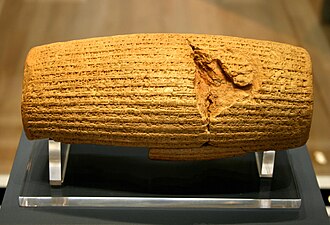
图:Photograph by Mike Peel (www.mikepeel.net). Modifications by… · CC BY-SA 4.0 · Wikimedia Commons
- 类型
- 遗物、考古发现、款识
- 发现 / 发明时间
- 1879 年
- 发现者 / 提出者
- 霍姆兹德·拉萨姆
- 开始时间
- 539 年
百科正文
据居鲁士文书所载,在波斯攻陷巴比伦后,居鲁士大帝宣布释放所有奴隶回乡。因此,圣经学者一般认为它是居鲁士大帝在巴比伦之囚后让犹太人重返应许之地政策的证据。居鲁士圆柱亦被视为世界上最早的人权宣言,尽管此看法被大英博物馆与部分西亚古代史学者所否定。
以上内容摘自维基百科「居魯士文書」,按 CC BY-SA 4.0 使用,去掉了参考文献、外部链接等尾部小节,公式改写成了纯文本。全文、配图和出处见原文。
英文维基百科补充中文条目比较短,下面是英文条目「Cyrus Cylinder」的原文
The Cyrus Cylinder is an ancient clay cylinder, now broken into several pieces, on which is written an Achaemenid royal inscription in Akkadian cuneiform script in the name of the Persian king Cyrus the Great. It dates from the 6th century BC and was discovered in the ruins of the ancient Mesopotamian city of Babylon (now in modern Iraq) in 1879. It is currently in the possession of the British Museum. It was created and used as a foundation deposit following the Persian conquest of Babylon in 539 BC, when the Neo-Babylonian Empire was invaded by Cyrus and incorporated into his Persian Empire.
The text on the Cylinder praises Cyrus, sets out his genealogy and portrays him as a king from a line of kings. The Babylonian king Nabonidus, who was defeated and deposed by Cyrus, is denounced as an impious oppressor of the people of Babylonia and his low-born origins are implicitly contrasted to Cyrus' kingly heritage. The victorious Cyrus is portrayed as having been chosen by the chief Babylonian god Marduk to restore peace and order to the Babylonians. The text states that Cyrus was welcomed by the people of Babylon as their new ruler and entered the city in peace. It appeals to Marduk to protect and help Cyrus and his son Cambyses. It extols Cyrus as a benefactor of the citizens of Babylonia who improved their lives, repatriated displaced people and restored temples and cult sanctuaries across Mesopotamia and elsewhere in the region. It concludes with a description of how Cyrus repaired the city wall of Babylon and found a similar inscription placed there by an earlier king.
The Cylinder's text has traditionally been seen by biblical scholars as corroborative evidence of Cyrus' policy of the repatriation of the Jewish people following their Babylonian captivity (an act that the Book of Ezra attributes to Cyrus), as the text refers to the restoration of cult sanctuaries and repatriation of deported peoples. This interpretation has been disputed, as the text identifies only Mesopotamian sanctuaries, and makes no mention of Jews, Jerusalem, or Judea. Nonetheless, it has been seen as a sign of Cyrus's relatively enlightened approach towards cultural and religious diversity. Neil MacGregor, a former director of the British Museum, said that the cylinder was "the first attempt we know about running a society, a state with different nationalities and faiths – a new kind of statecraft".
In modern times, the Cylinder was adopted as a national symbol of Iran by the ruling Pahlavi dynasty, which put it on display in Tehran in 1971 to commemorate the 2,500-year celebration of the Persian Empire. Princess Ashraf Pahlavi presented United Nations Secretary General U Thant with a replica of the Cylinder. The princess asserted that "the heritage of Cyrus was the heritage of human understanding, tolerance, courage, compassion and, above all, human liberty". Her brother, Shah Mohammad Reza Pahlavi, promoted the Cylinder as the "first charter of human rights", though this interpretation has been described by most historians as "rather anachronistic" and controversial.
The Freedom Sculpture
The Freedom Sculpture or Freedom: A Shared Dream (Persian: تندیس آزادی) is a 2017 stainless steel public art sculpture by artist and architect Cecil Balmond, located in Century City, California, and modeled on the Cyrus Cylinder.
以上节选摘自英文维基百科「Cyrus Cylinder」,按 CC BY-SA 4.0 使用,去掉了参考文献、外部链接等尾部小节,公式改写成了纯文本。篇幅所限,较长的小节只摘了开头一部分,有的小节没有收;全文、配图和出处见原文。