格物
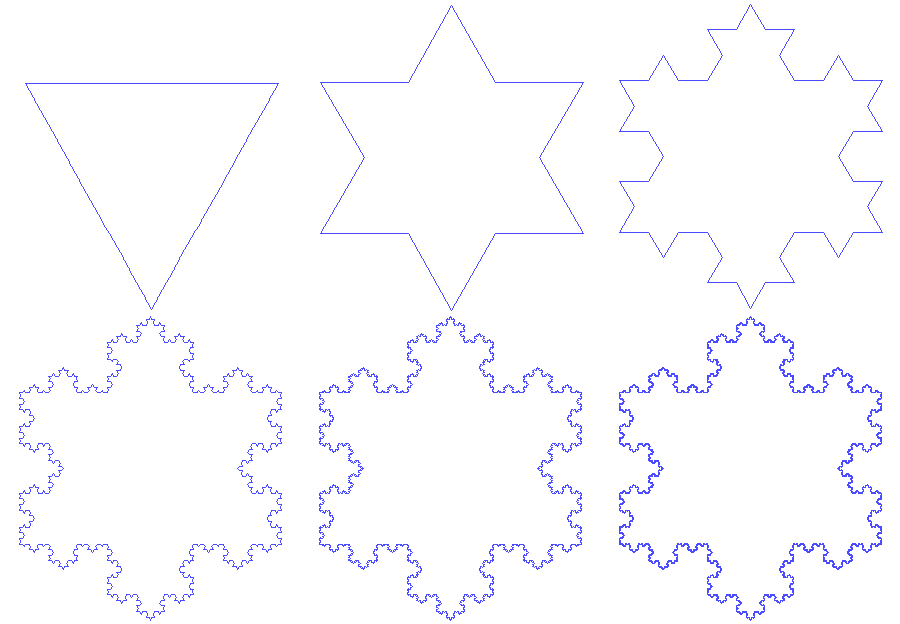
图:António Miguel de Campos · Public domain · Wikimedia Commons
- 发现 / 发明时间
- 1904 年
- 发现者 / 提出者
- 海里格·冯·科赫
- 命名来源
- 海里格·冯·科赫
- 学科
- 数学
相关科学家
百科正文
它最早出现在瑞典数学家海里格·冯·科赫的论文《关于一条连续而无切线,可由初等几何构作的曲线》(1904年,法语原题:Sur une courbe continue sans tangente, obtenue par une construction géométrique élémentaire)。
科赫曲线是de Rham曲线的特例。
- 给定线段AB,科赫曲线可以由以下步骤生成:
- 将线段分成三等份(AC,CD,DB)
- 以CD为底,向外(内外随意)画一个等边三角形DMC
- 将线段CD移去
分别对AC,CM,MD,DB重复1~3。
科赫雪花是以等边三角形三边生成的科赫曲线组成的。科赫雪花的面积是 (公式略),其中 s 是原来三角形的边长。每条科赫曲线的长度是无限大,它是连续而无处可微的曲线。
记录
- 以L系统:
- 字符: F
- 常数: +, −
- 公理: F++F++F
- 规则:
- F → F−F++F−F
- F:向前
- -:左转60°
- +:右转60°
以上内容摘自维基百科「科赫曲線」,按 CC BY-SA 4.0 使用,去掉了参考文献、外部链接等尾部小节,公式改写成了纯文本。全文、配图和出处见原文。
英文维基百科补充中文条目比较短,下面是英文条目「Koch snowflake」的原文
The Koch snowflake (also known as the Koch curve, Koch star, or Koch island is a fractal curve and one of the earliest fractals to have been described. It is based on the Koch curve, which appeared in a 1904 paper titled "On a Continuous Curve Without Tangents, Constructible from Elementary Geometry" by the Swedish mathematician Helge von Koch.
The Koch snowflake can be built up iteratively, in a sequence of stages. The first stage is an equilateral triangle, and each successive stage is formed by adding outward bends to each side of the previous stage, making smaller equilateral triangles. The areas enclosed by the successive stages in the construction of the snowflake converge to 8/5 times the area of the original triangle, while the perimeters of the successive stages increase without bound. Consequently, the snowflake encloses a finite area, but has an infinite perimeter.
The Koch snowflake has been constructed as an example of a continuous curve where drawing a tangent line to any point is impossible. Unlike the earlier Weierstrass function where the proof was purely analytical, the Koch snowflake was created to be possible to geometrically represent at the time, so that this property could also be seen through "naive intuition".
Thue–Morse sequence and turtle graphics
A turtle graphic is the curve that is generated if an automaton is programmed with a sequence.
- If the Thue–Morse sequence members are used in order to select program states:
- If t(n)=0, move ahead by one unit,
- If t(n)=1, rotate counterclockwise by an angle of (π)/3 radians or 60 degrees,
the resulting curve converges to the Koch snowflake.
Representation as Lindenmayer system
- The Koch curve can be expressed by the following rewrite system (Lindenmayer system):
- Alphabet: F
- Constants: +, −
- Axiom: F
- Production rules: F → F+F--F+F
Here, F means "draw forward", - means "turn right 60°", and + means "turn left 60°".
To create the Koch snowflake, one would use F--F--F (an equilateral triangle) as the axiom.
以上节选摘自英文维基百科「Koch snowflake」,按 CC BY-SA 4.0 使用,去掉了参考文献、外部链接等尾部小节,公式改写成了纯文本。篇幅所限,较长的小节只摘了开头一部分,有的小节没有收;全文、配图和出处见原文。