格物
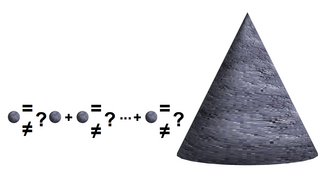
图:Hyacinth · CC BY-SA 4.0 · Wikimedia Commons
- 类型
- 悖论
- 研究学科
- 逻辑学、沙
- 主题
- 沙
百科正文
加法型态
连锁悖论的加法型态称为王氏悖论、麦子堆悖论,王氏悖论由王浩所提出。以下用一个情境做说明:
前提:1为一个很“小”的数
n粒麦子被定义为“很少”,那n粒麦子+1还是与一开始的数量n相差无几,所以还是少。
n+2麦子是n+1+1,由两个1组成,所以还是少。n+3、n+4、n+5……无论如何,麦子永远怎么加,其数量还是为“少”,但是,这明显和一般的认知不一致,所以为假。
举一个生活中的例子:
设身高n为矮,则n+1还是矮,n+2依然是矮……因此没有人是高的,但是这明显和一般的认知不一致,所以为假。
减法型态
连锁悖论的减法型态称为沙丘悖论、秃子悖论。以下用例子做说明:
前提:1为一个很“小”的数、沙堆=很多的沙组成
设n为一沙堆,则n-1还是沙堆,(n-1)-1依然是沙堆……最后剩下一粒沙时,却还是被称为沙堆,但是,这明显和一般的认知不一致,所以为假。
说明
这个悖论产生的原因即为人类语言的含糊性,许多的形容词是主观的,例如:“高”、“矮”、“胖”、“瘦”等形容词,或是意义暧昧不明的其他词语。而在科学的语言中,词语的语义大多具有明确的界线,是较为客观的。当用理性态度看待人类语言时,就会发现其中不乏有含糊、无明确界线的词汇。虽然没有定义“多”的标准与“少”的标准,但依然能够容易的将其依数量归到相应的集合中。
至于连锁悖论与连续体谬误的关系,连锁悖论是由正确的前提和正确的推理,却得到一个明显与认知上不一致的结果,而连续体谬误则是针对连锁悖论的结论,认为X与非X并没有区别。两者虽然相似,但有些微的差距。
以上内容摘自维基百科「連鎖悖論」,按 CC BY-SA 4.0 使用,去掉了参考文献、外部链接等尾部小节,公式改写成了纯文本。全文、配图和出处见原文。
英文维基百科补充中文条目比较短,下面是英文条目「Sorites paradox」的原文
The Sorites paradox , sometimes known as the paradox of the heap, is a paradox that results from vague predicates. A typical formulation involves a heap of sand, from which grains are removed individually. With the assumption that removing a single grain does not cause a heap not to be considered a heap anymore, the paradox is to consider what happens when the process is repeated enough times that only one grain remains and if it is still a heap. If not, then the question asks when it changed from a heap to a non-heap.
Original formulation
The word sorites (Ancient Greek: σωρείτης) derives from the Greek word for heap (Ancient Greek: σωρός). The paradox is named because of its original characterization, attributed to Eubulides of Miletus. The paradox is as follows: consider a heap of sand from which grains are removed individually. One might construct the argument from the following premises:
1,000,000 grains of sand is a heap of sand (Premise 1)
A heap of sand minus one grain is still a heap. (Premise 2)
Repeated applications of premise 2 (each time starting with one fewer grain) eventually forces one to accept the conclusion that a heap may be composed of just one grain of sand.
Read (1995) observes that "the argument is itself a heap, or sorites, of steps of modus ponens":
1,000,000 grains is a heap.
Variations
There are many variations of the sorites paradox, some of which allow consideration of the difference between "being" and "seeming", that is, between a question of fact and a question of perception; this may be seen to be relevant when the argument hinges on each change being "imperceptible".
Another formulation is to start with a grain of sand, which is clearly not a heap, and then assume that adding a single grain of sand to something that is not a heap does not cause it to become a heap. Inductively, this process can be repeated as much as one wants without ever constructing a heap. A more natural formulation of this variant is to assume a set of colored chips exists such that two adjacent chips vary in color too little for human eyesight to be able to distinguish between them.
General conditional sorites
A formal generalization of the paradoxical sorites argument is as follows: Fa₁.
If Fa₁, then Fa₂.
If Fa₂, then Fa₃. (公式略)
Faₙ₋₁, then Faₙ. (公式略) (where n can be arbitrarily large)
This formalization is in first-order logic, where F is a predicate and a₁,a₂,a₃,…,aₙ are different subjects to which it may be applied; for each subject aᵢ, the notation Faᵢ signifies the application of the predicate F aᵢ, i.e., the proposition that " aᵢ F ". (Jonathan Barnes originally represented each "if Faₙ, then Faₙ₊₁ " proposition using the symbol (公式略) for the material implication connective, so his argument originally ended with (公式略).)
Jonathan Barnes has discovered the conditions for an argument of this general form to be soritical.
Proposed resolutions
Denying the existence of heaps
One may object to the first premise by denying that 1,000,000 grains of sand make a heap. But 1,000,000 is just an arbitrary large number, and the argument will apply with any such number. So the response must deny outright that there are such things as heaps. Peter Unger defends this solution. However, A. J. Ayer repudiated it when presented with it by Unger: "If we regard everything as being composed of atoms, and think of Unger as consisting not of cells but of the atoms which compose the cells, then, as David Wiggins has pointed out to me, a similar argument could be used to prove that Unger, so far from being non-existent, is identical with everything that there is.
Continuum fallacy
The continuum fallacy (also known as the fallacy of the beard, line-drawing fallacy, or decision-point fallacy) is an informal fallacy related to the sorites paradox. Both fallacies cause one to erroneously reject a vague claim simply because it is not as precise as one would like it to be. Vagueness alone does not necessarily imply invalidity. The fallacy is the argument that two states or conditions cannot be considered distinct (or do not exist at all) because between them there exists a continuum of states.
以上节选摘自英文维基百科「Sorites paradox」,按 CC BY-SA 4.0 使用,去掉了参考文献、外部链接等尾部小节,公式改写成了纯文本。篇幅所限,较长的小节只摘了开头一部分,有的小节没有收;全文、配图和出处见原文。