格物
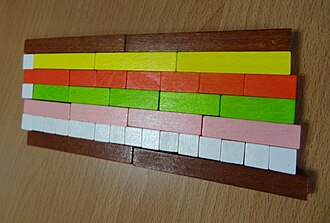
图:Annielogue · CC BY-SA 4.0 · Wikimedia Commons
- 发现 / 发明时间
- 1945 年
- 发现者 / 提出者
- 乔治.古辛纳
- 命名来源
- 乔治.古辛纳
- 上级概念
- manipulative
百科正文
起源
古氏积木由一位比利时的小学老师乔治·古辛纳(1891-1976)所研发,古辛纳将彩色古氏积木应用在数学教学上,其学生在学数学时因有了积木的辅助,更容易了解老师所教授的东西,并能在此种教学法中得到乐趣。在1952年时,古辛纳出版了积木的使用手册,说明积木的使用方法。
古氏积木的构成
古氏积木为十种不同的颜色及长度积木所构成,相同颜色的积木为相同的长度。其构成的颜色及长度如下述:
- 白色积木:一公分长
- 红色积木:两公分长
- 浅绿色积木:三公分长
- 紫色积木:四公分长
- 黄色积木:五公分长
- 深绿色积木:六公分长
- 黑色积木:七公分长
- 棕色积木:八公分长
- 蓝色积木:九公分长
- 橘色积木:十公分长
语言教学上的应用
Dr. Caleb Gattegno在1953年接触了古氏积木,他进一步的运用古氏积木在语言教学上,并应用了部分认知心理学的原理,发展出以学习者为中心的语言教学法-默示教学法。
以上内容摘自维基百科「古氏积木」,按 CC BY-SA 4.0 使用,去掉了参考文献、外部链接等尾部小节,公式改写成了纯文本。全文、配图和出处见原文。
英文维基百科补充中文条目比较短,下面是英文条目「Cuisenaire rods」的原文
Cuisenaire rods are mathematics learning aids for pupils that provide an interactive, hands-on way to explore mathematics and learn mathematical concepts, such as the four basic arithmetical operations, working with fractions, and finding divisors. In the early 1950s, Caleb Gattegno popularised this set of coloured number rods created by Georges Cuisenaire (1891–1975), a Belgian primary school teacher, who called the rods réglettes ('little rulers').
According to Gattegno, "Georges Cuisenaire showed in the early 1950s that pupils who had been taught traditionally, and were rated 'weak', took huge strides when they shifted to using the material. They became 'very good' at traditional arithmetic when they were allowed to manipulate the rods."
History
The educationalists Maria Montessori and Friedrich Fröbel had used rods to represent numbers, but it was Georges Cuisenaire who introduced the rods that were to be used across the world from the 1950s onwards. In 1952, he published Les nombres en couleurs, Numbers in Color, which outlined their use. Cuisenaire, a violin player, taught music as well as arithmetic in the primary school in Thuin. He wondered why children found it easy and enjoyable to pick up a tune and yet found mathematics neither easy nor enjoyable. These comparisons with music and its representation led Cuisenaire to experiment in 1931 with a set of ten rods sawn out of wood, with lengths from 1 cm (0.4 in) to 10 cm (4 in). He painted each length of rod a different colour and began to use these in his teaching of arithmetic. The invention remained almost unknown outside the village of Thuin for about 23 years until, in April 1953, British mathematician and mathematics education specialist Caleb Gattegno was invited to see pupils using the rods in Thuin.
Use in mathematics teaching
The rods are used in teaching a variety of mathematical concepts, and with a wide age range of learners. Topics they are used for include:
- counting, sequences, patterns, and algebraic reasoning;
- addition and subtraction (additive reasoning);
- multiplication and division (multiplicative reasoning);
- fractions, ratio, and proportion;
modular arithmetic leading to group theory.
The Silent Way
Though primarily used for mathematics, they have also become popular in language-teaching classrooms, particularly The Silent Way. They can be used:
to demonstrate most grammatical structures such as prepositions of place, comparatives and superlatives, determiners, tenses, adverbs of time, manner, etc.;
to show sentence and word stress, rising and falling intonation, and word groupings;
to create a visual model of constructs, for example the English verb tense system;
to represent physical objects: clocks, floor-plans, maps, people, animals, fruit, tools, etc., which can and has led to the creation of stories.
In New Zealand, they are used as part of the immersion-based Te Ataarangi approach for teaching the Māori language, in which they are known as rākau. Cuisenaire rods have also been used in multiple works by New Zealand artist Michael Parekowhai.
Other coloured rods
In her first school, and in schools since then, Maria Montessori used coloured rods in the classroom to teach concepts of both mathematics and length. This is possibly the first instance of coloured rods being used in the classroom for this purpose.
Catherine Stern also devised a set of coloured rods produced by staining wood with aesthetically pleasing colours, and published books on their use at around the same time as Cuisenaire and Gattegno. Her rods were different colours to Cuisenaire's, and also larger, with a 2 cm (0.8 in) unit cube rather than 1 cm (0.4 in). She produced various resources to complement the rods, such as trays to arrange the rods in, and tracks to arrange them on. Tony Wing, in producing resources for Numicon, built on many of Stern's ideas, also making trays and tracks available for use with Cuisenaire rods.
In 1961, Seton Pollock produced the Colour Factor system, consisting of rods from lengths 1 to 12 cm (0.39 to 4.7 in). Based on the work of Cuisenaire and Gattegno, he had invented a unified system for logically assigning a colour to any number. After white (1), the primary colours red, blue, and yellow are assigned to the first three primes (2, 3, and 5).
以上节选摘自英文维基百科「Cuisenaire rods」,按 CC BY-SA 4.0 使用,去掉了参考文献、外部链接等尾部小节,公式改写成了纯文本。篇幅所限,较长的小节只摘了开头一部分,有的小节没有收;全文、配图和出处见原文。