格物
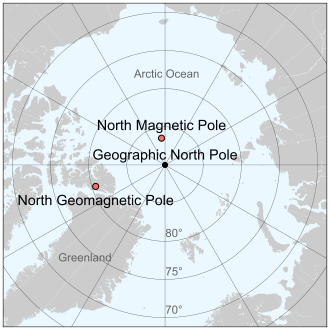
图:Cavit · CC BY 4.0 · Wikimedia Commons
地磁北极1831
North Magnetic Pole
point in the Arctic at which Earth's magnetic field points vertically downwards, at 86°N 175°E in the Arctic Ocean as of 2019
地磁北极,或北磁极,是地球表面地球磁场方向垂直向下的点。地磁北极与地理北极并不相同。地磁北极正在不断的改变,以每天20.5米的速度移动。另外,由于地球磁场并不是完全对称的,地磁北极与地磁南极并不是处在对跖点位置上。
2001年,地磁北极处于在加拿大北部埃尔斯米尔岛附近,经纬度为81.3°N 110.8°W
2005年,地磁北极位置在加拿大北方的北冰洋上,经纬度为83.1°N 117.8°W
2009年,地磁北极向北移动,经纬度为84.9°N 141.0°W
2016年,地磁北极持续往俄罗斯移动,经纬度为86.4°N 166.3°W
摘自维基百科「地磁北极」,CC BY-SA 4.0
- 类型
- 地理位置、地球磁极
- 发现 / 发明时间
- 1831 年
- 发现者 / 提出者
- 詹姆斯·克拉克·罗斯
- 命名来源
- 北
- 起因
- 地磁场
- 相对的概念
- 地磁南极
百科正文
另外需要注意的是地磁北极实际是物理上的磁场南极。出现这种状况的原因是人们在发现磁极异性相吸、同性相斥的规律之前就定义了地磁北极这个名词。首先,人们定义了指南针指向地理北极的一端为磁场北极,由于这个定义是随意的,因此是可以接受的。然后,人们根据北方的地磁场极点接近地理北极的知识,定义了这个极点为地磁北极。可是,当人们最后发现磁场原来是同性相斥的规律以后,地磁北极也就只能作为习惯用法被保留下来了。相应地,地磁南极实际上是物理上的磁场北极。
简单的说,所有磁铁都有两个磁极,被称为磁铁的“北”和“南”极。因为它们在发明指南针中使用时,指向北极的方向被定义为北极。但因为异极相吸,这意味着如果作为物理磁铁,地球的磁北极实际上在南极。
以上内容摘自维基百科「地磁北极」,按 CC BY-SA 4.0 使用,去掉了参考文献、外部链接等尾部小节,公式改写成了纯文本。全文、配图和出处见原文。
英文维基百科补充中文条目比较短,下面是英文条目「North magnetic pole」的原文
The north magnetic pole, also known as the magnetic north pole, is a point on the surface of Earth's Northern Hemisphere at which the planet's magnetic field points vertically downward (in other words, if a magnetic compass needle is allowed to rotate in three dimensions, it will point straight down). There is only one location where this occurs, near (but distinct from) the geographic north pole. The Earth's magnetic north pole is actually considered the "south pole" in terms of a typical magnet, meaning that the north pole of a magnet would be attracted to the Earth's magnetic north pole.
The north magnetic pole moves over time according to magnetic changes and flux lobe elongation in the Earth's outer core. In 2001, it was determined by the Geological Survey of Canada to lie west of Ellesmere Island in northern Canada at 81°18′N 110°48′W. It was situated at 83°06′N 117°48′W in 2005. In 2009, while still situated within the Canadian Arctic at 84°54′N 131°00′W, it was moving toward Russia at between 55 and 60 km (34 and 37 mi) per year. In 2013, the distance between the north magnetic pole and the geographic north pole was approximately 800 kilometres (500 mi). As of 2021, the pole is projected to have moved beyond the Canadian Arctic to 86.400°N 156.786°E / 86.400; 156.786 (Magnetic North Pole 2021 est).
Its southern hemisphere counterpart is the south magnetic pole. Since Earth's magnetic field is not exactly symmetric, the north and south magnetic poles are not antipodal, meaning that a straight line drawn from one to the other does not pass through the geometric center of Earth.
Earth's north and south magnetic poles are also known as magnetic dip poles, with reference to the vertical "dip" of the magnetic field lines at those points.
Polarity
All magnets have two poles, where lines of magnetic flux enter one pole and emerge from the other pole. By analogy with Earth's magnetic field, these are called the magnet's "north" and "south" poles. Before magnetism was well understood, the north-seeking pole of a magnet was defined to have the north designation, according to their use in early compasses.
History
Early European navigators, cartographers and scientists believed that compass needles were attracted to a hypothetical "magnetic island" somewhere in the far north (see Rupes Nigra), or to Polaris, the pole star. The idea that Earth itself acts as essentially a giant magnet was first proposed in 1600, by the English physician and natural philosopher William Gilbert.
Expeditions and measurements
First observations
The first group to reach the north magnetic pole was led by James Clark Ross, who found it at Cape Adelaide on the Boothia Peninsula on 1 June 1831, while serving on the second arctic expedition of his uncle, Sir John Ross. Roald Amundsen found the north magnetic pole in a slightly different location in 1903.
Magnetic north and magnetic declination
Historically, the magnetic compass was an important tool for navigation. While it has been widely replaced by Global Positioning Systems, many airplanes and ships still carry them, as do casual boaters and hikers.
The direction in which a compass needle points is known as magnetic north. In general, this is not exactly the direction of the north magnetic pole (or of any other consistent location).
North geomagnetic pole
As a first-order approximation, Earth's magnetic field can be modeled as a simple dipole (like a bar magnet), tilted about 10° with respect to Earth's rotation axis (which defines the geographic north and geographic south poles) and centered at Earth's center. The north and south geomagnetic poles are the antipodal points where the axis of this theoretical dipole intersects Earth's surface.
Geomagnetic reversal
Over the life of Earth, the orientation of Earth's magnetic field has reversed many times, with magnetic north becoming magnetic south and vice versa – an event known as a geomagnetic reversal. Evidence of geomagnetic reversals can be seen at mid-ocean ridges where tectonic plates move apart and the seabed is filled in with magma.
以上节选摘自英文维基百科「North magnetic pole」,按 CC BY-SA 4.0 使用,去掉了参考文献、外部链接等尾部小节,公式改写成了纯文本。篇幅所限,较长的小节只摘了开头一部分,有的小节没有收;全文、配图和出处见原文。