格物
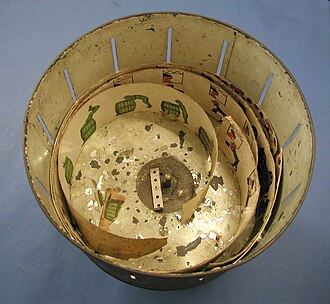
图:Auckland Museum · CC BY 4.0 · Wikimedia Commons
- 发现 / 发明时间
- 1834 年
- 发现者 / 提出者
- 威廉·乔治·霍纳
- 上级概念
- optical toy
- 基于
- 费纳奇镜
百科正文
英文维基百科补充中文条目比较短,下面是英文条目「Zoetrope」的原文
A zoetrope is a pre-film animation device that produces the illusion of motion, by displaying a sequence of drawings or photographs showing progressive phases of that motion. A zoetrope is a cylindrical variant of the phenakistiscope, an apparatus suggested after the stroboscopic discs were introduced in 1833. The definitive version of the zoetrope, with replaceable film picture film strips, was introduced as a toy by Milton Bradley in 1866 and became very successful.
Etymology
The name zoetrope was composed from the Greek root words ζωή zoe, "life" and τρόπος tropos, "turning" as a translation of "wheel of life".
The term was coined by inventor William E. Lincoln, of Providence, Rhode Island.
Technology
The zoetrope consists of a cylinder with cuts vertically in the sides. On the inner surface of the cylinder is a band with images from a set of sequenced pictures. As the cylinder spins, the user looks through the cuts at the pictures across. The scanning of the slits keeps the pictures from simply blurring together, and the user sees a rapid succession of images, producing the illusion of motion.
Earlier rotating devices with images
An earthenware bowl from Iran, over 5000 years old, could be considered a predecessor of the zoetrope. This bowl is decorated in a series of images portraying a goat jumping toward a tree and eating its leaves. Though the images are sequential and seem evenly distributed around the bowl, to have the images appear as an animation the bowl would have to rotate quite fast and steadily while a stroboscopic effect would somehow have to be generated.
Invention
Simon Stampfer (1833)
Simon Stampfer, one of the inventors of the phenakistiscope animation disc (or "stroboscopic discs" as he called them), suggested in July 1833 in a pamphlet that the sequence of images for the stroboscopic animation could alternatively be placed on a cylinder, or a looped strip of paper or canvas stretched around two parallel rollers.
Linear zoetropes
A linear zoetrope consists of an opaque linear screen with thin vertical slits in it. Behind each slit is an image, often illuminated. A motion picture is seen by moving past the display.
Linear zoetropes have several differences compared to cylindrical zoetropes due to their different geometries. Linear zoetropes can have arbitrarily long animations and can cause images to appear wider than their actual sizes.
Subway zoetropes
3D zoetropes
3D zoetropes apply the same principle to three-dimensional models, as already practiced by Czermak (1855) and Desvignes (1860) in predecessors of the zoetrope. In 1887, Étienne-Jules Marey used a large zoetrope to animate a series of plaster models based on his chronophotographs of birds in flight.
Giant zoetropes
An 1857 textbook on physics mentioned an early cylindrical stroboscopic installation with moving images that was 18 feet (5.5 meters) in diameter and had been exhibited in Frankfurt.
A "Great Zoetrope; or: Wheel of Life", 50 feet (15 meters) in circumference, with "life-size figures", was installed in the Concert Hall of the Crystal Palace in London by permission of the London Stereoscopic and Photographic Company.
Successors
Émile Reynaud's 1877 praxinoscope was an improvement on the zoetrope that became popular toward the end of the 19th century. It replaced the zoetrope's narrow viewing slits with an inner circle of mirrors that intermittently reflected the images.
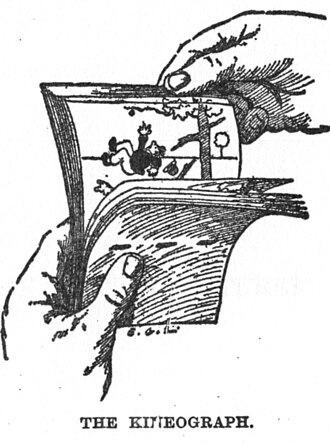
Soon after the zoetrope became popular, the flip book was introduced in 1868. With its simplicity and compactness, along with its more tactile qualities, the flip book has stayed relatively popular.
Contemporary media uses
Since the late 20th century, zoetropes have seen occasional use for artwork, entertainment, marketing and other media use, notably as linear zoetropes and 3D zoetropes (see above).
Making a zoetrope has also become a relatively common arts and crafts assignment and a means to explain some of the technical and optical principles of film and motion viewing in educational programs.
以上节选摘自英文维基百科「Zoetrope」,按 CC BY-SA 4.0 使用,去掉了参考文献、外部链接等尾部小节,公式改写成了纯文本。篇幅所限,较长的小节只摘了开头一部分,有的小节没有收;全文、配图和出处见原文。