格物
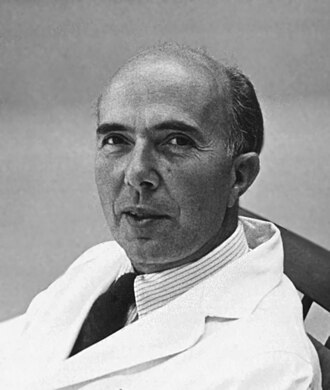
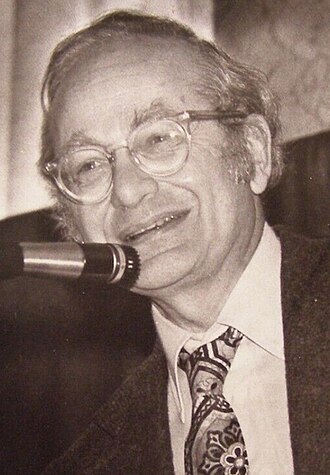
图:Renato_Dulbecco.jpg: Unknown, gift Dr. Dulbecco derivative w… · Public domain · Wikimedia Commons
罗纳托·杜尔贝科1914—2012
Renato Dulbecco
病毒学家, 意大利
罗纳托·杜尔贝科,意大利出生的病毒学家,二次世界大战后与好友神经生物学家丽塔·列维-蒙塔尔奇尼一起移居美国。由于发现肿瘤病毒与细胞遗传物质之间的相互作用而获得1975年的诺贝尔生理学或医学奖。1973年他获得哥伦比亚大学的路易莎·格罗斯·霍维茨奖。
摘自维基百科「罗纳托·杜尔贝科」,CC BY-SA 4.0
- 出生
- 1914 年 2 月 22 日,卡坦扎罗
- 逝世
- 2012 年 2 月 19 日,拉霍亚
- 国籍
- 意大利、美国、意大利王国
- 学科
- 生物学、医学、博物与综合
- 职业
- 病毒学家、医生、生物学家
- 母语 / 工作语言
- 意大利语、英语
- 母校
- 都灵大学(医学士,1936 年)
- 工作单位
- 加州理工学院、人类基因组计划、圣迭戈加利福尼亚大学、印第安纳大学
研究领域
师承
博士生2
来自 Wikidata 的「博士导师」「师从」「博士生」「学生」记录,可能不全。
所获奖项(16)
- 1957古根海姆学者奖
- 1958约翰·斯科特奖
- 1961AACR-G.H.A. Clowes Award for Outstanding Basic Cancer Research
- 1964拉斯克基础医学研究奖
- 1965Howard Taylor Ricketts Prize
- 1967保罗·埃尔利希和路德维希‧达姆施泰特奖
- 1973Marjory Stephenson Prize
- 1973路易莎·格罗斯·霍维茨奖
- 1974微生物学的塞尔曼A.瓦克斯曼奖
- 1974列文虎克演讲
- 1974英国皇家学会外籍会员
- 1975诺贝尔生理学或医学奖
- 1978honorary doctorate of the Vrije Universiteit Brussel
- 1981意大利共和国功绩大军官勋章
- 1991意大利共和国功绩大十字骑士勋章
- 1996honorary doctorate of the University of Las Palmas, Gran Canaria
学会与院士
百科正文
罗纳托·杜尔贝科(Renato Dulbecco)于2012年2月19日在美国拉霍亚市逝世,享年97岁。
以上内容摘自维基百科「罗纳托·杜尔贝科」,按 CC BY-SA 4.0 使用,去掉了参考文献、外部链接等尾部小节,公式改写成了纯文本。全文、配图和出处见原文。
英文维基百科补充中文条目比较短,下面是英文条目「Renato Dulbecco」的原文
Renato Dulbecco ( dul-BEK-oh, Italian: [reˈnaːto dulˈbɛkko, -ˈbek-]; February 22, 1914 – February 19, 2012) was an Italian–American virologist who won the 1975 Nobel Prize in Physiology or Medicine for his work on oncoviruses, which are viruses that can cause cancer when they infect animal cells. He studied at the University of Turin under Giuseppe Levi, along with fellow students Salvador Luria and Rita Levi-Montalcini, who also moved to the U.S. with him and won Nobel prizes. He was drafted into the Italian army in World War II, but later joined the resistance.
Early life
Dulbecco was born in Catanzaro (Calabria, Southern Italy), but spent his childhood and grew up in Liguria, in the coastal city Imperia. He graduated from high school at 16, then moved to the University of Turin. Despite a strong interest in mathematics and physics, he decided to study medicine. At only 22, he graduated in morbid anatomy and pathology under the supervision of professor Giuseppe Levi. During these years he met Salvador Luria and Rita Levi-Montalcini, whose friendship and encouragement would later bring him to the United States. In 1936 he was called up for military service as a medical officer, and later (1938) discharged. In 1940 Italy entered World War II and Dulbecco was recalled and sent to the front in France and Russia, where he was wounded. After hospitalization and the collapse of Fascism, he joined the resistance against the German occupation.
Career and research
After the war he resumed his work at Levi's laboratory, but soon he moved, together with Levi-Montalcini, to the U.S., where, at Indiana University, he worked with Salvador Luria on bacteriophages. In the summer of 1949 he moved to Caltech, joining Max Delbrück's group (see Phage group). In the early 1950s, on Delbruck's advice, Dulbecco visited the major centers of animal virus work in the US in order to discover a way to quantitatively assay animal viruses by a plaque technique, similar to the technique that had recently been developed for bacterial viruses. Within less than a year, he worked out such a method for Western equine encephalitis virus, which then opened up animal virology to quantitative work. The technique was then used by Dulbecco and Vogt to study the biological properties of poliovirus. These accomplishments led to Dulbecco's appointment first to associate professor, and then to full professor at the California Institute of Technology. There he started his studies about animal oncoviruses, especially of polyoma family. In the late 1950s, he took Howard Temin as a student, with whom, and together with David Baltimore, he would later share the 1975 Nobel Prize in Physiology or Medicine for "their discoveries concerning the interaction between tumour viruses and the genetic material of the cell." Temin and Baltimore arrived at the discovery of reverse transcriptase simultaneously and independently from each other; although Dulbecco did not take direct part in either of their experiments, he had taught the two methods they used to make the discovery.
Throughout this time he also worked with Marguerite Vogt. In 1962, he moved to the Salk Institute and then in 1972 to The Imperial Cancer Research Fund (now named the Cancer Research UK London Research Institute) where he was first appointed associate professor and then full professor. Like many Italian scientists, Dulbecco did not have a PhD because it did not exist in the Italian higher education system (until it was introduced in 1980). In 1986 he was among the scientists who launched the Human Genome Project. From 1993 to 1997 he moved back to Italy, where he was president of the Institute of Biomedical Technologies at C.N.R. (National Council of Research) in Milan. He also retained his position on the faculty of Salk Institute for Biological Studies. Dulbecco was actively involved in research into identification and characterization of mammary gland cancer stem cells until December 2011. His research using a stem cell model system suggested that a single malignant cell with stem cell properties may be sufficient to induce cancer in mice and can generate distinct populations of tumor-initiating cells also with cancer stem cell properties. Dulbecco's examinations into the origin of mammary gland cancer stem cells in solid tumors was a continuation of his early investigations of cancer being a disease of acquired mutations.
以上节选摘自英文维基百科「Renato Dulbecco」,按 CC BY-SA 4.0 使用,去掉了参考文献、外部链接等尾部小节,公式改写成了纯文本。篇幅所限,较长的小节只摘了开头一部分,有的小节没有收;全文、配图和出处见原文。
同年获同一奖项
同一学科、同时代的科学家

同一学科的科学家
更多 ›