格物

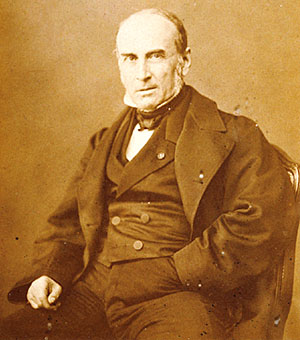
图:Jean de Humnicki (1803-) · Public domain · Wikimedia Commons
- 出生
- 1787 年 9 月 15 日,康斯坦茨
- 逝世
- 1875 年 7 月 14 日,Eaux-Vives
- 国籍
- 瑞士、日内瓦共和国、法国
- 学科
- 工程与发明
- 职业
- 制图师、土木工程师、政治人物、军人
- 母语 / 工作语言
- 法语
- 母校
- 巴黎综合理工学院
主要贡献
代表成就
师承
学生2
来自 Wikidata 的「博士导师」「师从」「博士生」「学生」记录,可能不全。
所获奖项(1)
- 1866荣誉军团大十字勋章
百科正文
1847年,杜福尔受瑞士邦联(激进-自由派各邦)委托,作为军队最高统帅以迅速而较少伤亡的方式赢的瑞士内战的胜利,奠定了瑞士联邦次年建国的基础。他于1845-1864年绘制的瑞士地形图(杜富尔图)至今是瑞士地图的典范之作。1863年,杜福尔在亨利·杜南的邀请下参与组建了红十字国际委员会并担任首任主席。
1875年,杜福尔于日内瓦逝世。阿尔卑斯山第二高峰、瑞士最高峰杜富尔峰以他命名。
以上内容摘自维基百科「纪尧姆·亨利·杜福尔」,按 CC BY-SA 4.0 使用,去掉了参考文献、外部链接等尾部小节,公式改写成了纯文本。全文、配图和出处见原文。
英文维基百科补充中文条目比较短,下面是英文条目「Guillaume Henri Dufour」的原文
Guillaume Henri Dufour (French pronunciation: [ɡijom ɑ̃ʁi dyfuʁ]; 15 September 1787 – 14 July 1875) was a Swiss military officer, structural engineer and topographer. He served under Napoleon I and held the Swiss office of General four times in his career, firstly in 1847 when he led the Swiss Confederation forces to victory against the Sonderbund. In 1864 Dufour presided over the First Geneva Convention which established the International Red Cross. He was founder and president (1838 to 1865) of the Swiss Federal Office of Topography.
Early life
Dufour was born on 15 September 1787 in Konstanz, where his parents from Geneva were living in exile for their involvement in the Revolution of 1782. He was the son of Bénédict Dufour, a watchmaker, and Pernette Valentin. When he was two years old, his parents were allowed to return to Geneva, where Dufour attended school and studied drawing and medicine. In 1807, Dufour travelled to Paris to join the École Polytechnique, then a military academy. He studied descriptive geometry under Jean Nicolas Pierre Hachette, and graduated fifth in his class in 1809, going on to study military engineering at the École d'Application in Metz.
Career
In 1811, Dufour joined the French Army and was sent to help defend Corfu, in the French Ionian Islands, where he mapped the island's old fortifications. He was wounded in action in June 1813 during a naval battle against the British. By 1814, he had attained the rank of captain, and was awarded the Cross of the Légion d'Honneur for his work repairing fortifications at Lyon. In 1817, he resumed his status as a Swiss citizen, and returned to Geneva to become commander of the Canton of Geneva's military engineers, as well as a professor of mathematics at the Academy of Geneva. From 1819 to 1830 he was chief instructor in the military school of Thun, which had been founded mainly through his efforts. Among other distinguished foreign pupils he instructed Louis-Napoleon Bonaparte, nephew of the former Emperor.
In 1827 he was raised to the rank of colonel, and commanded the Federal army in a series of field manoeuvres. In 1831 he became chief of the staff, and soon afterwards he was appointed quartermaster-general. Two years later the Federal Diet commissioned him to superintend the execution of a complete trigonometrical survey of Switzerland.
Saint Antoine Bridge
Dufour acted as state engineer from 1817, although he was not officially appointed as such until 1828. His work included rebuilding a pumping station, quays and bridges, and he arranged the first steam boat on Lake Geneva as well as the introduction of gas streetlights.
The scientist Marc-Auguste Pictet had visited Marc Seguin's temporary wire-cable simple suspension bridge at Annonay in 1822, the first wire-cable bridge in the world, and published details in Switzerland. He joined with others to promote a new bridge across the Genevan fortifications, consulting with Seguin on how it might be built, receiving back a series of sketches. Dufour developed the design in late 1822, proposing a two-span suspension bridge using wire cables — this would become the first permanent wire cable suspension bridge in the world. The design used three cables on each side of an iron and timber bridge deck. The cables stretched 131 feet between the towers, although the largest span was only 109 feet.
Memorials
Memorials are at:
Equestrian statue (1884) by Alfred Lanz, at Place Neuve, Geneva, erected by public subscription
Two plaques on his birth house at Wessenbergstraße 14 (formerly Plattengasse), Konstanz, Germany
Plaque at the building where he lived from 1826 to 1845 at Geneva
Plaque at Château de Montrottier in Lovagny, France
Plaque at 22, rue Saint-Victor, Carouge, commemorating its use as office of topography.
Bronze bust, made by Fonderie Leuba, B. Brasseur, succ. at Army Training Center, Lucerne
His home from 1845–1875 at Rue de Contamines, Geneva, is preserved by a foundation.
Numerous cities and towns in Switzerland have streets named for him: rue du Général-Dufour in Geneva, La Chaux-de-Fonds; via Gen. Henri Dufour in Chiasso; rue du Général- Dufour/General-Dufour-Strasse in Biel/Bienne; Dufourstrasse in Aarau, Basel, Bern, Biberist, Lenzburg, Luzern, Rorschach, St. Gallen, Thun, Weinfelden, Wettingen, Wil, Zollikon, Zürich; via Dufour in Lugano. There is also Dufourplatz in Zollikon.
The general was depicted on the 20 francs note of the 1956 series of Swiss banknotes (in circulation 1956–1980).
以上节选摘自英文维基百科「Guillaume Henri Dufour」,按 CC BY-SA 4.0 使用,去掉了参考文献、外部链接等尾部小节,公式改写成了纯文本。篇幅所限,较长的小节只摘了开头一部分,有的小节没有收;全文、配图和出处见原文。