格物
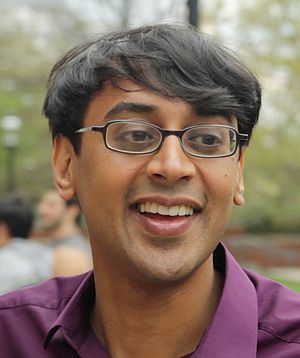
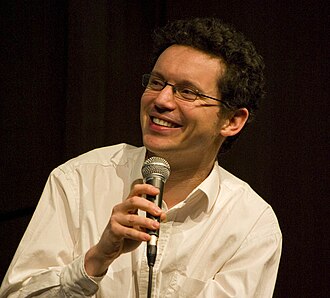
图:IMU · FAL · Wikimedia Commons
- 出生
- 1974 年 8 月 8 日,哈密尔顿
- 国籍
- 加拿大、美国
- 学科
- 数学、博物与综合
- 职业
- 数学家、大学教师
- 母校
- 哈佛大学、普林斯顿大学、Plainedge High School
- 工作单位
- 普林斯顿大学、莱顿大学
研究领域
师承
博士导师1
博士生11
来自 Wikidata 的「博士导师」「师从」「博士生」「学生」记录,可能不全。
所获奖项(12)
- 1996摩根奖
- 2004Packard Fellowship for Science and Engineering
- 2005布卢门撒尔奖
- 2008Cole Prize in Number Theory
- 2011费马奖
- 2012印孚瑟斯奖
- 2013美国数学会会士
- 2014菲尔兹奖
- 2015Padma Bhushan in science & engineering
- 2019英国皇家学会院士
- 2022古根海姆学者奖
- —克雷研究奖
学会与院士
百科正文
生平
他是普林斯顿大学教授,主要以对数论的研究知名。2014年,巴尔加瓦获费尔兹奖,获奖原因是“发展了数的几何的强有力的新方法,他用其计算了小秩环并界定了椭圆曲线的平均秩”。
以上内容摘自维基百科「曼朱尔·巴尔加瓦」,按 CC BY-SA 4.0 使用,去掉了参考文献、外部链接等尾部小节,公式改写成了纯文本。全文、配图和出处见原文。
英文维基百科补充中文条目比较短,下面是英文条目「Manjul Bhargava」的原文
Manjul Bhargava (born 8 August 1974) is an Indian Canadian-American mathematician. He is the Robert Gunning-Brandon Fradd, Class of 1983, professor of mathematics at Princeton University, the Stieltjes professor of number theory at Leiden University, and also holds adjunct professorships at the Tata Institute of Fundamental Research, the Indian Institute of Technology Bombay, and the University of Hyderabad. He is known primarily for his contributions to number theory.
Bhargava was awarded the Fields Medal in 2014. According to the International Mathematical Union citation, he was awarded the prize "for developing powerful new methods in the geometry of numbers, which he applied to count rings of small rank and to bound the average rank of elliptic curves". He was also a member of the Padma Award committee in 2023.
In February 2026, he became the first president of the National Museum of Mathematics (MoMath) in New York city.
Education and career
Bhargava was born to an Indian family in Hamilton, Ontario, Canada, but grew up and attended school primarily on Long Island, New York. His mother Mira Bhargava, a mathematician at Hofstra University, was his first mathematics teacher. He completed all of his high school math and computer science courses by age 14. He attended Plainedge High School in North Massapequa, and graduated in 1992 as the class valedictorian. He obtained his AB from Harvard University in 1996, where he was elected to Phi Beta Kappa. For his research as an undergraduate, he was awarded the 1996 Morgan Prize. The research was eventually published in The American Mathematical Monthly in 2000, and established the Bhargava factorial. Bhargava went on to pursue graduate studies at Princeton University, where he completed a doctoral dissertation titled "Higher composition laws" under the supervision of Andrew Wiles and received his PhD in 2001, with the support of a Hertz Fellowship. He was a visiting scholar at the Institute for Advanced Study in 2001–02, and at Harvard University in 2002–03. Princeton appointed him as a tenured full professor in 2003.
Career and research
Bhargava’s PhD thesis generalized Gauss's classical law for composition of binary quadratic forms to many other situations. One major use of his results is the parametrization of quartic and quintic orders in number fields, thus allowing the study of the asymptotic behavior of the arithmetic properties of these orders and fields.
His research also includes fundamental contributions to the representation theory of quadratic forms, to interpolation problems and p-adic analysis, to the study of ideal class groups of algebraic number fields, and to the arithmetic theory of elliptic curves. A short list of his specific mathematical contributions are:
Fourteen new Gauss-style composition laws.
Determination of the asymptotic density of discriminants of quartic and quintic number fields.
Proofs of the first-known cases of the Cohen-Lenstra-Martinet heuristics for class groups.
Proof of the 15 theorem, including an extension of the theorem to other number sets such as the odd numbers and the prime numbers.
Proof (with Jonathan Hanke) of the 290 theorem.
A novel generalization of the factorial function, Bhargava factorial, providing an answer to a decades-old question of George Pólya.
Awards and honours
Bhargava has won several awards for his research, the most prestigious being the Fields Medal, the highest award in the field of mathematics, which he won in 2014.
He received the Morgan Prize in 1996. and Hertz Fellowship He was named one of Popular Science magazine's "Brilliant 10" in November 2002. He then received a Clay 5-year Research Fellowship and the Merten M. Hasse Prize from the MAA in 2003, the Clay Research Award, the SASTRA Ramanujan Prize, and the Leonard M. and Eleanor B. Blumenthal Award for the Advancement of Research in Pure Mathematics in 2005.
Peter Sarnak of Princeton University has said of Bhargava:
At mathematics he's at the very top end. For a guy so young I can't remember anybody so decorated at his age. He certainly started out with a bang and has not let it get to his head, which is unusual. Of course he couldn't do what he does if he wasn't brilliant. It's his exceptional talent that's so striking.
In 2008, Bhargava was awarded the American Mathematical Society's Cole Prize. The citation reads:
Bhargava's original and surprising contribution is the discovery of laws of composition on forms of higher degree.
以上节选摘自英文维基百科「Manjul Bhargava」,按 CC BY-SA 4.0 使用,去掉了参考文献、外部链接等尾部小节,公式改写成了纯文本。篇幅所限,较长的小节只摘了开头一部分,有的小节没有收;全文、配图和出处见原文。
同年获同一奖项
同一学科、同时代的科学家




同一学科的科学家
更多 ›