格物
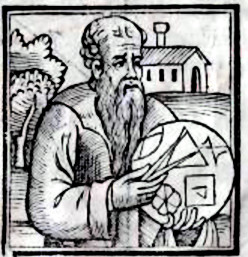
图:Giovanni Battista Memo · Public domain · Wikimedia Commons
- 出生
- 公元前 262 年,佩尔盖
- 逝世
- 公元前 190 年,亚历山大
- 学科
- 数学、天文学、博物与综合
- 职业
- 数学家、天文学家
- 母语 / 工作语言
- 古希腊语
研究领域
主要贡献
代表成就
以他 / 她命名
百科正文
生平
阿波罗尼奥斯出生于潘菲利亚(位于小亚细亚南部)的佩尔吉,求学于帕加马,成名于托勒密三世统治下的亚历山大港。
以上内容摘自维基百科「阿波罗尼奥斯」,按 CC BY-SA 4.0 使用,去掉了参考文献、外部链接等尾部小节,公式改写成了纯文本。全文、配图和出处见原文。
英文维基百科补充中文条目比较短,下面是英文条目「Apollonius of Perga」的原文
Apollonius of Perga (Ancient Greek: Ἀπολλώνιος ὁ Περγαῖος Apollṓnios ho Pergaîos; c. 240 BC – c. 190 BC) was an ancient Greek geometer and astronomer known for his work on conic sections. Beginning from the earlier contributions of Euclid and Archimedes on the topic, he brought them to the state prior to the invention of analytic geometry. His definitions of the terms ellipse, parabola, and hyperbola are the ones in use today. With his predecessors Euclid and Archimedes, Apollonius is generally considered among the greatest mathematicians of antiquity.
Aside from geometry, Apollonius worked on numerous other topics, including astronomy. Most of this work has not survived, where exceptions are typically fragments referenced by other authors like Pappus of Alexandria. His hypothesis of eccentric orbits to explain the apparently aberrant motion of the planets, commonly believed until the Middle Ages, was superseded during the Renaissance. The Apollonius crater on the Moon is named in his honor.
Life
Despite his momentous contributions to the field of mathematics, scant biographical information on Apollonius remains. The 6th century Greek commentator Eutocius of Ascalon, writing on Apollonius's Conics, states:
Apollonius, the geometrician,... came from Perga in Pamphylia in the times of Ptolemy III Euergetes, so records Herakleios the biographer of Archimedes....
From this passage Apollonius can be approximately dated, but specific birth and death years stated by modern scholars are only speculative. Ptolemy III Euergetes ("benefactor") was third Greek dynast of Egypt in the Diadochi succession, who reigned 246–222/221 BC. "Times" are always recorded by ruler or officiating magistrate, so Apollonius was likely born after 246. The identity of Herakleios is uncertain.
Perga was a Hellenized city in Pamphylia, Anatolia, whose ruins yet stand. It was a center of Hellenistic culture. Eutocius appears to associate Perga with the Ptolemaic dynasty of Egypt. Never under Egypt, Perga in 246 BC belonged to the Seleucid Empire, an independent diadochi state ruled by the Seleucid dynasty.
Attributed ideas
According to Heath, the "Methods of Apollonius" were not personal to him; whatever influence he had on later theorists was the influence of geometry, not of his own innovation of technique. Heath says,
As a preliminary to the consideration in detail of the methods employed in the Conics, it may be stated generally that they follow steadily the accepted principles of geometrical investigation which found their definitive expression in the Elements of Euclid.
When referring to golden age geometers, modern scholars use the term "method" to mean the visual, reconstructive way in which the geometer produces a result equivalent to that produced by algebra today. As a simple example, the algebraic method to compute the area of a square is to square its side length; the analogous geometric method is to construct a visual square. Geometric methods in the golden age could produce most of the results of elementary algebra.
Contribution to astronomy
The equivalence of two descriptions of planet motions, one using eccentrics and another deferent and epicycles, is attributed to Apollonius. Ptolemy describes this equivalence in the Almagest.
Legacy
The Conics exerted an influence on later geometry during Classical antiquity, through the medieval and modern era.
Classical antiquity
In the 4th century, Serenus of Antinoöpolis wrote a commentary on the Conics, which has been lost, along with two shorter works still extant on parts of the Conics: On the Section of a Cylinder and On the Section of a Cone.
In the 6th century, Eutocius of Ascalon wrote a commentary on the Conics books I-IV, which is extant.
Medieval period
In the 9th century, the Banū Mūsā commissioned an Arabic translation of the Conics.
Early printed editions
Books I–IV of Apollonius's Conics were first printed in Latin in 1566. In 1626, Jacobus Golius discovered a surviving copy of the Arabic translation of Books V–VI, which was eventually donated to the Bodleian Library (originally as MS Marsh 607, dated 1070). Encouraged by the success of his translation of David Gregory's emended Arabic text of Cutting off a Ratio, published in 1706, Halley went on to restore and translate into Latin Apollonius's entire Conics, including a reconstruction of Book VIII from Pappus's summary.
以上节选摘自英文维基百科「Apollonius of Perga」,按 CC BY-SA 4.0 使用,去掉了参考文献、外部链接等尾部小节,公式改写成了纯文本。篇幅所限,较长的小节只摘了开头一部分,有的小节没有收;全文、配图和出处见原文。
同一学科、同时代的科学家
同一学科的科学家
更多 ›