格物
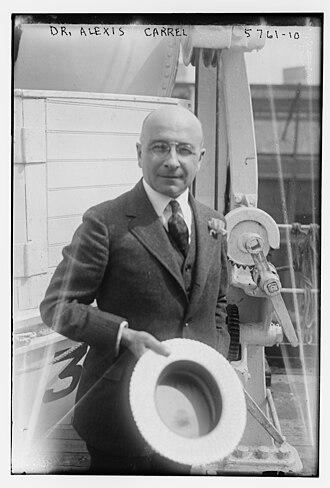
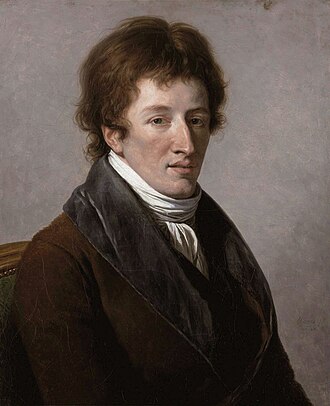
图:作者不详 · Public domain · Wikimedia Commons
- 出生
- 1873 年 6 月 28 日,圣富瓦莱里昂
- 逝世
- 1944 年 11 月 5 日,巴黎
- 国籍
- 法国
- 学科
- 生物学、医学、博物与综合
- 职业
- 外科医生、生理学家、社会学家、生物学家
- 母语 / 工作语言
- 法语、英语
- 母校
- 里昂大学(医学士,1893 年)、Saint-Marc Lycée
- 工作单位
- 芝加哥大学(1904—1906)、洛克菲勒大学(1906—1939)
研究领域
主要贡献
代表成就
师承
博士生1
来自 Wikidata 的「博士导师」「师从」「博士生」「学生」记录,可能不全。
所获奖项(6)
- 1912诺贝尔生理学或医学奖
- 1913法国荣誉军团骑士勋章
- 1915法国荣誉军团军官勋章
- 1916Commander of the Order of Leopold
- 1917荣誉军团司令
- 1936Bordin Prize
学会与院士
百科正文
生平
在1912年因为对于血管以及器官移植的研究,获得诺贝尔生理学或医学奖。此外他也曾是法国群众党(Parti Populaire Français)成员。此政党是维希法国时期的亲纳粹政党。
他的主要著作 Man, the Unknown 首先被胡先骕与萧宗训译为中文《未了知之人类》(2023(1945))。
以上内容摘自维基百科「亚历克西·卡雷尔」,按 CC BY-SA 4.0 使用,去掉了参考文献、外部链接等尾部小节,公式改写成了纯文本。全文、配图和出处见原文。
英文维基百科补充中文条目比较短,下面是英文条目「Alexis Carrel」的原文
Alexis Carrel (French: [alɛksi kaʁɛl]; 28 June 1873 – 5 November 1944) was a French surgeon and biologist who spent most of his scientific career in the United States. He was awarded the Nobel Prize in Physiology or Medicine in 1912 for pioneering vascular suturing techniques. He invented the first perfusion pump with Charles Lindbergh opening the way to organ transplantation. In later time however, it was acknowledged that Carrel and Lindbergh's version of the perfusion pump, which initially had media prominence, was impractical and difficult to use, and would lose influence by the 1940s. Carrel was also a pioneer in tissue culture, transplantology and thoracic surgery. He is known for his leading role in implementing eugenic policies in Vichy France.
Biography
Born in Sainte-Foy-lès-Lyon, Rhône, Carrel was raised in a devout Catholic family and was educated by Jesuits, though he had become an agnostic by the time he became a university student. He studied medicine at the University of Lyon.
Working as an intern at a Lyon hospital, he developed a technique for suturing small blood vessels using extremely fine needles. He published his first scientific article about this method in 1902.
In 1902, Carrel underwent a transformative experience that led him from being a skeptic of the reported visions and miracles at Lourdes to a believer in spiritual cures.
Contributions to science
Vascular suture
Carrel was a young surgeon who was deeply affected by the 1894 assassination of the French president, Sadi Carnot, who died from a severed portal vein that surgeons believed was irreparable. This tragedy inspired Carrel to develop new techniques for suturing blood vessels, such as the "triangulation" technique using three stay-sutures to minimize damage to the vascular wall during suturing. Carrel learned this technique from an embroideress, and later incorporated it into his work.
Honors
Carrel was elected to the American Philosophical Society in 1909 and the American Academy of Arts and Sciences in 1914. Carrel was a member of learned societies in the U.S., Spain, Russia, Sweden, the Netherlands, Belgium, France, Vatican City, Germany, Italy, and Greece, and was elected twice, in 1924 and 1927, as an honorary member of the Academy of Sciences of the USSR. He also received honorary doctorates from Queen's University of Belfast, Princeton University, Brown University, and Columbia University.
In 1972, the Swedish Post Office honored Carrel with a stamp that was part of its Nobel stamp series.
Man, the Unknown (1935, 1939)
In 1935, Carrel's book, L'Homme, cet inconnu (Man, the Unknown), became a best-seller. The book attempted to comprehensively outline what is known, and unknown, of the human body and human life "in light of discoveries in biology, physics, and medicine", to shed light on the problems of the modern world, and to provide possible routes to a better life for human beings.
In the book, Carrel argued that humans of "poor quality" were outbreeding those of good quality and causing the "enfeeblement of the white races." He advocated for an elite group of intellectuals to guide mankind and to incorporate eugenics into the social framework.
French Foundation for the Study of Human Problems
In 1937, Carrel joined the Centre d'Etudes des Problèmes Humains, which was led by Jean Coutrot. Coutrot's goal was to develop what he called an "economic humanism" through "collective thinking." However, in 1941, Carrel went on to advocate for the creation of the French Foundation for the Study of Human Problems (Fondation Française pour l'Etude des Problèmes Humains). This foundation was created by decree of the Vichy regime in 1941, and Carrel served as a "regent." Carrel's connections to the cabinet of Vichy France president Philippe Pétain, specifically French industrial physicians André Gros and Jacques Ménétrier, helped pave the way for the creation of the foundation.
Honours and awards
- Commandeur of the Order of Legion of Honour
- Commandeur of the Order of Leopold (Belgium)
- Chevalier of the Order of Isabella the Catholic
- Commandeur of the Order of the Polar Star
以上节选摘自英文维基百科「Alexis Carrel」,按 CC BY-SA 4.0 使用,去掉了参考文献、外部链接等尾部小节,公式改写成了纯文本。篇幅所限,较长的小节只摘了开头一部分,有的小节没有收;全文、配图和出处见原文。
同一学科、同时代的科学家




同一学科的科学家
更多 ›