格物
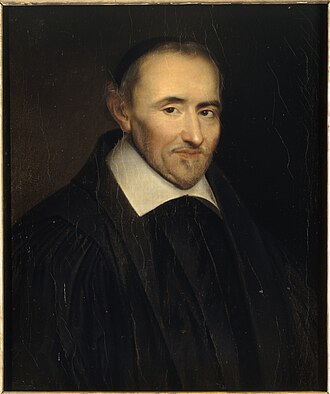
图:Louis-Édouard Rioult · Public domain · Wikimedia Commons
皮埃尔·伽桑狄1592—1655
Pierre Gassendi
法国哲学家,天文学家,数学家,牧师和科学家
皮埃尔·伽桑狄,法国科学家、数学家、哲学家、传教士、天文学家。他在法国东南部的教堂拥有一份工作,并且在巴黎领导一群自由思想派的知识分子。他同时也是一个积极观测的科学家,在1631年出版了水星凌日一书,伽桑狄陨石坑便是以他命名。 他使伊比鸠鲁学派复兴,以取代亚里士多德学派,他宣传原子论思想。他认为世界上的一切东西都是按一定次序结合起来的原子总和,世界是无限的。伽桑狄在认识方面是感觉论者,他肯定感觉是知识的唯一来源。他的社会观点是“自然权利”的观点,他说国家只是一种分工,是建立在社会契约的基础上的。
摘自维基百科「皮埃尔·伽桑狄」,CC BY-SA 4.0
- 出生
- 1592 年 1 月 22 日,尚泰西耶
- 逝世
- 1655 年 10 月 24 日,巴黎
- 国籍
- 法兰西王国
- 学科
- 物理学、数学、天文学、博物与综合
- 职业
- 哲学家、数学家、天文学家、教授
- 母语 / 工作语言
- 拉丁语、法语
- 母校
- Aix University(1612 年)、阿维尼翁大学(1614 年)
- 工作单位
- 法兰西公学院(1645—1655)、Aix University(1617—1623)
研究领域
主要贡献
代表成就
师承
师从1
来自 Wikidata 的「博士导师」「师从」「博士生」「学生」记录,可能不全。
百科正文
连接
伽桑狄著作的介绍浏览
关于幸福——伽桑狄的著作
Stanford Encyclopedia of Philosophy: Pierre Gassendi (页面存档备份,存于互联网档案馆)
以上内容摘自维基百科「皮埃尔·伽桑狄」,按 CC BY-SA 4.0 使用,去掉了参考文献、外部链接等尾部小节,公式改写成了纯文本。全文、配图和出处见原文。
英文维基百科补充中文条目比较短,下面是英文条目「Pierre Gassendi」的原文
Pierre Gassendi (French: [pjɛʁ gasɛ̃di]; born Pierre Gassend, Latinized Petrus Gassendus; 22 January 1592 – 24 October 1655) was a French philosopher, Catholic priest, astronomer, and mathematician. While he held a church position in south-east France, he also spent much time in Paris, where he was a leader of a group of free-thinking intellectuals. He was also an active observational scientist, publishing the first data on the transit of Mercury in 1631. The lunar crater Gassendi is named after him.
He wrote numerous philosophical works, and some of the positions he worked out are considered significant, finding a way between skepticism and dogmatism. Richard Popkin indicates that Gassendi was one of the first thinkers to formulate the modern "scientific outlook", of moderated skepticism and empiricism. He clashed with his contemporary Descartes on the possibility of certain knowledge. His best known intellectual project attempted to reconcile Epicurean atomism with Christianity.
Biography
Early life
Gassendi was born at Champtercier, near Digne, in France to Antoine Gassend and Françoise Fabry. His earliest education was entrusted to his maternal uncle, Thomas Fabry, the curé of the church of Champtercier. A youthful prodigy, at a very early age he showed academic potential and attended the collège (the town high school) at Digne, where he displayed a particular aptitude for languages and mathematics. In 1609 he entered the University of Aix-en-Provence, to study philosophy under Philibert Fesaye, O.Carm. at the Collège Royal de Bourbon (the Faculty of Arts of the University of Aix). In 1612 the college of Digne called him to lecture on theology. While at Digne, he travelled to Senez, where he received minor orders from Bishop Jacques Martin. In 1614 he received the degree of Doctor of Theology from the University of Avignon, and was elected Theologian in the Cathedral Chapter of Digne. On 1 August 1617 he received holy orders from Bishop Jacques Turricella of Marseille.
Scientific achievements
As part of his promotion of empirical methods and his anti-Aristotelian and anti-Cartesian views, Gassendi was responsible for a number of scientific 'firsts':
He explained parhelia in 1629 as due to ice crystals.
In 1631, Gassendi became the first person to observe the transit of a planet across the Sun, viewing the transit of Mercury that Kepler had predicted. In December of the same year, he watched for the transit of Venus, but this event occurred when it was night time in Paris.
Use of camera obscura to gauge the apparent diameter of the Moon.
Dropping a stone from the mast of a ship (in De motu) conserves horizontal momentum, removing an objection to the rotation of the Earth.
Measurement of speed of sound (to about 25% accuracy), showing that it is invariant of pitch.
Satisfactory interpretation of Pascal's Puy-de-Dôme experiment with a barometer in the late 1640s; this suggested a created vacuum is possible.
Views
According to Gabriel Daniel, Gassendi was a little Pyrrhonian in matters of science; but that was no bad thing. He wrote against the magical animism of Robert Fludd, and judicial astrology. He became dissatisfied with the Peripatetic system, the orthodox approach to natural philosophy based on the writings of Aristotle. Gassendi shared an empirical tendency of the age. He contributed to the objections against Aristotelian philosophy, but waited to publish his own thoughts.
There remains some controversy as to the extent to which Gassendi subscribed to the so-called libertinage érudit, the learned free-thinking that characterised the Tétrade, the Parisian circle to which he belonged, along with Gabriel Naudé and two others (Élie Diodati and François de La Mothe Le Vayer). Gassendi, at least, belonged to the fideist wing of the sceptics, arguing that the absence of certain knowledge implied the room for faith.
Early commentary
Samuel Sorbière, a disciple, recounts Gassendi's life in the first collected edition of the works, by Joseph Bougerel, Vie de Gassendi (1737; 2nd ed., 1770); as does Jean Philibert Damiron, Mémoire sur Gassendi (1839). An abridgment of his philosophy was given by his friend, the celebrated traveller, François Bernier (Abrégé de la philosophie de Gassendi, 8 vols., 1678; 2nd ed., 7 vols., 1684).
以上节选摘自英文维基百科「Pierre Gassendi」,按 CC BY-SA 4.0 使用,去掉了参考文献、外部链接等尾部小节,公式改写成了纯文本。篇幅所限,较长的小节只摘了开头一部分,有的小节没有收;全文、配图和出处见原文。
同一学科、同时代的科学家


同一学科的科学家
更多 ›