格物
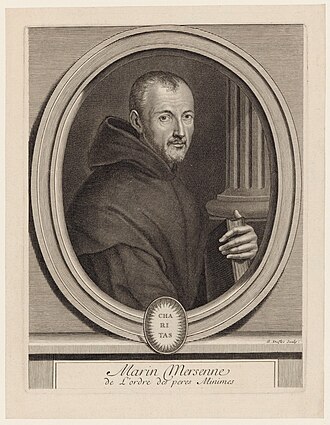
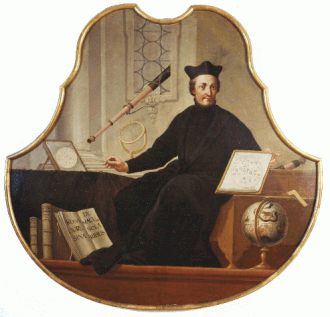
图:Claude Duflos · Public domain · Wikimedia Commons
- 出生
- 1588 年 9 月 8 日,瓦泽
- 逝世
- 1648 年 9 月 1 日,巴黎
- 国籍
- 法国
- 学科
- 物理学、数学、天文学、博物与综合
- 职业
- 哲学家、神学家、数学家、音乐学家
- 母语 / 工作语言
- 拉丁语、法语
- 母校
- 巴黎大学(1611 年)、拉弗莱什亨利四世学院(1609 年)
研究领域
主要贡献
代表成就
师承
来自 Wikidata 的「博士导师」「师从」「博士生」「学生」记录,可能不全。
百科正文
马兰·梅森(法语:Marin Mersenne,法语发音:[maʁɛ̃ mɛʁsɛn],1588年9月8日—1648年9月1日),法国博学家。
生平
梅森1611年进入修道院,成为法国最小兄弟会会士。1626年,他把自己在巴黎的修道室办成了科学家聚会场所和交流信息中心,称为“梅森学院”。他与同时代的最伟大的数学家保持经常的通信联系,和“业余数学王子”费马是好朋友。梅森编辑过多位希腊数学家的著作,并对其中的的课题用出论述,尤其是以梅森素数闻名,并于1644年发表的《物理数学随感》(Cogitata physico—mathe-matica)中讨论它。其著作《宇宙和谐》(Harmonie universelle)一书,是记录当代乐器的一份珍贵的史料。1648年9月1日,梅森于巴黎逝世。
以上内容摘自维基百科「马兰·梅森」,按 CC BY-SA 4.0 使用,去掉了参考文献、外部链接等尾部小节,公式改写成了纯文本。全文、配图和出处见原文。
英文维基百科补充中文条目比较短,下面是英文条目「Marin Mersenne」的原文
Marin Mersenne, OM (also known as Marinus Mersennus or le Père Mersenne; French: [maʁɛ̃ mɛʁsɛn]; 8 September 1588 – 1 September 1648) was a French polymath whose works touched a wide variety of fields. He is perhaps best known today among mathematicians for Mersenne prime numbers, those written in the form Mn = 2n − 1 for some integer n. He also developed Mersenne's laws, which describe the harmonics of a vibrating string (such as may be found on guitars and pianos), and his seminal work on music theory, Harmonie universelle, for which he is referred to as the "father of acoustics".
Mersenne, an ordained Catholic priest, had many contacts in the scientific world and has been called "the center of the world of science and mathematics during the first half of the 1600s" and, because of his ability to make connections between people and ideas, "the post-box of Europe". He was also a member of the ascetical Minim religious order and wrote and lectured on theology and philosophy.
Life
Mersenne was born of Jeanne Moulière, wife of Julien Mersenne, peasants who lived near Oizé, County of Maine (present-day Sarthe, France). He was educated at Le Mans and at the Jesuit College of La Flèche. On 17 July 1611, he joined the Minim Friars and, after studying theology and Hebrew in Paris, was ordained a priest in 1613.
Between 1614 and 1618, he taught theology and philosophy at Nevers, but he returned to Paris and settled at the convent of L'Annonciade in 1620. There he studied mathematics and music and met with other kindred spirits such as René Descartes, Étienne Pascal, Pierre Petit, Gilles de Roberval, Thomas Hobbes, and Nicolas-Claude Fabri de Peiresc. He corresponded with Giovanni Doni, Jacques Alexandre Le Tenneur, Constantijn Huygens, Galileo Galilei, and other scholars in Italy, England and the Dutch Republic. He was a staunch defender of Galileo, assisting him in translations of some of his mechanical works.
For four years, Mersenne devoted himself entirely to philosophic and theological writing, and published Quaestiones celeberrimae in Genesim (Celebrated Questions on the Book of Genesis) (1623); L'Impieté des déistes (The Impiety of the Deists) (1624); La Vérité des sciences (Truth of the Sciences Against the Sceptics, 1624). It is sometimes incorrectly stated that he was a Jesuit. He was educated by Jesuits, but he never joined the Society of Jesus. He taught theology and philosophy at Nevers and Paris.
In 1635 he set up the informal Académie Parisienne (Academia Parisiensis), which had nearly 140 correspondents, including astronomers and philosophers as well as mathematicians, and was the precursor of the Académie des sciences established by Jean-Baptiste Colbert in 1666. He was not afraid to cause disputes among his learned friends in order to compare their views, notable among which were disputes between Descartes, Pierre de Fermat, and Jean de Beaugrand. Peter L. Bernstein, in his book Against the Gods: The Remarkable Story of Risk, wrote, "The Académie des Sciences in Paris and the Royal Society in London, which were founded about twenty years after Mersenne's death, were direct descendants of Mersenne's activities."
In 1635 Mersenne met with Tommaso Campanella but concluded that he could "teach nothing in the sciences... but still he has a good memory and a fertile imagination." Mersenne asked if Descartes wanted Campanella to come to Holland to meet him, but Descartes declined. He visited Italy fifteen times, in 1640, 1641 and 1645. In 1643–1644 Mersenne also corresponded with the German Socinian Marcin Ruar concerning the Copernican ideas of Pierre Gassendi, finding Ruar already a supporter of Gassendi's position. Among his correspondents were Descartes, Galileo, Roberval, Pascal, Beeckman and other scientists.
He died on 1 September 1648 of complications arising from a lung abscess.
List of works
- Euclidis elementorum libri, etc. (Paris, 1626)
- Les Mécaniques de Galilée (Paris, 1634)
- Questions inouies ou récréation des savants (1634)
- Questions théologiques, physiques, etc. (1634)
Harmonie universelle First edition online from Gallica (Paris, 1636). Translation to English by Roger E. Chapman (The Hague, 1957)
- Nouvelles découvertes de Galilée (1639)
- Cogitata physico-mathematica (1644)
- Universae geometriae synopsis (1644)
Tractatus mechanicus theoricus et practicus (in Latin). Paris: Antoine Bertier. 1644.
以上节选摘自英文维基百科「Marin Mersenne」,按 CC BY-SA 4.0 使用,去掉了参考文献、外部链接等尾部小节,公式改写成了纯文本。篇幅所限,较长的小节只摘了开头一部分,有的小节没有收;全文、配图和出处见原文。
同一学科、同时代的科学家



同一学科的科学家
更多 ›