格物
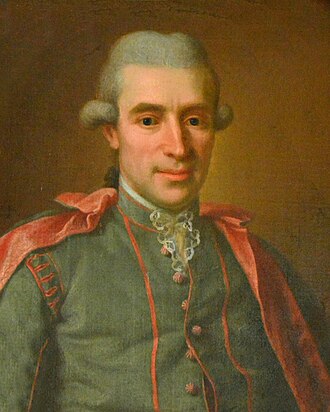
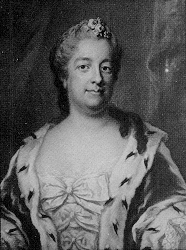
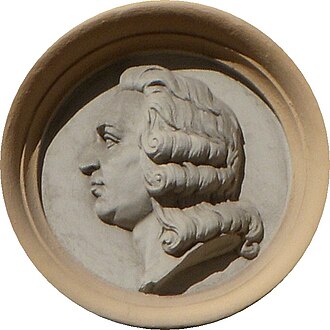
图:Ulrika Pasch · Public domain · Wikimedia Commons
- 出生
- 1735 年 3 月 20 日,Katrineberg
- 逝世
- 1784 年 7 月 8 日,Medevi
- 国籍
- 瑞典
- 学科
- 化学、生物学、地球科学
- 职业
- 化学家、大学教师、昆虫学家、矿物学家
- 母语 / 工作语言
- 瑞典语、拉丁语
- 母校
- 乌普萨拉大学、Katedralskolan
- 工作单位
- 乌普萨拉大学
研究领域
师承
博士导师1
学生3
来自 Wikidata 的「博士导师」「师从」「博士生」「学生」记录,可能不全。
所获奖项(2)
- 1772Knight of the Order of Vasa
- —英国皇家学会院士
学会与院士
百科正文
生平
1735年,出生于瑞典卡特琳娜贝里(Katharinberg)。17岁,进入乌普萨拉大学学习。后成为教授。1764年,成为瑞典皇家科学院院士。1765年,成为英国皇家学会会士。
贝里曼主要科学贡献在为化学定量分析的改进,发展了基于化学性质的矿物分类体系。
以上内容摘自维基百科「托尔贝恩·贝里曼」,按 CC BY-SA 4.0 使用,去掉了参考文献、外部链接等尾部小节,公式改写成了纯文本。全文、配图和出处见原文。
英文维基百科补充中文条目比较短,下面是英文条目「Torbern Bergman」的原文
Torbern Olof Bergman (KVO) (20 March 1735 – 8 July 1784) was a Swedish chemist and mineralogist noted for his 1775 Dissertation on Elective Attractions, containing the largest chemical affinity tables ever published. Bergman was the first chemist to use the A, B, C, etc., system of notation for chemical species.
Early life and education
Torbern was born on 20 March 1735, the son of Barthold Bergman and Sara Hägg. He enrolled at the University of Uppsala at age 17. His father wished him to hear either law or divinity, while he himself was anxious to study mathematics and natural science; in the effort to please both himself and his father, he overworked himself and harmed his health. During a period of enforced abstinence from study, he amused himself with field botany and entomology. He was able to send Linnaeus specimens of several new kinds of insects, and in 1756 he succeeded in proving that, contrary to the opinion of that naturalist, the so-called Coccus aquaticus was really the ovum of a kind of leech. He returned to the university in 1758, and received his PhD in that year.
Career
Bergman lectured at the University of Uppsala on physics and mathematics, publishing papers on the rainbow, the aurora, the pyroelectric phenomena of tourmaline. Upon the resignation of the celebrated Johan Wallerius, Bergman was a candidate for the professorship of chemistry and mineralogy. His competitors charged him with ignorance of the subject, because he had never written on it. To refute them, he shut himself up for some time in a laboratory, and prepared a treatise on the manufacture of alum, which became a standard work. Thanks to the influence of Gustav III, then crown prince and chancellor of the university, he was appointed a professor of chemistry, and remained at this position for the rest of his life.
Bergman greatly contributed to the advancement of quantitative analysis, and he developed a mineral classification scheme based on chemical characteristics and appearance. He is noted for his research on the chemistry of metals, especially bismuth and nickel.
In 1764, Bergman was elected a member of the Royal Swedish Academy of Sciences. In April 1765 he was elected a Fellow of the Royal Society of London. In 1773 he was elected a member of the American Philosophical Society. In March 1782, he was elected Foreign Associate of the French Academy of Sciences.
In 1771, six years after he first discovered carbonated water and four years after Joseph Priestley first created artificially carbonated water, Bergman perfected a process to make carbonated water from chalk by the action of sulphuric acid. He is also noted for his sponsorship of Carl Wilhelm Scheele, whom some deem to be Bergman's "greatest discovery". The translation into English of his book Physical and Chemical Essays was read widely and regarded as the first systematic method of chemical analysis.
Personal life
In 1771, Bergman married Margareta Catharina Trast.
Legacy
In Bergman's honour, the uranium mineral torbernite and the lunar crater Bergman both bear his name.
以上内容摘自英文维基百科「Torbern Bergman」,按 CC BY-SA 4.0 使用,去掉了参考文献、外部链接等尾部小节,公式改写成了纯文本。全文、配图和出处见原文。
同一学科、同时代的科学家