格物
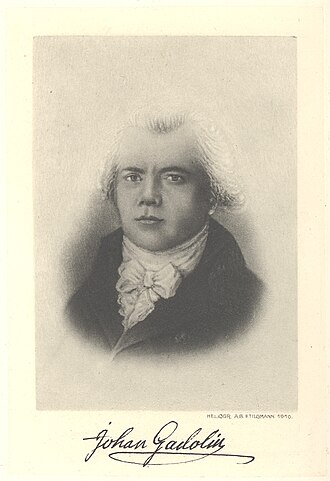
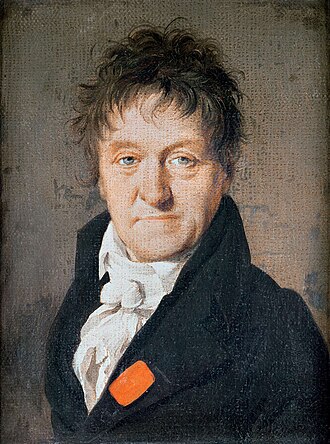
图:Lysippos · Public domain · Wikimedia Commons
- 出生
- 1760 年 6 月 5 日,图尔库
- 逝世
- 1852 年 8 月 15 日,米奈迈基
- 国籍
- 芬兰大公国、瑞典
- 学科
- 物理学、化学、地球科学、博物与综合
- 职业
- 化学家、物理学家、矿物学家、地质学家
- 母语 / 工作语言
- 拉丁语、瑞典语、芬兰语、俄语、德语
- 母校
- 乌普萨拉大学
- 工作单位
- 奥布皇家学院
研究领域
主要贡献
发现的元素
以他 / 她命名
师承
博士导师1
来自 Wikidata 的「博士导师」「师从」「博士生」「学生」记录,可能不全。
所获奖项(3)
- —Order of St. Vladimir, 4th class
- —Order of St. Vladimir, 3rd class
- —Order of Saint Anna, 2nd class
学会与院士
百科正文
英文维基百科补充中文条目比较短,下面是英文条目「Johan Gadolin」的原文
Johan Gadolin (5 June 1760 – 15 August 1852) was a Finnish chemist, physicist and mineralogist. Gadolin discovered a "new earth" containing the first rare-earth compound yttrium, which was later determined to be a chemical element. He is also considered the founder of Finnish chemistry research, as the second holder of the Chair of Chemistry at the Royal Academy of Turku (or Åbo Kungliga Akademi). Gadolin was ennobled for his achievements and awarded the Order of Saint Vladimir and the Order of Saint Anna.
Early life and education
Johan Gadolin was born in Turku (Swedish name Åbo), Finland (then a part of Sweden). Johan was the son of Jakob Gadolin, professor of physics and theology at Turku. Johan began to study mathematics at the Royal Academy of Turku (Åbo Kungliga Akademi) when he was fifteen. Later he changed his major to chemistry, studying with Pehr Adrian Gadd, the first chair of chemistry at Turku.
In 1779 Gadolin moved to Uppsala University. In 1781, he published his dissertation Dissertatio chemica de analysi ferri ("Chemical dissertation on the analysis of iron"), under the direction of Torbern Bergman. Bergman founded an important research school, and many of his students, including Gadolin, Johan Gottlieb Gahn, and Carl Wilhelm Scheele, became close friends.
Career
Gadolin was fluent in Latin, Finnish, Russian, German, English and French in addition to his native Swedish. He was a candidate for the chair of chemistry at Uppsala in 1784, but Johann Afzelius was selected instead. Gadolin became an extraordinary professor at Åbo in 1785 (an unpaid position). Beginning in 1786, he made a chemical "grand tour" of Europe, visiting universities and mines in various countries. He worked with Lorenz Crell, editor of the journal Chemische Annalen in Germany, and with Adair Crawford and Richard Kirwan in Ireland.
Gadolin was elected a member of the Royal Swedish Academy of Sciences in 1790.
Gadolin became the ordinary professor of chemistry at the Royal Academy of Turku in 1797, after the death of Pehr Adrian Gadd. He retained the position until his retirement in 1822. He was one of the first chemists who gave laboratory exercises to students. He even allowed the students to use his private laboratory.
Chemical achievements
Gadolin made contributions in a variety of areas.
Although he never visited France, he became a proponent of Antoine Lavoisier's theory of combustion. Gadolin's Inledning till Chemien (1798) was the first chemistry textbook in the Nordic countries that questioned the theory of phlogiston and discussed the role of oxygen in combustion in a modern way.
Studies of heat
Gadolin studied the relationship of heat to chemical changes, in particular, the ability of different substances to absorb heat (specific heat) and the absorption of heat during state changes (latent heat). This thermochemical work required extremely precise measurements. Gadolin published important papers on specific heat by 1784, and on the latent heat of steam in 1791. He demonstrated that the heat of ice was equal to the heat of snow, and published a standard set of heat tables.
The best series of experiments on the distribution of heat among different bodies was performed before the year 1784 by Professor Gadolin of Åbo, who, rejecting the notion of Capacity, introduced the unexceptionable expression, Specific Heat. One of the most beautiful consequences derived from this theory, was the determination of the absolute zero or lowest point in the scale of Heat.
Yttrium, the first rare-earth element
Gadolin became famous for his description of the first rare-earth element, yttrium. In 1792 Gadolin received a sample of black, heavy mineral found in a quarry in a Swedish village Ytterby near Stockholm by Carl Axel Arrhenius.
Awards
Gadolin was knighted and is registered under number 245 in the Finnish House of Nobility. He was also awarded the Order of Saint Vladimir and the Order of Saint Anna. His heraldic device was:
Argent, on a bend Azure with two mullets Or between a rose Gules and crystals Proper.
Later life
Johan Gadolin married first, at age 35, Hedvig Tihleman, with whom he had nine children. After his wife's death he married, at age 59, Ebba Palander. Gadolin retired as professor emeritus in 1822 at age 62, a mandatory age of retirement. He moved to a country estate where he lived for another 30 years. He died in Mynämäki, Finland on 15 August 1852.
The Great Fire of Turku of 1827 started in a bakery and damaged or destroyed much of the town of Åbo. Gadolin's laboratory and collection of minerals near the cathedral were destroyed.
以上节选摘自英文维基百科「Johan Gadolin」,按 CC BY-SA 4.0 使用,去掉了参考文献、外部链接等尾部小节,公式改写成了纯文本。篇幅所限,较长的小节只摘了开头一部分,有的小节没有收;全文、配图和出处见原文。
同一学科、同时代的科学家





同一学科的科学家
更多 ›