格物
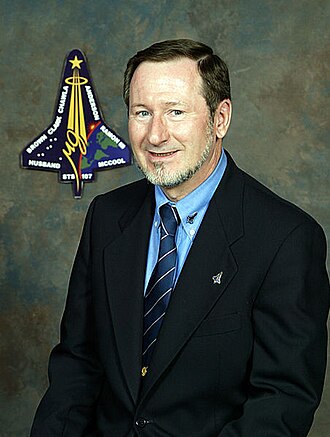
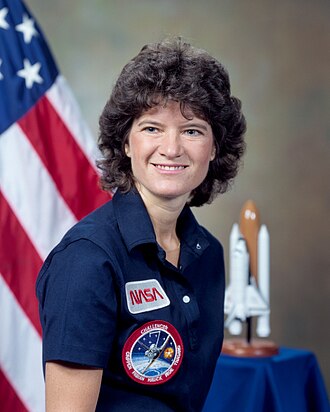
图:See http://caib.nasa.gov/photos/sub_section3eb5.html?categor… · Public domain · Wikimedia Commons
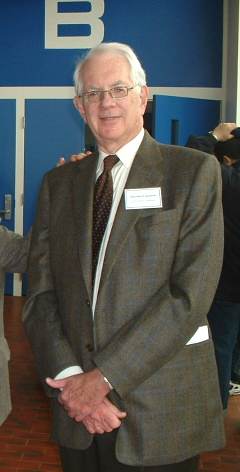
道格拉斯·奥谢罗夫1945—
Douglas Osheroff
物理学家, 美国
道格拉斯·奥谢罗夫,美国物理学家,1996年获诺贝尔物理学奖。
摘自维基百科「道格拉斯·奥谢罗夫」,CC BY-SA 4.0
- 出生
- 1945 年 8 月 1 日,阿伯丁
- 国籍
- 美国
- 学科
- 物理学、博物与综合
- 职业
- 物理学家、大学教师
- 母语 / 工作语言
- 英语
- 母校
- 加州理工学院、康奈尔大学、Aberdeen High School
- 工作单位
- 斯坦福大学、贝尔实验室
研究领域
师承
博士导师1
来自 Wikidata 的「博士导师」「师从」「博士生」「学生」记录,可能不全。
所获奖项(8)
- 1976Simon Memorial Prize
- 1981麦克阿瑟天才奖
- 1981奥利弗·巴克利奖
- 1996诺贝尔物理学奖
- 1998里克特迈耶纪念奖
- 2001Continuing Bass University Fellow in Undergraduate Education
- 2012honorary doctorate of Slovak University of Technology in Bratislava
- —美国物理学会会士
学会与院士
百科正文
英文维基百科补充中文条目比较短,下面是英文条目「Douglas Osheroff」的原文
Douglas Dean Osheroff (born August 1, 1945) is an American physicist known for his work in experimental condensed matter physics, in particular for his co-discovery of superfluidity in Helium-3. For his contributions he shared the 1996 Nobel Prize in Physics along with David Lee and Robert C. Richardson. Osheroff is currently the J. G. Jackson and C. J. Wood Professor of Physics, emeritus, at Stanford University.
Life and work
Osheroff was born in Aberdeen, Washington on August 1, 1945. His father, William Osheroff, was the son of Jewish immigrants who left Russia. His mother, Bessie Anne (Ondov), a nurse, was the daughter of Slovak immigrants (her own father was a Lutheran minister) from the Felvidék, Upper Hungary, Kingdom of Hungary.
Osheroff was confirmed in the Lutheran Church but he was given the chance to choose and decided not to attend any longer. He has stated "In some sense it seemed that lying in church is the worst place to lie. I guess at some emotional level I accept the idea of God, but I don't know how God would manifest itself."
Osheroff earned his bachelor's degree in 1967 from Caltech, where he attended lectures by Richard Feynman and did undergraduate research for Gerry Neugebauer.
Osheroff joined the Laboratory of Atomic and Solid State Physics at Cornell University as a graduate student, doing research in low-temperature physics. Together with David Lee, the head of the laboratory, and Robert C. Richardson, Osheroff used a Pomeranchuk cell to investigate the behaviour of 3He at temperatures within a few thousandths of a degree of absolute zero. They discovered unexpected effects in their measurements, which they eventually explained as phase transitions to a superfluid phase of 3He. Lee, Richardson and Osheroff were jointly awarded the Nobel Prize in Physics in 1996 for this discovery.
Osheroff received a Ph.D. from Cornell University in 1973. He then worked at Bell Labs in Murray Hill, New Jersey for 15 years, continuing to research low-temperature phenomena in 3He. In 1987 he moved to the Departments of Physics and Applied Physics at Stanford University, where he also served as department chair from 1993 to 1996. His research is focused on phenomena that occur at extremely low temperatures.
Osheroff was selected to serve on the Space Shuttle Columbia investigation panel, serving much the same role as Richard Feynman did on the Space Shuttle Challenger panel.
He currently serves on the board of advisors of Scientists and Engineers for America, an organization focused on promoting sound science in American government.
Osheroff is left-handed, and he often blames his slight quirks and eccentricities on it. He is also an avid photographer and introduces students at Stanford to medium-format film photography in a freshman seminar titled "Technical Aspects of Photography." In addition, he has taught the Stanford introductory physics course on electricity and magnetism on multiple occasions, most recently in Spring 2008, as well as undergraduate labs on low temperature physics.
Among his physics outreach activities, Osheroff participated in the science festivals for middle and high school students, is an official guest of honor at the International Young Physicists' Tournament 2013.
He married a biochemist, Phyllis Liu-Osheroff, in 1970.
Osheroff is one of the 20 American recipients of the Nobel Prize in Physics to sign a letter addressed to President George W. Bush in May 2008, urging him to "reverse the damage done to basic science research in the Fiscal Year 2008 Omnibus Appropriations Bill" by requesting additional emergency funding for the Department of Energy’s Office of Science, the National Science Foundation, and the National Institute of Standards and Technology.
Awards and honors
- Nobel Prize in Physics (1996)
- Simon Memorial Prize (1976)
- Oliver E. Buckley Condensed Matter Prize (1981)
- MacArthur Fellowship Program (1981)
- Golden Plate Award of the American Academy of Achievement (1997)
以上内容摘自英文维基百科「Douglas Osheroff」,按 CC BY-SA 4.0 使用,去掉了参考文献、外部链接等尾部小节,公式改写成了纯文本。全文、配图和出处见原文。
同年获同一奖项
同一学科、同时代的科学家





同一学科的科学家
更多 ›