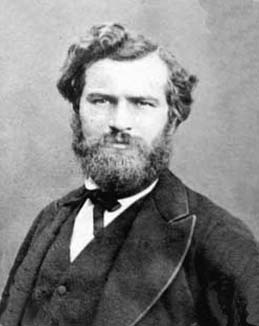
格物

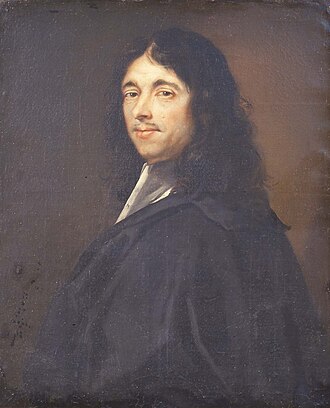
图:After Godfrey Kneller · Public domain · Wikimedia Commons
- 出生
- 1616 年 11 月 23 日,阿什福德
- 逝世
- 1703 年 10 月 28 日,牛津
- 国籍
- 英格兰王国
- 学科
- 数学、博物与综合
- 职业
- 数学家、数学史学家、哲学家、音乐学家
- 母语 / 工作语言
- 拉丁语、英语
- 母校
- 剑桥大学伊曼纽尔学院(1637 年)、费尔斯德学校(1632 年)、剑桥大学(1640 年)、Tenterden Infant School(1631 年)
- 工作单位
- 牛津大学(1649—1703)、剑桥大学女皇学院(1644—1645)
研究领域
主要贡献
代表成就
师承
学生1
来自 Wikidata 的「博士导师」「师从」「博士生」「学生」记录,可能不全。
学会与院士
百科正文
约翰·沃利斯的父亲是阿什福德的名人,很受尊敬。可惜他在沃利斯六岁时便逝世。1625年他进入James Movat's grammar school。学校没有教授数学。1631年的圣诞假期,沃利斯的兄长教他算术,沃利斯首次和数学接触,数学从此成为了其爱好。1632年他进入剑桥大学埃马努尔学院。当时没有人能指引他的数学学习,他便读了很多不同的课程,包括伦理学、形而上学、地理、天文、医学和解剖学。他曾辩倒其老师Francis Glisson的血液循环革命理论。
1637年获文学士学位。1640年获硕士学位。1644年成为西敏神职人员的秘书。1660年,皇家学会成立,他是创立人之一。
他写了不少宗教文章、一本关于神秘学的书、语法书Grammatica linguae Anglicanae(牛津,1653年)和逻辑学书籍Institutio logicae (牛津,1687年)。
数学
代数
他奠定了幂的表示法,并将指数的定义从正整数扩充至有理数: x⁰=1, x⁻¹=1/x, x⁻²=1/x², etc. x^(1/2)=
- x 的开方, x^(2/3)=
- x² 的开立方, etc. x^(1/n)=
- x 的开 n 次方 x^(p/q)=
- x^(p) 的开 q 次方
接受方程有复数根。
证明 a³-7a=6 有三个实数根。
微积分
找到 x^(m) 的积分,即曲线 y=x^(m) 下的面积。他证明了这个面积是等高等底的平行四边形的面积的 1/(m+1)
数学史
- 整理、增补古希腊的文稿,包括:
- 托勒密《谐和论》
- 阿里斯塔克斯《论太阳与月亮的距离》
- 阿基米德《数沙者》
数学著作
Treatise on Algebra
Arithmetica Infinitorum
以上内容摘自维基百科「約翰·沃利斯」,按 CC BY-SA 4.0 使用,去掉了参考文献、外部链接等尾部小节,公式改写成了纯文本。全文、配图和出处见原文。
英文维基百科补充中文条目比较短,下面是英文条目「John Wallis」的原文
John Wallis (; Latin: Wallisius; 3 December [O.S. 23 November] 1616 – 8 November [O.S. 28 October] 1703) was an English clergyman and mathematician, who is given partial credit for the development of infinitesimal calculus.
Between 1643 and 1689 Wallis served as chief cryptographer for Parliament and, later, the royal court. He extended Cavalieri's method of indivisibles through the use of interpolation. Applying Kepler's principle of continuity, he developed techniques for the evaluation of integrals. He is credited with introducing the symbol ∞ to represent the concept of infinity. He similarly used 1/∞ for an infinitesimal. He was a contemporary of Isaac Newton and one of the greatest intellectuals of the early modern mathematics.
Biography
Educational background
Cambridge, M.A., Oxford, D.D.
Grammar School at Tenterden, Kent, 1625–31.
School of Martin Holbeach at Felsted, Essex, 1631–2.
Cambridge University, Emmanuel College, 1632–40; B.A., 1637; M.A., 1640.
D.D. at Oxford in 1654.
Family
On 14 March 1645, he married Susanna Glynde (c. 1600 – 16 March 1687). They had three children:
Anne, Lady Blencowe (4 June 1656 – 5 April 1718), married Sir John Blencowe (30 November 1642 – 6 May 1726) in 1675, with issue
John Wallis (26 December 1650 – 14 March 1717), MP for Wallingford 1690–1695, married Elizabeth Harris (d. 1693) on 1 February 1682, with issue: one son and two daughters
Elizabeth Wallis (1658–1703), married William Benson (1649–1691) of Towcester, died with no issue
Life
John Wallis was born in Ashford, Kent. He was the third of five children of Revd. John Wallis and Joanna Chapman. He was initially educated at a school in Ashford but moved to James Movat's school in Tenterden in 1625 following an outbreak of plague. Wallis was first exposed to mathematics in 1631, at Felsted School (then known as Martin Holbeach's school in Felsted); he enjoyed maths, but his study was erratic, since "mathematics, at that time with us, were scarce looked on as academical studies, but rather mechanical" (Scriba 1970). At the school in Felsted, Wallis learned how to speak and write Latin. By this time, he also was proficient in French, Greek, and Hebrew. As it was intended he should be a doctor, he was sent in 1632 to Emmanuel College, Cambridge.
Contributions to mathematics
Wallis made significant contributions to trigonometry, calculus, geometry, and the analysis of infinite series. In his Opera Mathematica I (1695) he introduced the term "continued fraction".
Analytic geometry
In 1655, Wallis published a treatise on conic sections in which they were defined analytically. This was the earliest book in which these curves are considered and defined as curves of the second degree. It helped to remove some of the perceived difficulty and obscurity of René Descartes' work on analytic geometry.
In Treatise on the Conic Sections, Wallis popularised the symbol ∞ for infinity.
Music theory
Wallis translated into Latin works of Ptolemy and Bryennius, and Porphyrius's commentary on Ptolemy. He also published three letters to Henry Oldenburg concerning tuning. He approved of equal temperament, which was being used in England's organs.
Other works
His Institutio logicae, published in 1687, was very popular. The Grammatica linguae Anglicanae was a work on English grammar, that remained in print well into the eighteenth century. He also published on theology.
Wallis as a cryptographer
While employed as Lady Vere's chaplain in 1642, Wallis was given an enciphered letter about the fall of Chichester which he managed to decipher within two hours. This started his career as a cryptographer. He was a moderate supporter of the Parliamentarian side in the First English Civil War and therefore worked as a decipherer of intercepted correspondence for the Parliamentarian leaders. For his services, he was rewarded with the Livings of St. Gabriel and St. Martin's in London.
Because of his Parliamentarian sympathies, Wallis was not employed as a cryptographer after the Stuart Restoration; after the Glorious Revolution, he was sought out by Lord Nottingham and frequently employed to decipher encrypted intercepted correspondence, though he thought that he was not always adequately rewarded for his work.
以上节选摘自英文维基百科「John Wallis」,按 CC BY-SA 4.0 使用,去掉了参考文献、外部链接等尾部小节,公式改写成了纯文本。篇幅所限,较长的小节只摘了开头一部分,有的小节没有收;全文、配图和出处见原文。
同一学科、同时代的科学家



同一学科的科学家
更多 ›