格物

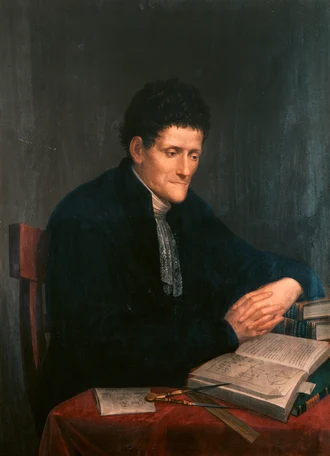
图:Pierre Roch Vigneron · Public domain · Wikimedia Commons
- 出生
- 1608 年 1 月 28 日,那不勒斯
- 逝世
- 1679 年 12 月 31 日,罗马
- 国籍
- 那不勒斯王国
- 学科
- 数学、医学、工程与发明、博物与综合
- 职业
- 数学家、数学史学家、医生、发明家
- 母语 / 工作语言
- 拉丁语
- 母校
- 罗马大学
- 工作单位
- 比萨大学(1656—1667)、墨西拿大学(1635—1656)、墨西拿大学(1667—1672)
研究领域
主要贡献
代表成就
师承
博士导师1
来自 Wikidata 的「博士导师」「师从」「博士生」「学生」记录,可能不全。
学会与院士
百科正文
英文维基百科补充中文条目比较短,下面是英文条目「Giovanni Alfonso Borelli」的原文
Giovanni Alfonso Borelli (Italian: [dʒoˈvanni alˈfɔnso boˈrɛlli]; 28 January 1608 – 31 December 1679) was an Italian physiologist, physicist, and mathematician who is often described as the father of biomechanics. He contributed to the modern principle of scientific investigation by continuing Galileo's practice of testing hypotheses against observation. Trained in mathematics, Borelli also made extensive studies of Jupiter's moons, the mechanics of animal locomotion and, in microscopy, of the constituents of blood. He also used microscopy to investigate the stomatal movement of plants, and undertook studies in medicine and geology. During his career, he enjoyed the patronage of Queen Christina of Sweden. He was the first scientist to explain that animal and human bodily movements are caused by muscular contractions.
Biography
Giovanni Borelli was born on 28 January 1608 in the district of Castel Nuovo, in Naples. He was the first-born son of Spanish infantryman Miguel Alfonso and a local woman named Laura Porello (alternately Porelli or Borelli.) Borelli had five siblings.
Borelli eventually travelled to Rome where he studied under Benedetto Castelli, matriculating in mathematics at Sapienza University of Rome. From 1635 to 1656 he served as a Professor of Mathematics in Messina, Sicily. In 1635, the Senate of Messina offered him a membership in the prestigious Accademia della Fucina, which was an intellectual society of scientists devoted to studying and publishing largely on physical and natural sciences under the supervision and protection of the Senate. Borelli was designated to investigate "the causes of the malignant fever that lashed a large part of Italy in 1647. He attributed the cause to an airborne infection and contested the prevailing opinion that the illness was due to excessive heat, humidity, or astrological influences." He even devised a treatment for the disease. While Borelli worked on studying the disease he also continued to study mathematics. In 1658 he published a revised version of Euclid’s Elements called, Euclides Restitutus (Euclid Restored). Euclid was an ancient Greek mathematician whose book had been one of the most important mathematical texts for centuries. Borelli also revised Apollonius of Perga: Conics, a treatise on mathematics that examined parabolas and ellipses. Apollonius of Perga was an ancient Greek astronomer and mathematician.
Around 1655, Borelli was invited to the University of Pisa by Ferdinando De' Medici Grand Duke of Tuscany.
Scientific achievements
Borelli's major scientific achievements are focused on his investigation into biomechanics. This work originated with his studies of animals. His publications, De Motu Animalium I and De Motu Animalium II, borrowing their title from the Aristotelian treatise, relate animals to machines and utilize mathematics to prove his theories. The first volume covers biomechanical and muscular action in humans and animals (how muscles move while living beings walk, run, swim, jump, and fly). The second volume discusses the physiology of human organs, namely the lungs and heart. In this volume he concluded that the heart contracted like other muscles, but unlike other muscles it was not attached to any limb. He noted that the purpose of cardiac contraction was to send blood throughout the body.
The anatomists of the 17th century were the first to suggest the contractile movement of muscles. Borelli, however, first suggested that 'muscles do not exercise vital movement otherwise than by contracting.' He was also the first to deny corpuscular influence on the movements of muscles. This was proven through his scientific experiments demonstrating that living muscles did not release corpuscles into the water when cut. Borelli also recognized that forward motion entailed the movement of a body's center of gravity forward, which was then followed by the swinging of its limbs in order to maintain balance. His studies also extended beyond muscle and locomotion. In particular, he likened the action of the heart to that of a piston. For this to work properly he derived the idea that the arteries have to be elastic. For these discoveries, Borelli is labeled as the father of modern biomechanics, and the American Society of Biomechanics uses the Borelli Award as its highest honor for research in the area.
以上节选摘自英文维基百科「Giovanni Alfonso Borelli」,按 CC BY-SA 4.0 使用,去掉了参考文献、外部链接等尾部小节,公式改写成了纯文本。篇幅所限,较长的小节只摘了开头一部分,有的小节没有收;全文、配图和出处见原文。
同一学科、同时代的科学家


同一学科的科学家
更多 ›