格物
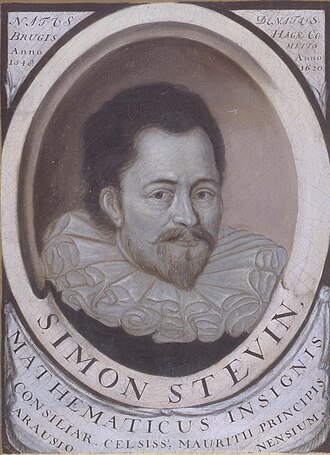
图:作者不详 · Public domain · Wikimedia Commons
- 出生
- 1548 年,布鲁日
- 逝世
- 1620 年,海牙
- 国籍
- 哈布斯堡尼德兰
- 学科
- 物理学、数学、天文学、工程与发明、博物与综合
- 职业
- 数学家、工程师、物理学家、天文学家
- 母语 / 工作语言
- 荷兰语、法语
研究领域
主要贡献
代表成就
百科正文
关于他的生平所知不多。或生于布鲁日。他曾为拿骚的莫里茨的老师。
他大部分作品都用荷兰语写成,不只因他认为荷兰语是最适合诠释科学的语言,更希望能借此帮助学术界外不懂拉丁语的人学习科学。
成就
制造了一个“陆地风帆”,能比马匹走得更快。
编写利率表Tafelen of Interest(1582年)
分辨了稳定平衡和不稳定平衡。
1586年曾做实验证明两个重量不同的球同时落下同时到地,时间比伽里略还早。
在De Beghinselen des Waterwichts(《流体静力学原理》,1586年)中,提出流体静力学悖论。
写一张小册子De Thiende推广小数点记号。
发明了许多数学名词的荷兰语译名。这使荷兰语成为唯一一种大部分数学名词的源头都不是来自拉丁语的西欧语言,例如数学“wiskunde”、直径“middellijn”(穿过中心的线)等词。
1585年在De Spiegheling der Singconst中提出十二平均律,比朱载堉稍晚,虽然斯特芬生前没有公开发表。
在建筑学、公共事务上他都有不少见解,记录在Materiae Politicae, Burgherlike Stoffen(1649年)、Vita Politica. Het Burgherlick leven等书中。
以上内容摘自维基百科「西蒙·斯泰芬」,按 CC BY-SA 4.0 使用,去掉了参考文献、外部链接等尾部小节,公式改写成了纯文本。全文、配图和出处见原文。
英文维基百科补充中文条目比较短,下面是英文条目「Simon Stevin」的原文
Simon Stevin (Dutch: [ˈsimɔn steːˈvɪn]; 1548–1620), sometimes called Stevinus, was a Flemish mathematician, scientist and music theorist. He made various contributions in many areas of science and engineering, both theoretical and practical. He also translated various mathematical terms into Dutch, making it one of the few European languages in which the word for mathematics, wiskunde (wis and kunde, i.e., "the knowledge of what is certain"), was not a loanword from Greek but a calque via Latin. He also replaced the word chemie, the Dutch for chemistry, by scheikunde ("the art of separating"), made in analogy with wiskunde.
Biography
Very little is known with certainty about Simon Stevin's life, and what we know is mostly inferred from other recorded facts. The exact birth date and the date and place of his death are uncertain. It is assumed he was born in Bruges, since he enrolled at Leiden University under the name Simon Stevinus Brugensis (meaning "Simon Stevin from Bruges"). His name is usually written as Stevin, but some documents regarding his father use the spelling Stevijn (pronunciation [ˈste:vεɪn]); this was a common spelling shift in 16th-century Dutch.
Simon Stevin's mother, Cathelijne (or Catelyne), was the daughter of a wealthy family from Ypres; her father Hubert was a poorter of Bruges. Cathelijne would later marry Joost Sayon, who was involved in the carpet and silk trade and was a member of the schuttersgilde Sint-Sebastiaan. Through her marriage, Cathelijne became a member of a family of Calvinists; it is thought that Simon Stevin was likely brought up in the Calvinist faith.
It is believed that Stevin grew up in a relatively affluent environment and enjoyed a good education. He was likely educated at a Latin school in his hometown.
Simon Stevin's travels
Stevin left Bruges in 1571 apparently without a particular destination.
Discoveries and inventions
Stevin is responsible for many discoveries and inventions. Stevin wrote numerous bestselling books, and he was a pioneer of the development and the practical application of (engineering related) science such as mathematics, physics and applied science like hydraulic engineering and surveying. He was thought to have invented the decimal fractions until the middle of the 20th century, when researchers discovered that decimal fractions had been previously introduced by the medieval Islamic scholar al-Uqlidisi in a book written in 952. Moreover, a systematic development of decimal fractions was given well before Stevin in the book Miftah al-Hisab written in 1427 by Al-Kashi.
His contemporaries were most struck by his invention of a so-called land yacht, a carriage with sails, of which a model was preserved in Scheveningen until 1802. The carriage itself had been lost long before. Around the year 1600 Stevin, with Prince Maurice of Orange and twenty-six others, used the carriage on the beach between Scheveningen and Petten. The carriage was propelled solely by the force of wind and acquired a speed which exceeded that of horses.
Management of waterways
Stevin's work in the waterstaet involved improvements to the sluices and spillways to control flooding, exercises in hydraulic engineering.
Legacy
Following his life, Belgium and the city of Bruges have continued to name places, statues and other topics in honor of Stevin
In 1839, the city of Bruges and the government of West Flanders commissioned the creation of Simon Stevinplein (Simon Stevin Square) in honor of Stevin. The square features a statue of Stevin, which was made by Eugène Simonis and was officially unveiled in 1847. The statue features a scroll showcasing Stevin's proof of the law of equilibrium on an inclined plane.
On 25 May 2012, VLOOT dab, a Belgian government-run ferry and vessel company, launched the RV Simon Stevin, a vessel created for oceanographic research off the port of Ostend, in Southern Bight of the North Sea, and in the eastern part of the English Channel.
The Dutch Research Council (NWO), established a scientific award named after Stevin in 2018, the Stevin Prize, which highlights contributions that bridge the gap between scientific research and practical applications that benefit society.
The study association of mechanical engineering at the Technische Universiteit Eindhoven, W.S.V. Simon Stevin, is named after Simon Stevin. In Stevin's memory, the association calls its bar "De Weeghconst" and owns a self-built fleet of land yachts.
以上节选摘自英文维基百科「Simon Stevin」,按 CC BY-SA 4.0 使用,去掉了参考文献、外部链接等尾部小节,公式改写成了纯文本。篇幅所限,较长的小节只摘了开头一部分,有的小节没有收;全文、配图和出处见原文。
同一学科、同时代的科学家

同一学科的科学家
更多 ›