格物
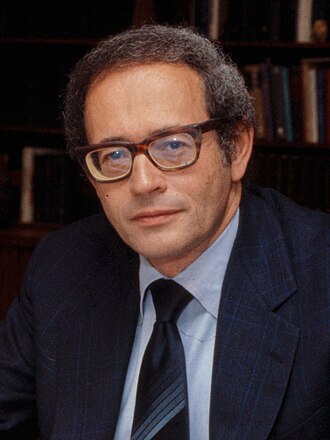
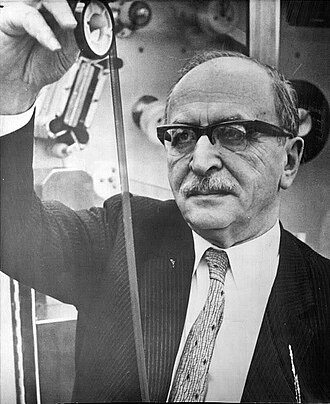
图:Bernard Gotfryd · Public domain · Wikimedia Commons
杰拉尔德·埃德尔曼1929—2014
Gerald Edelman
生物学家, 美国
杰拉尔德·埃德尔曼 是一位美国生物学家。由于关于免疫系统的研究,而获得了1972年的诺贝尔生理学或医学奖。
摘自维基百科「傑拉爾德·埃德爾曼」,CC BY-SA 4.0
- 出生
- 1929 年 7 月 1 日,皇后区
- 逝世
- 2014 年 5 月 17 日,拉霍亚
- 国籍
- 美国
- 学科
- 物理学、化学、生物学、医学、博物与综合
- 职业
- 免疫学家、神经学家、大学教师、神经科医生
- 母语 / 工作语言
- 英语
- 母校
- 乌尔辛纳斯学院、医学佩雷尔曼学院宾夕法尼亚大学、洛克菲勒大学
- 工作单位
- 洛克菲勒大学
研究领域
师承
博士导师1
博士生1
来自 Wikidata 的「博士导师」「师从」「博士生」「学生」记录,可能不全。
所获奖项(6)
- 1965Eli Lilly Award in Biological Chemistry
- 1972诺贝尔生理学或医学奖
- 1989巴黎第七大学名誉博士
- 1995honorary doctor of the University of Miami
- 1999Ariëns Kappers Medal
- 2003honorary doctorate of the University of La Coruña
学会与院士
百科正文
东京工业大学教授大隅良典曾受其指导。
以上内容摘自维基百科「傑拉爾德·埃德爾曼」,按 CC BY-SA 4.0 使用,去掉了参考文献、外部链接等尾部小节,公式改写成了纯文本。全文、配图和出处见原文。
英文维基百科补充中文条目比较短,下面是英文条目「Gerald Edelman」的原文
Gerald Maurice Edelman (; July 1, 1929 – May 17, 2014) was an American biologist who shared the 1972 Nobel Prize in Physiology or Medicine for work with Rodney Robert Porter on the immune system. Edelman's Nobel Prize-winning research concerned discovery of the structure of antibody molecules. In interviews, he has said that the way the components of the immune system evolve over the life of the individual is analogous to the way the components of the brain evolve in a lifetime. There is a continuity in this way between his work on the immune system, for which he won the Nobel Prize, and his later work in neuroscience and in philosophy of mind.
Early life and education
Gerald Edelman was born in 1929 in Ozone Park, Queens, New York, to Jewish parents, physician Edward Edelman, and Anna (née Freedman) Edelman, who worked in the insurance industry. He studied violin for years, but eventually realized that he did not have the inner drive needed to pursue a career as a concert violinist, and decided to go into medical research instead. He attended public schools in New York, graduating from John Adams High School, and then attended Ursinus College, where he graduated magna cum laude with a B.S. in 1950. He received an M.D. from the University of Pennsylvania School of Medicine in 1954.
Career
After a year at the Johnson Foundation for Medical Physics, Edelman became a resident at the Massachusetts General Hospital; he then practiced medicine in France while serving with US Army Medical Corps. In 1957, Edelman joined the Rockefeller Institute for Medical Research as a graduate fellow, working in the laboratory of Henry Kunkel and receiving a Ph.D. in 1960. The institute made him the assistant (later associate) dean of graduate studies; he became a professor at the school in 1966. In 1992, he moved to California and became a professor of neurobiology at The Scripps Research Institute.
Nobel Prize
While in Paris serving in the Army, Edelman read a book that sparked his interest in antibodies. He decided that, since the book said so little about antibodies, he would investigate them further upon returning to the United States, which led him to study physical chemistry for his 1960 Ph.D. Research by Edelman and his colleagues and Rodney Robert Porter in the early 1960s produced fundamental breakthroughs in the understanding of the antibody's chemical structure, opening a door for further study. For this work, Edelman and Porter shared the Nobel Prize in Physiology or Medicine in 1972.
In its Nobel Prize press release in 1972, the Karolinska Institutet lauded Edelman and Porter's work as a major breakthrough:
Theory of consciousness
In his later career, Edelman was noted for his theory of consciousness, documented in a trilogy of technical books and in several subsequent books written for a general audience, including Bright Air, Brilliant Fire (1992), A Universe of Consciousness (2001, with Giulio Tononi), Wider than the Sky (2004) and Second Nature: Brain Science and Human Knowledge (2007).
In Second Nature Edelman defines human consciousness as:
"... what you lose on entering a dreamless deep sleep... deep anesthesia or coma... what you regain after emerging from these states. [The] experience of a unitary scene composed variably of sensory responses... memories... situatedness..."
Evolution theory
Edelman and Gally were the first to point out the pervasiveness of degeneracy in biological systems and the fundamental role that degeneracy plays in facilitating evolution.
Later career
Edelman founded and directed The Neurosciences Institute, a nonprofit research center in San Diego that between 1993 and 2012 studied the biological bases of higher brain function in humans. He served on the scientific board of the World Knowledge Dialogue project.
Edelman was a member of the USA Science and Engineering Festival's advisory board.
Personal
Edelman married Maxine M. Morrison in 1950. They have two sons, Eric, a visual artist in New York City, and David, an adjunct professor of neuroscience at University of San Diego. Their daughter, Judith Edelman, is a bluegrass musician, recording artist, and writer. Some observers have noted that a character in Richard Powers' The Echo Maker may be a nod to Edelman.
Health and death
Later in his life, he developed prostate cancer and Parkinson's disease. Edelman died on May 17, 2014, in La Jolla, California, aged 84.
以上节选摘自英文维基百科「Gerald Edelman」,按 CC BY-SA 4.0 使用,去掉了参考文献、外部链接等尾部小节,公式改写成了纯文本。篇幅所限,较长的小节只摘了开头一部分,有的小节没有收;全文、配图和出处见原文。
同年获同一奖项
同一学科、同时代的科学家


同一学科的科学家
更多 ›