格物
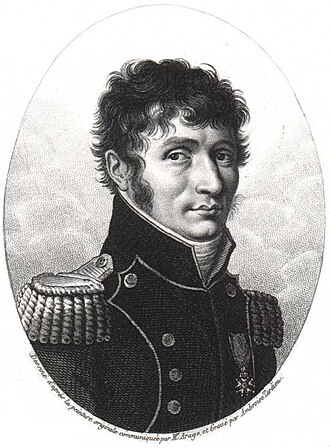
图:Public domain · Wikimedia Commons
- 出生
- 1775 年 7 月 23 日,巴黎
- 逝世
- 1812 年 2 月 24 日,巴黎
- 国籍
- 法国
- 学科
- 物理学、数学、工程与发明、博物与综合
- 职业
- 数学家、物理学家、战斗工兵
- 母语 / 工作语言
- 法语
- 母校
- 巴黎综合理工学院(1796 年)、梅济耶尔皇家工程学院(1793 年)、梅斯炮兵工程学校(1796 年)
- 工作单位
- 巴黎综合理工学院、法国军事(1793—1812)
研究领域
主要贡献
代表成就
师承
来自 Wikidata 的「博士导师」「师从」「博士生」「学生」记录,可能不全。
所获奖项(3)
- 1810伦福德奖
- 1810Grand prix des sciences mathématiques
- —埃菲尔铁塔上所刻的72人列表
学会与院士
百科正文
生平
马吕斯出生于法国巴黎。他参加了拿破仑的远征远征到埃及(1798年至1801年),是埃及研究所(Institut d'Egypte)的数学组成员之一。马吕士在1810年成为法国科学院的成员。在1810年伦敦皇家学会授予他拉姆福德奖章(Rumford Medal)。
他的数学工作几乎完全专注于光的研究。他研究的几何系统称为“光线系统”,与尤利乌斯·普吕克的线几何密切相关。他进行实验来加以验证克里斯蒂安·惠更斯的光学理论,以分析形式改写了理论。于1809年时出版了他发现的用反射机制制成偏振光的方法,在1810年出版了他的光在晶体里的双折射现象理论。
马吕斯试图找出偏振角度和反光材料的折射率这两个物理量之间的关系。虽然他正确地推断出对于水所表现出的关系,但是他不能对于玻璃给出这关系,这是因为提供给他的玻璃材料品质很低(当时大多数的玻璃会在表面和内部之间显示出变异的折射率)。 直到1815年大卫·布儒斯特先生才获得较好品质的玻璃进行测试,并正确地表述出其著名的布儒斯特定律。
马吕斯定律定量地给出偏振光通过检偏器后的辐照度,考虑到偏振方向与检偏器传输轴方向之间的夹角角度。
马吕斯定理是关于同源光经多次反射、折射后保持与波前垂直的定理。
马吕思对于偏振现象做出诸多贡献,后人尊称他为“偏振之父”。他的名字是艾菲尔铁塔题写的72个名字中的其中之一。
以上内容摘自维基百科「艾蒂安-路易·马吕斯」,按 CC BY-SA 4.0 使用,去掉了参考文献、外部链接等尾部小节,公式改写成了纯文本。全文、配图和出处见原文。
英文维基百科补充中文条目比较短,下面是英文条目「Étienne-Louis Malus」的原文
Étienne-Louis Malus (; French: [e.tjɛn.lwi ma.lys]; 23 July 1775 – 23 February 1812) was a French officer, engineer, physicist, and mathematician.
Malus was born in Paris, France and studied at the military engineering school at Mezires where he was taught by Gaspard Monge. He participated in Napoleon's expedition into Egypt (1798 to 1801). He was also a member of the mathematics section of the Institut d'Égypte. Malus became a member of the Académie des Sciences in 1810. In 1810 the Royal Society of London awarded him the Rumford Medal.
His mathematical work was almost entirely concerned with the study of light. He studied geometric systems called ray systems, closely connected to Julius Plücker's line geometry. He conducted experiments to verify Christiaan Huygens's theories of light and rewrote the theory in analytical form. His discovery of the polarization of light by reflection was published in 1809 and his theory of double refraction of light in crystals, in 1810.
Malus attempted to identify the relationship between the polarising angle of reflection that he had discovered, and the refractive index of the reflecting material. While he deduced the correct relation for water, he was unable to do so for glasses due to the low quality of materials available to him (the refractive index of most glasses available at that time varied between the surface and the interior of the glass). It was not until 1815 that Sir David Brewster was able to experiment with higher quality glasses and correctly formulate what is known as Brewster's law. This law was later explained theoretically by Augustin Fresnel, as a special case of his Fresnel equations.
Malus is probably best remembered for Malus's law, giving the resultant intensity, when a polariser is placed in the path of an incident beam. A follower of Laplace, both his statement of the Malus's law and his earlier works on polarisation and birefringence were formulated using the corpuscular theory of light.
His name is one of the 72 names inscribed on the Eiffel tower.
He had been in poor health for several years, partly due to illnesses contracted during Napoleon’s Egyptian campaign. By 1812, his tuberculosis had advanced, and he died in Paris at age 36.
"Discovery" of polarization
In 1810, Malus, while engaged on the theory of double refraction, casually examined through a doubly refracting prism of quartz the sunlight reflected from the windows of the Luxembourg palace. He was surprised to find that the two rays alternately disappeared as the prism was rotated through successive right angles, in other words, that the reflected light had acquired properties exactly corresponding to those of the rays transmitted through Iceland spar.
He named this phenomenon polarization, and thought it could not be explained by wave theory of light. Instead, he explained it by stating that light-corpuscules have polarity (like magnetic poles).
Work
Malus mathematically analyzed the properties of a system of continuous light rays in three dimensions. He found the equation of caustic surfaces and the Malus theorem: Rays of light that are emitted from a point source, after which they have been reflected on a surface, are all normal to a common surface, but after the second refraction they no longer have this property. If the perpendicular surface is identified with a wave front, it is obvious that this result is false, which Malus did not realize because he adhered to Newton's theory of light emission. Malus's theorem was not proved until 1824 by W. R. Hamilton, with Adolphe Quetelet and Joseph Diez Gergonne giving a separate proof in 1825.
以上内容摘自英文维基百科「Étienne-Louis Malus」,按 CC BY-SA 4.0 使用,去掉了参考文献、外部链接等尾部小节,公式改写成了纯文本。全文、配图和出处见原文。
同一学科、同时代的科学家






同一学科的科学家
更多 ›