格物

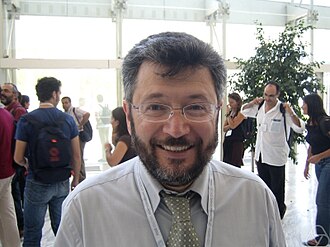
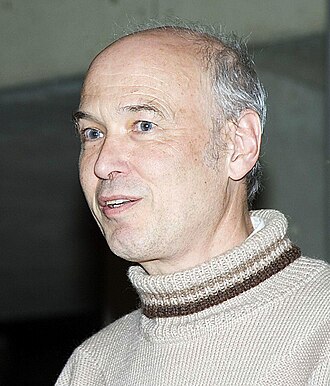
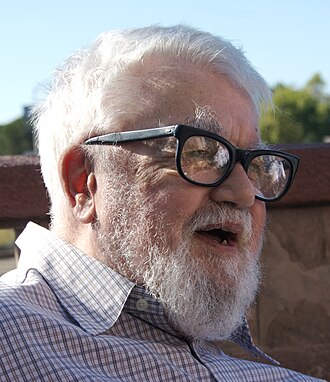
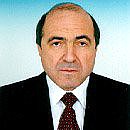
图:Brewster Kahle · Public domain · Wikimedia Commons
- 出生
- 1934 年 6 月 13 日,纽约
- 国籍
- 美国
- 学科
- 数学、计算机科学、工程与发明、博物与综合
- 职业
- 数学家、计算机科学家、教授
- 母语 / 工作语言
- 英语
- 母校
- 布朗克斯科学高级中学(高中文凭,1951 年)、纽约市立学院(Bachelor of Electrical Engineering,1957 年)、麻省理工学院(哲学博士,1963 年)
- 工作单位
- 加州大学洛杉矶分校
研究领域
师承
博士导师2
博士生36
学生1
来自 Wikidata 的「博士导师」「师从」「博士生」「学生」记录,可能不全。
所获奖项(14)
- 1976Frederick W. Lanchester Prize
- 1986马可尼奖
- 1990SIGCOMM Award
- 1996亨利·h·古德纪念奖
- 2000互联网奖章
- 2000ACM会士
- 2001查尔斯·斯塔克·德雷珀奖
- 2001大川奖
- 2007美国国家科学奖章
- 2010丹大卫奖
- 2012贝尔奖
- 2012互联网名人堂
- 2014BBVA基金会前沿奖
- —古根海姆学者奖
学会与院士
百科正文
英文维基百科补充中文条目比较短,下面是英文条目「Leonard Kleinrock」的原文
Leonard Kleinrock (born June 13, 1934) is an American computer scientist and Internet pioneer. He is Distinguished Professor Emeritus of Computer Science at UCLA's Henry Samueli School of Engineering and Applied Science. Kleinrock made several important contributions to the field of computer science, in particular to the mathematical foundations of data communication in computer networking. He has received numerous prestigious awards.
In the early 1960s, Kleinrock pioneered the application of queueing theory to model delays in message switching networks in his Ph.D. thesis, published as a book in 1964. In the late 1960s and 1970s, he played an influential role in the development of the ARPANET. In the 1970s, he applied queueing theory to model and measure the performance of packet switching networks and published several of the standard works on the subject. He supervised graduate students who worked on the communication protocols for the ARPANET including students whose later work on internetworking and the Internet protocol suite led to the networking technology employed in the Internet. His theoretical work on hierarchical routing in the late 1970s with student Farouk Kamoun remains critical to the operation of the Internet today.
Education and career
Leonard Kleinrock was born in New York City on June 13, 1934, to a Jewish family, and graduated from the noted Bronx High School of Science in 1951. He received a Bachelor of Electrical Engineering degree in 1957 from the City College of New York, and a master's degree and a doctorate (Ph.D.) in electrical engineering and computer science from the Massachusetts Institute of Technology (MIT) in 1959 and 1963 respectively. He then joined the faculty at the University of California at Los Angeles (UCLA), where he remains to the present day; during 1991–1995 he served as the chairman of the Computer Science Department there.
Achievements
Queueing theory
Kleinrock's best-known and most-significant work is on queueing theory, a major topic of applied mathematics that has applications in many fields. His thesis proposal in 1961, Information Flow in Large Communication Nets, led to a doctoral thesis at MIT in 1962, Message Delay in Communication Nets with Storage, later published as book in 1964, Communication Nets: Stochastic Message Flow and Delay. In this work, he researched the configuration and operation of communication networks, considering design parameters such as "channel capacity, effect of priority discipline, choice of routing procedure, and design of topological structure". He analyzed delays in Plan 55-A, a message switching system operated by Western Union for processing telegrams. His thesis went on to apply probability theory to model queueing delays in a generalized communication network.
Donald Davies, in his 1966 paper on packet switching, applied Kleinrock's techniques to show that "there is an ample margin between the estimated performance of the [packet-switched] system and the stated requirement" in terms of a satisfactory response time for a human user. This addressed a key question about the viability of computer networking.
Awards and recognition
Kleinrock made several important contributions to the field of computer science, in particular to the mathematical foundations of data communication in computer networking. He has received numerous professional awards. In 1980, he was elected a member of the National Academy of Engineering for pioneering contributions to the field and leadership as an educator in computer communications networks. In 2001 he received the Draper Prize "for the development of the Internet". He was elected to the 2002 class of Fellows of the Institute for Operations Research and the Management Sciences. Kleinrock was selected to receive the prestigious National Medal of Science, the nation's highest scientific honor, from President George W. Bush in the White House on September 29, 2008. "The 2007 National Medal of Science to Leonard Kleinrock for his fundamental contributions to the mathematical theory of modern data networks, and for the functional specification of packet switching, which is the foundation of Internet technology. His mentoring of generations of students has led to the commercialization of technologies that have transformed the world."
以上节选摘自英文维基百科「Leonard Kleinrock」,按 CC BY-SA 4.0 使用,去掉了参考文献、外部链接等尾部小节,公式改写成了纯文本。篇幅所限,较长的小节只摘了开头一部分,有的小节没有收;全文、配图和出处见原文。
同一学科、同时代的科学家



同一学科的科学家
更多 ›