格物
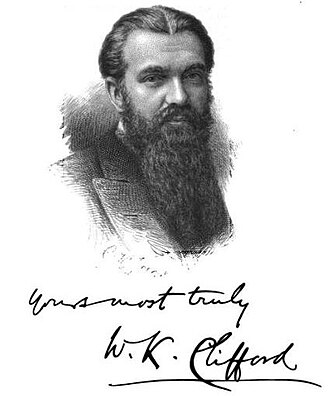
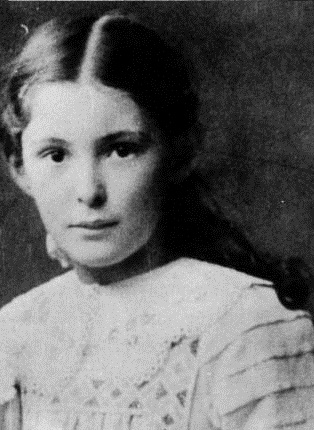
图:William Kingdon Clifford (editors Leslie Stephen and Fredick… · Public domain · Wikimedia Commons
- 出生
- 1845 年 5 月 4 日,埃克塞特
- 逝世
- 1879 年 3 月 3 日,马德拉岛
- 国籍
- 大不列颠及爱尔兰联合王国
- 学科
- 数学、博物与综合
- 职业
- 数学家、哲学家、大学教师
- 母语 / 工作语言
- 英语
- 母校
- 剑桥大学三一学院(1867 年)、伦敦国王学院(1863 年)、剑桥大学(博士,1868 年)
- 工作单位
- 伦敦大学学院(1871—1879)、剑桥大学三一学院(1868—1871)
研究领域
主要贡献
代表成就
师承
师从1
来自 Wikidata 的「博士导师」「师从」「博士生」「学生」记录,可能不全。
所获奖项(1)
- 1874英国皇家学会院士
学会与院士
百科正文
先后入读伦敦大学国王学院、剑桥大学三一学院。1867年,他在年终考试排第二。1871年,成为伦敦大学学院数学和力学教授,1874年成为英国皇家学会院士。1875年和小说家露西·蓝恩结婚。1876年,他工作过度,身体几乎崩溃,因为他白天忙着教学和管理事务,晚上又工作。他往阿尔及尼亚和西班牙度假。后来他到了马德拉,在那儿因肺结核逝世,终年34岁。11天后,爱因斯坦出生。
数学
受黎曼和罗巴切夫斯基的影响,他学习非欧几何。1870年,他写了On the space theory of matter,指出能量和物质只是空间类型不同的曲率。这些想法是爱因斯坦的广义相对论的基础。
克利福德推广了复数和四元数的概念,即复四元数。他又曾对双曲复数进行研究,称之为motor。
他对泛代数和椭圆函数都很有兴趣。他亦发表了几篇关于代数形式和射影几何的论文。
以上内容摘自维基百科「威廉·金頓·克利福德」,按 CC BY-SA 4.0 使用,去掉了参考文献、外部链接等尾部小节,公式改写成了纯文本。全文、配图和出处见原文。
英文维基百科补充中文条目比较短,下面是英文条目「William Kingdon Clifford」的原文
William Kingdon Clifford (4 May 1845 – 3 March 1879) was a British mathematician and philosopher. Building on the work of Hermann Grassmann, he introduced what is now termed geometric algebra. This is a special case of what later became known as the Clifford algebra, which was named in his honour. The operations of geometric algebra have the effect of mirroring, rotating, translating, and mapping the geometric objects that are being modelled to new positions. Clifford algebras in general and geometric algebra in particular have been of ever increasing importance to mathematical physics, geometry, and computing. Clifford was the first to suggest that gravitation might be a manifestation of an underlying geometry. In his philosophical writings he coined the expression mind-stuff.
Biography
Born in Exeter, William Clifford was educated at Doctor Templeton's Academy on Bedford Circus and showed great promise at school. He went on to King's College London (at age 15) and Trinity College, Cambridge, where he was elected fellow in 1868, after being Second Wrangler in 1867 and second Smith's prizeman. In 1870, he was part of an expedition to Italy to observe the solar eclipse of 22 December 1870. During that voyage he survived a shipwreck along the Sicilian coast.
In 1871, he was appointed professor of mathematics and mechanics at University College London, and in 1874 became a fellow of the Royal Society. He was also a member of the London Mathematical Society and the Metaphysical Society.
Clifford married Lucy Lane on 7 April 1875, with whom he had two children. Lucy Clifford was an accomplished novelist, playwright, and journalist.
Mathematics
"Clifford was above all and before all a geometer."
The discovery of non-Euclidean geometry opened new possibilities in geometry in Clifford's era. The field of intrinsic differential geometry was born, with the concept of curvature broadly applied to space itself as well as to curved lines and surfaces. Clifford was very much impressed by Bernhard Riemann’s 1854 essay "On the hypotheses which lie at the bases of geometry". In 1870, he reported to the Cambridge Philosophical Society on the curved space concepts of Riemann, and included speculation on the bending of space by gravity. Clifford's translation of Riemann's paper was published in Nature in 1873. The report of his 1870 talk at Cambridge was published in 1876, anticipating Albert Einstein's general relativity by 40 years. Clifford elaborated elliptic space geometry as a non-Euclidean metric space.
Philosophy
As a philosopher, Clifford's name is chiefly associated with two phrases of his coining, mind-stuff and the tribal self. The former symbolizes his metaphysical conception, suggested to him by his reading of Baruch Spinoza, which Clifford (1878) defined as follows:
That element of which, as we have seen, even the simplest feeling is a complex, I shall call Mind-stuff. A moving molecule of inorganic matter does not possess mind or consciousness; but it possesses a small piece of mind-stuff. When molecules are so combined together as to form the film on the under side of a jelly-fish, the elements of mind-stuff which go along with them are so combined as to form the faint beginnings of Sentience.
Premonition of relativity
Though Clifford never constructed a full theory of spacetime and relativity, there are some remarkable observations he made in print that foreshadowed these modern concepts:
In his book Elements of Dynamic (1878), he introduced "quasi-harmonic motion in a hyperbola". He wrote an expression for a parametrized unit hyperbola, which other authors later used as a model for relativistic velocity. Elsewhere he states:
The geometry of rotors and motors…forms the basis of the whole modern theory of the relative rest (Static) and the relative motion (Kinematic and Kinetic) of invariable systems.
This passage makes reference to biquaternions, though Clifford made these into split-biquaternions as his independent development.
The book continues with a chapter "On the bending of space", the substance of general relativity. Clifford also discussed his views in On the Space-Theory of Matter in 1876.
Collections
University College London holds a portfolio of Clifford's mathematical fragments.
以上节选摘自英文维基百科「William Kingdon Clifford」,按 CC BY-SA 4.0 使用,去掉了参考文献、外部链接等尾部小节,公式改写成了纯文本。篇幅所限,较长的小节只摘了开头一部分,有的小节没有收;全文、配图和出处见原文。
同一学科、同时代的科学家


同一学科的科学家
更多 ›