格物
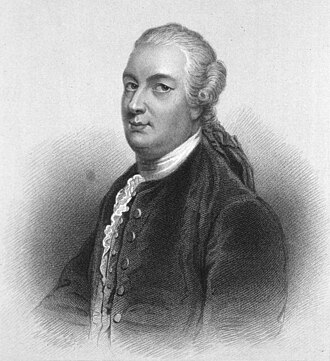
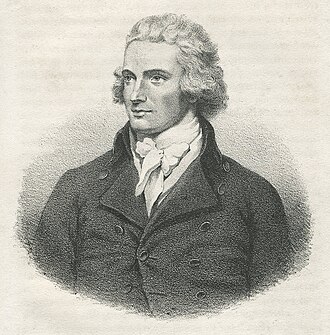
图:Samuel Freeman / David Martin · Public domain · Wikimedia Commons
- 出生
- 1730 年 12 月 14 日,斯特灵
- 逝世
- 1794 年 4 月 27 日,斯特灵
- 国籍
- 大不列颠王国
- 学科
- 生物学、天文学、博物与综合
- 职业
- 探险家、考古学家、植物学家、天文学家
- 母语 / 工作语言
- 英语
- 母校
- 爱丁堡大学、哈罗公学
研究领域
主要贡献
代表成就
所获奖项(1)
- —英国皇家学会院士
学会与院士
百科正文
本条目暂无中文维基百科条目,下面是英文维基百科原文。
James Bruce of Kinnaird (14 December 1730 – 27 April 1794) was a Scottish traveller and travel writer who physically confirmed the source of the Blue Nile. He spent more than a dozen years in North and East Africa and in 1770 became the first European to trace and document the course of the Nile by following it upstream from Egypt through Sudan to its origins in the Blue Nile in Ethiopia.
Early life
James Bruce was born at the family seat of Kinnaird, Stirlingshire, and educated at Harrow School and Edinburgh University. He began to study for the bar, but his marriage to the daughter of a wine importer and merchant resulted in him entering that business instead. His wife died in October 1754, within nine months of marriage, and Bruce thereafter travelled in Portugal and Spain as part of the wine trade. The examination of oriental manuscripts at the Escorial in Spain led him to the study of Arabic and Geʽez and determined his future career. In 1758, his father's death placed him in possession of the estate of Kinnaird.
To North Africa
On the outbreak of war with Spain in 1762, he submitted to the British government a plan for an attack on Ferrol. His suggestion was not adopted, but it led to his selection by the 2nd Earl of Halifax for the post of British consul at Algiers, with a commission to study the ancient ruins in that country, in which interest had been excited by the descriptions sent home by Thomas Shaw (1694–1751), who was consular chaplain at Algiers. Having spent six months in Italy studying antiquities, Bruce reached Algiers in March 1763. The whole of his time was taken up with his consular duties at the piratical court of the dey, and he was kept without the assistance promised. But in August 1765, a successor in the consulate having arrived, Bruce began his exploration of the Roman ruins in Barbary.
The Nile and Ethiopia
In June 1768, he arrived at Alexandria, having resolved to endeavour to discover the source of the Nile, which he believed to rise in Ethiopia. At Cairo, he gained the support of the Mamluk ruler, Ali Bey. After visiting Thebes, where he entered the tomb of Ramesses III, KV11, he crossed the desert to Kosseir, where he embarked in the dress of a Turkish sailor. After an extensive navigation of the Red Sea in a local vessel, he reached Jidda in May 1769, and after a stay in Arabia he recrossed the Red Sea and landed at Massawa, then nominally in possession of the Turks, but actually controlled by the local Na'ib, on 19 September. He reached Gondar, then the capital of Ethiopia on 14 February 1770, where he was well received by the Emperor Tekle Haymanot II, Ras Mikael Sehul, the real ruler of the country, Weizero Aster, wife of the Ras (whom Bruce calls "Esther"), and all Ethiopians generally.
His return
Setting out from Gondar in December 1771, Bruce made his way, in spite of enormous difficulties, by Sennar to Nubia, being the first European to trace the Blue Nile to its confluence with the White Nile. He was detained in Al Qadarif (which he calls "Teawa") by its governor Fidele, until a combination of cunning, diplomacy and a show of force by his friend the Ethiopian governor of "Ras el Fils" (Ras Filuk) induced Fidele to release him. Once in Sennar he found himself detained there, and on the night of 25 August the house he was staying in was attacked by thieves, whom Bruce for good reason suspected to be acting with the knowledge, if not on the orders of King Ismai'l.
His Travels
In retirement, Bruce devoted himself to the management of his estate and the oversight of his collieries. In May 1776, he married Mary Dundas, the daughter of a neighbour, with whom he had three children. After his wife's early death in 1785, and at the urging of his friend Daines Barrington, he embarked on writing up his travels, which were published in five quarto volumes (totalling 3,000 pages) as Travels to Discover the Source of the Nile. The book was very successful, selling very well and being favourably reviewed in the monthly journals, but was assailed by other travellers as being unworthy of credence. The substantial accuracy of his Ethiopian travels has since been demonstrated, and it is considered that he made a real addition to the geographical knowledge of his day.
Freemasonry
Bruce was a Scottish Freemason. He was Initiated in Lodge Canongate Kilwinning, No. 2, on 1 August 1753. The Lodge history, which details his Initiation in the Lodge reads: 'Bruce, James, Younger of Kinnaird – the Abyssinian Traveller.'
Death
In his final years, Bruce became very corpulent. He died on 27 April 1794 of injuries sustained when on the previous day he fell down stairs at Kinnaird House. He was buried behind his wife in the Larbert old churchyard. The highly unusual monument was made out of cast iron by the local Carron Ironworks and stands on the south east corner of the churchyard.
Legacy
Bruce's Travels were published in a second edition (1804–05) and a third (1813), both edited from Bruce's papers by Alexander Murray, who also wrote a valuable contemporary biography of Bruce (1808).
Several of Bruce's drawings were presented to King George III and are in the royal collection at Windsor Castle. According to Edward Ullendorff, "There is little doubt that those volumes contain the pick of Bruce's work, and when they were shown, in 1862, by permission of Queen Victoria, to the Society of Antiquaries, all who saw them were greatly impressed."
Bruce also brought back to Europe a select collection of Ethiopian manuscripts. "They opened up entirely new vistas for the study of Ethiopian languages and placed this branch of Oriental scholarship on a much more secure basis," writes Ullendorff. "It is not known how many MSS.
Editions of his book
Travels to Discover the Source of the Nile, In the Years 1768, 1769, 1770, 1771, 1772 and 1773. Five Volumes, G.G.J. and J. Robinson, London, 1790.
Travels, ed. Alexander Murray. Seven volumes, London: 1805 and 1813.
Bruce, James, Travels. Abridged edition. Horizon Press, New York, 1964.
Travels to discover the source of the Nile. 1 [fre]. 1790.
Travels to discover the source of the Nile. 2 [fre]. 1790.
Travels to discover the source of the Nile. 3 [fre]. 1790.
Travels to discover the source of the Nile. 4 [fre]. 1791.
Travels to discover the source of the Nile. 5 [fre]. 1791.
Travels to discover the source of the Nile. 6 [fre]. 1791.
Travels to discover the source of the Nile. 7 [fre]. 1791.
Travels to discover the source of the Nile. 9 [fre]. 1791.
Travels to discover the source of the Nile. 12 [fre]. 1791.
Travels to discover the source of the Nile. 13 [fre]. 1792.
以上节选摘自英文维基百科「James Bruce」,按 CC BY-SA 4.0 使用,去掉了参考文献、外部链接等尾部小节,公式改写成了纯文本。篇幅所限,较长的小节只摘了开头一部分,有的小节没有收;全文、配图和出处见原文。
同一学科、同时代的科学家




同一学科的科学家
更多 ›