格物
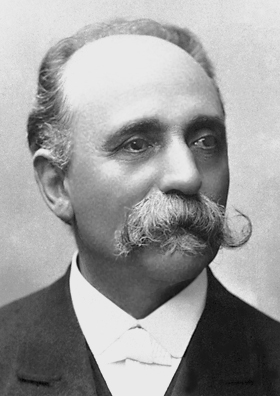
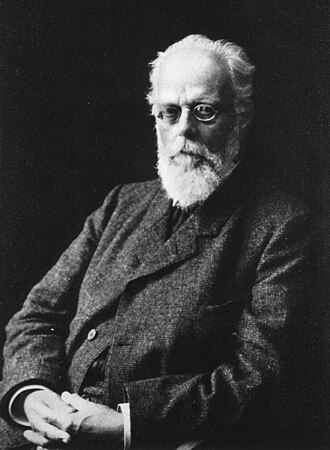
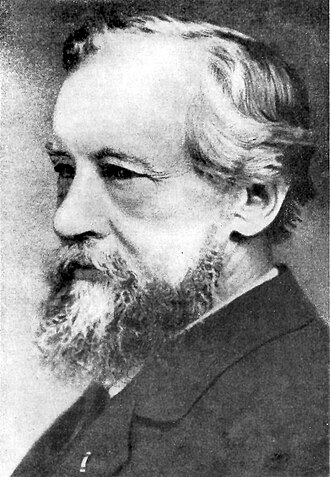
图:作者不详 · Public domain · Wikimedia Commons
卡米洛·高尔基1843—1926
Camillo Golgi
细胞生物学家, 意大利王国
卡米洛·高尔基,是一位意大利医师与科学家,高尔基体的发现者,出生于布雷西亚。1906年因为神经系统的研究,而与西班牙的圣地亚哥·拉蒙-卡哈尔共同获得诺贝尔生理学或医学奖。于1898年发现高尔基体,主要功能为处理细胞膜、溶酶体或内体与细胞生产的蛋白质,将它们分到不同的小泡,是细胞的中心传送系统。
摘自维基百科「卡米洛·高尔基」,CC BY-SA 4.0
- 出生
- 1843 年 7 月 7 日,科尔泰诺戈尔吉
- 逝世
- 1926 年 1 月 21 日,帕维亚
- 国籍
- 意大利王国、撒丁王国、奥地利帝国
- 学科
- 生物学、医学、博物与综合
- 职业
- 细胞生物学家、医生、神经科医生、教授
- 母语 / 工作语言
- 意大利语
- 母校
- Ugo Foscolo - Pavia、帕维亚大学(桂冠学士,1865 年)
- 工作单位
- 锡耶纳大学(1876—)、帕维亚大学(1876—1918)
研究领域
师承
博士导师1
博士生1
学生1
来自 Wikidata 的「博士导师」「师从」「博士生」「学生」记录,可能不全。
所获奖项(3)
- 1906诺贝尔生理学或医学奖
- 1923doctor honoris causa from the University of Paris
- —Pour le Mérite for Sciences and Arts order
学会与院士
百科正文
英文维基百科补充中文条目比较短,下面是英文条目「Camillo Golgi」的原文
Camillo Golgi (, Italian: [kaˈmilːo ˈɡɔldʒi]; 7 July 1843 – 21 January 1926) was an Italian biologist and pathologist who was awarded the 1906 Nobel Prize in Physiology or Medicine for his works on the central nervous system. He studied medicine at the University of Pavia (where he later spent most of his professional career) between 1860 and 1868 under the tutelage of Cesare Lombroso. Inspired by pathologist Giulio Bizzozero, he pursued research in the nervous system. His discovery of a staining technique called black reaction (sometimes called Golgi's method or Golgi's staining in his honour) in 1873 was a major breakthrough in neuroscience. Several structures and phenomena in anatomy and physiology are named for him, including the Golgi apparatus, the Golgi tendon organ and the Golgi tendon reflex.
Golgi and the Spanish biologist Santiago Ramón y Cajal were jointly awarded the Nobel Prize in Physiology or Medicine in 1906 "in recognition of their work on the structure of the nervous system".
Biography
Camillo Golgi was born on 7 July 1843 in the village of Corteno near Brescia, in the province of Brescia (Lombardy), at the time Kingdom of Lombardy–Venetia, today Italy. The village is now named Corteno Golgi in his honour. He was the son of Alessandro and Carolina Golgi, and his father was a physician and district medical officer, originally from Pavia. In 1860, he entered the University of Pavia to study medicine, and earned his medical degree in 1865. He did an internship at the San Matteo Hospital (now IRCCS Policlinico San Matteo Foundation). During his internship he briefly worked as a civil physician in the Italian Army, and as assistant surgeon at the Novara Hospital (now Azienda Ospedaliero Universitaria Maggiore della Carità di Novara). At the same time he was also involved in the medical team for investigating cholera epidemic in villages around Pavia.
In 1867, he resumed his academic study under the supervision of Cesare Lombroso.
Contributions
Black reaction or Golgi's staining
The central nervous system was difficult to study during Golgi's time because the cells were hard to identify. The available tissue staining techniques were useless for studying nervous tissue. While working as chief medical officer at the Hospital of the Chronically Ill, he experimented with metal impregnation of nervous tissue, using mainly silver (silver staining). In early 1873, he discovered a method of staining nervous tissue that would stain a limited number of cells at random in their entirety. He first treated the tissue with potassium dichromate to harden it, and then with silver nitrate. Under the microscope, the outline of the neuron became distinct from the surrounding tissue and cells. The silver chromate precipitate, as a reaction product, selectively stains only some cellular components randomly, sparing other cell parts.
Awards and legacy
In 1903, Golgi was named an honorary member of the American Association for Anatomy.
Golgi, together with Santiago Ramón y Cajal, received the Nobel Prize in Physiology or Medicine in 1906 for his studies of the structure of the nervous system. Prior to the work that earned Cajal and Golgi their prize, there was a debate over how nerve impulses were conducted in the brain. One camp thought that neurons fused (between axon terminals of cell #1 and dendrites of cell #2), so that the brain essentially became one contiguous cell, a superneuron; this would result in a syncytium, forming the basis of the obsolete reticular theory. The other camp thought that neurons didn't fuse, but met in very close proximity, and this was called the neuron doctrine. Resolution of the cellular components at the point of interaction between cells was impossible at the time, and would only become possible much later with the invention of the electron microscope in the 1950s.
Eponyms
- The organelle Golgi apparatus or Golgi complex
- The sensory receptor Golgi tendon organ
- Golgi's method or Golgi stain, a nervous tissue staining technique
- The enzyme Golgi alpha-mannosidase II
- Golgi cells of the cerebellum
- Golgi I nerve cells (with long axons)
- Golgi II nerve cells (with short or no axons)
- Golgi (crater), a lunar impact crater
Minor planet 6875 Golgi is named after him.
以上节选摘自英文维基百科「Camillo Golgi」,按 CC BY-SA 4.0 使用,去掉了参考文献、外部链接等尾部小节,公式改写成了纯文本。篇幅所限,较长的小节只摘了开头一部分,有的小节没有收;全文、配图和出处见原文。
同年获同一奖项
同一学科、同时代的科学家

同一学科的科学家
更多 ›