格物
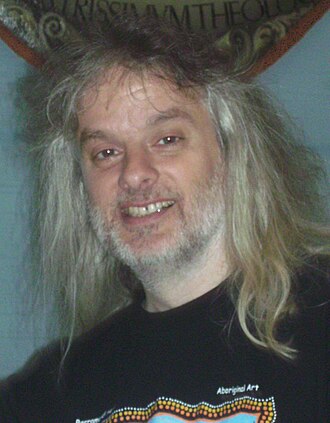
图:HerbertErwin · CC BY-SA 3.0 · Wikimedia Commons
- 出生
- 1966 年 4 月 20 日,悉尼
- 国籍
- 澳大利亚
- 学科
- 博物与综合
- 职业
- 哲学家、大学教师、学者
- 母语 / 工作语言
- 英语
- 母校
- 牛津大学林肯学院、阿德莱德大学、印第安纳大学、印第安纳大学布卢明顿分校
- 工作单位
- 纽约大学、澳大利亚国立大学、亚利桑那大学
研究领域
师承
博士导师2
来自 Wikidata 的「博士导师」「师从」「博士生」「学生」记录,可能不全。
所获奖项(5)
- 1987罗德奖学金
- 2007Barwise Prize
- 2015冉尼科德奖
- 2024Corresponding Fellow of the British Academy
- —美国文理科学院院士
学会与院士
百科正文
哲学贡献
心灵哲学
构想困难问题。
论证解释鸿沟不是客观而是主观的。
立场是自然主义二元论。
语言哲学
二维主义,反对索尔·阿伦·克里普克。
关于语词上争议的哲学
最近的作品关注语词争议。
以上内容摘自维基百科「戴维·查尔莫斯」,按 CC BY-SA 4.0 使用,去掉了参考文献、外部链接等尾部小节,公式改写成了纯文本。全文、配图和出处见原文。
英文维基百科补充中文条目比较短,下面是英文条目「David Chalmers」的原文
David John Chalmers (; born 20 April 1966) is an Australian philosopher and cognitive scientist, specializing in philosophy of mind and philosophy of language. He is a professor of philosophy and neural science at New York University (NYU), as well as co-director of NYU's Center for Mind, Brain and Consciousness (along with Ned Block). In 2006, he was elected a fellow of the Australian Academy of the Humanities. In 2013, he was elected as a fellow of the American Academy of Arts and Sciences.
Chalmers is best known for formulating the hard problem of consciousness, and for popularizing the philosophical zombie thought experiment.
Chalmers and David Bourget co-founded PhilPapers; a database of journal articles for philosophers.
Early life and education
David Chalmers was born in Sydney, New South Wales, and subsequently grew up in Adelaide, South Australia, where he attended Unley High School.
As a child, he experienced synesthesia. He began coding and playing computer games at the age of 10 on a PDP-10 at a medical center. He also performed exceptionally in mathematics, and secured a bronze medal in the International Mathematical Olympiad. When Chalmers was 13, he read Douglas Hofstadter's 1979 book Gödel, Escher, Bach, which awakened an interest in philosophy.
Chalmers received his undergraduate degree in pure mathematics from the University of Adelaide. After graduating, Chalmers spent six months reading philosophy books while hitchhiking across Europe, before continuing his studies at the University of Oxford, where he was a Rhodes Scholar but eventually withdrew from the course.
In 1993, Chalmers received his PhD in philosophy and cognitive science from Indiana University Bloomington under Douglas Hofstadter, writing a doctoral thesis entitled Toward a Theory of Consciousness.
Career
In 1994, Chalmers presented a lecture at the inaugural Toward a Science of Consciousness conference. According to the Chronicle of Higher Education, this "lecture established Chalmers as a thinker to be reckoned with and goosed a nascent field into greater prominence." He went on to co-organize the conference (renamed "The Science of Consciousness") for some years with Stuart Hameroff, but stepped away when he felt it became too divergent from mainstream science. Chalmers is a founding member of the Association for the Scientific Study of Consciousness and one of its past presidents.
Having established his reputation, Chalmers received his first professorship at UC Santa Cruz, from August 1995 to December 1998. In 1996 he published the widely cited book The Conscious Mind. Chalmers was subsequently appointed Professor of Philosophy (1999–2004) and then Director of the Center for Consciousness Studies (2002–2004) at the University of Arizona.
Philosophical work
Philosophy of mind
Chalmers is best known for formulating what he calls the "hard problem of consciousness", in both his 1995 paper "Facing Up to the Problem of Consciousness" and his 1996 book The Conscious Mind. He makes a distinction between "easy" problems of consciousness, such as explaining object discrimination or verbal reports, and the single hard problem, which could be stated "why does the feeling which accompanies awareness of sensory information exist at all?" The essential difference between the (cognitive) easy problems and the (phenomenal) hard problem is that the former are at least theoretically answerable via the dominant strategy in the philosophy of mind: physicalism. Chalmers argues for an "explanatory gap" from the objective to the subjective, and criticizes physicalist explanations of mental experience, making him a dualist. Chalmers characterizes his view as "naturalistic dualism": naturalistic because he believes mental states supervene "naturally" on physical systems (such as brains); dualist because he believes mental states are ontologically distinct from and not reducible to physical systems.
Personal life
Regarding religion, Chalmers said in 2011: "I have no religious views myself and no spiritual views, except watered-down humanistic spiritual views. And consciousness is just a fact of life. It's a natural fact of life".
As of 2012 Chalmers was the lead singer of the Zombie Blues band, which performed at the music festival Qualia Fest in 2012 in New York.
以上节选摘自英文维基百科「David Chalmers」,按 CC BY-SA 4.0 使用,去掉了参考文献、外部链接等尾部小节,公式改写成了纯文本。篇幅所限,较长的小节只摘了开头一部分,有的小节没有收;全文、配图和出处见原文。