格物
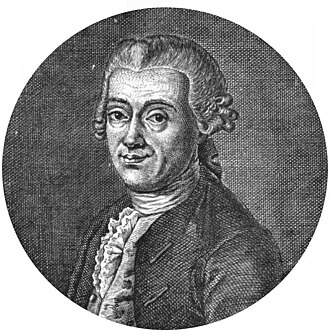
图:Public domain · Wikimedia Commons
- 出生
- 1729 年 1 月 2 日,霍伊尼采
- 逝世
- 1796 年 12 月 11 日,维滕贝格
- 国籍
- 普鲁士王国
- 学科
- 物理学、生物学、数学、天文学、博物与综合
- 职业
- 天文学家、物理学家、数学家、大学教师
- 母语 / 工作语言
- 德语
- 母校
- 莱比锡大学
- 工作单位
- 莱比锡大学、维滕贝格大学、哈雷-维滕贝格大学
主要贡献
以他 / 她命名
师承
博士导师1
博士生6
来自 Wikidata 的「博士导师」「师从」「博士生」「学生」记录,可能不全。
百科正文
生平
约翰·丹尼尔·提丢斯出生于皇家普鲁士科尼茨(霍伊尼采),父亲是雅各布·蒂茨,一位科尼茨的商人和议员,母亲是玛丽亚·多萝西娅。
约翰·丹尼尔·提丢斯的原名是约翰·蒂茨 (Johann Tietz),但按照18世纪的习俗,当他成为大学教授时,他将自己的姓氏拉丁化为 提丢斯(Titius)。约翰·在但泽(格但斯克)上学,并在莱比锡大学学习(1749-1752年)。
提丢斯-波德定律
他最著名的成就是提出提丢斯-波德定律,并利用这条定律预测了距离太阳2.8个天文单位的天体,导致了1801年,朱塞普·皮亚齐发现谷神星。1766年,他将自己对行星距离的观察结果融入查尔斯·博内 (Charles Bonnet) 的《自然沉思录》 (Contemplation de la Nature)的德文译本中,发明提丢斯定律。由于提丢斯定律,前四颗小行星最初被标记为行星。经过十五年的中断,其他小行星开始以稳定增加的速度被天文学家发现,谷神星最终被重新标记为小行星。谷神星自2006年以来已升级为矮行星。
小行星1998和月球上提丢斯环形山以他的名字命名。
以上内容摘自维基百科「約翰·丹尼爾·提丟斯」,按 CC BY-SA 4.0 使用,去掉了参考文献、外部链接等尾部小节,公式改写成了纯文本。全文、配图和出处见原文。
英文维基百科补充中文条目比较短,下面是英文条目「Johann Daniel Titius」的原文
Johann Daniel Titius (born Johann Daniel Tietz(e), 2 January 1729 – 16 December 1796) was a German astronomer and a professor at Wittenberg.
Titius was born in Konitz (Chojnice), Royal Prussia (Crown of Poland) to Jakob Tietz, a merchant and council member from Konitz, and Maria Dorothea, née Hanow. His original name was Johann Tietz, but as was customary in the 18th century, when he became a university professor, he Latinized his surname to Titius. Tietz attended school in Danzig (Gdańsk) and studied at the University of Leipzig (1749–1752). He died in Wittenberg, Electorate of Saxony.
Astronomy
He is best known for formulating the Titius–Bode law, and for using this rule to predict the existence of a celestial object at 2.8 AU from the sun which led to the 1801 discovery of what we now know as Ceres. He drew up the law in 1766, when he inserted his mathematical observation on planetary distances into a German translation of Charles Bonnet's book Contemplation de la Nature. In part because of this law, the first four minor planets were at first labeled as full-fledged planets. After a fifteen-year hiatus, other minor planets started to be discovered at steadily increasing rates, and Ceres and company were eventually relabeled as minor planets or asteroids. Because of its spherical shape, Ceres has had upgraded status as a dwarf planet since 2006.
The asteroid 1998 Titius and the crater Titius on the Moon are named in his honour.
Physics
Titius published a number of works on other areas in physics, such as a set of conditions and rules for performing experiments, and he was particularly focused in thermometry. In 1765 he presented a survey of thermometry up to that date. He wrote about the metallic thermometer constructed by Hanns Loeser. In his treatises on both theoretical and experimental physics, he incorporated the findings of other scientists, such as the descriptions of experiments written by Georg Wolfgang Kraft in 1738.
Biology
Titius was also active in biology, particularly in classification of organisms and minerals. His biological work was influenced by Linnaeus. Lehrbegriff der Naturgeschichte Zum ersten Unterrichte, his most extensive publication in biology, was on systematic classification of plants, animals, and minerals, as well as the elemental substances ether, fire, air, water and earth.
以上内容摘自英文维基百科「Johann Daniel Titius」,按 CC BY-SA 4.0 使用,去掉了参考文献、外部链接等尾部小节,公式改写成了纯文本。全文、配图和出处见原文。
同一学科、同时代的科学家




同一学科的科学家
更多 ›