格物
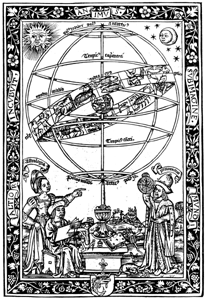
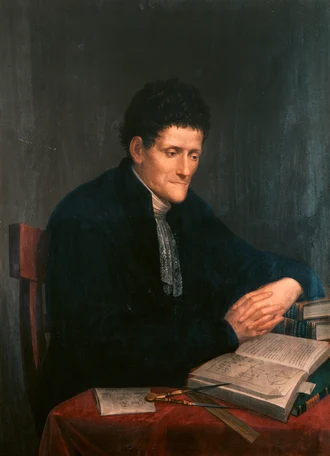
图:Public domain · Wikimedia Commons
格奥尔格·冯·波伊尔巴赫1423—1461
Georg von Peuerbach
Austrian mathematician and astronomer (1423-1461)
Georg von Peuerbach was an Austrian astronomer, poet, mathematician and instrument maker, best known for his streamlined presentation of Ptolemaic astronomy in the Theoricae Novae Planetarum. Peuerbach was instrumental in making astronomy, mathematics and literature simple and accessible for Europeans during the Renaissance and beyond.
摘自英文维基百科「Georg von Peuerbach」(英文维基百科,暂无中文条目),CC BY-SA 4.0
- 出生
- 1423 年 5 月 30 日,派尔巴赫
- 逝世
- 1461 年 4 月 8 日,维也纳
- 学科
- 数学、天文学、博物与综合
- 职业
- 天文学家、数学家、大学教师
- 母语 / 工作语言
- 拉丁语
- 母校
- 维也纳大学
- 工作单位
- 维也纳大学
研究领域
主要贡献
代表成就
师承
博士生1
来自 Wikidata 的「博士导师」「师从」「博士生」「学生」记录,可能不全。
百科正文
本条目暂无中文维基百科条目,下面是英文维基百科原文。
Biography
Peuerbach's life remains relatively unknown until he enrolled at the University of Vienna in 1446. He was born in the Austrian town of Peuerbach in upper Austria. A horoscope published eighty-nine years after his death places his date of birth specifically on 30 May 1423, though other evidence only indicates that he was born sometime after 1421. He received his Bachelor of Arts in 1448.
Peuerbach's intellect was discovered by a priest of his hometown, Dr. Heinrich Barucher. Dr. Barucher recognized Peuerbach's academic abilities from a young age and put him in contact with the Augustinian provost of Klosterneuburg Monastery, Georg Muestinger. Georg Muestinger taught a course at the University of Vienna entitled Theoricae Planetarum. These lectures were the first that Georg von Peuerbach attended at the University of Vienna and inspired him to enroll.
During his time at University of Vienna, Peuerbach received a master of philosophy in 1446 and a second master's degree in 1448, studying mathematics under the guidelines of Johann von Gmünden. His curriculum was composed primarily of humanities courses, as was usual at the time. His knowledge of astronomy derived from independent study, possibly from studying under followers of John von Gmünden. During his enrollment, there were no professors of astronomy at the University of Vienna. However, under his tutelage astronomic studies emerged at the University of Vienna throughout the 15th and 16th centuries.
Peuerbach observed the occultation of Jupiter by the Moon in 1451, signifying the beginning of his personal astronomy career. After this point Peuerbach essentially devoted his life to astronomy, developing tools and theories, and collaborating with his pupil Regiomontanus (Johannes Müller von Königsberg) to make astrology more digestible to common people. Majority of Georg's astrological discoveries were made in the last ten years of his life.
Georg Peuerbach traveled through central and southern Europe, most notably in Italy, giving lectures on astronomy.
Work
Peuerbach is best-known for his work Theoricae Novae Planetarum, written in 1454, and published by his disciple Regiomontanus in 1472. Theoricae Novae Planetarum presented a version of Claudius Ptolemy geocentric system in a more colloquial and comprehensible way. Based on a series of Peuerbach's lectures at Bürgerschule in Vienna that were transcribed by Regiomontanus. The book introduced the "New Planetary Theory of Georg von Peuerbach" based on the already successful Ptolemaic system, this new theory presented the physical realities of eccentric planetary spheres. In his model of the sun Peuerbach removed simple eccentric shells and added partial orbs, some of which were eccentric and some concentric to the center of the world. Similar models for the planets replaced the body of the sun with an epicycle sphere carrying each planet.
Peuerbach's ideas replaced Theorica Planetarum Communis, a work credited to Gerardus Cremonensis, as the standard university text on astronomy and was studied by many influential astronomers including Nicolaus Copernicus and Johannes Kepler.
In 1457 Peuerbach observed an eclipse and noted that it had occurred 8 minutes earlier than had been predicted by the Alphonsine Tables, the best available astronomical tables at the time. He then computed his own set of eclipse tables, the Tabulae Eclipsium. Widely read in manuscript form beginning around 1459 and formally published in 1514, these tables remained highly influential for many years.
Peuerbach wrote various papers on practical mathematics and constructed various astronomical instruments. Most notably, he computed sine tables based on techniques developed by Islamicate mathematicians. Peuerbach's work was instrumental in establishing a more modern understanding of mathematics.
In 1460, Cardinal Johannes Bessarion, while visiting Frederick's court seeking assistance in a crusade to reclaim Constantinople from the Turks, proposed that Peuerbach and Regiomontanus create a new translation of Ptolemy's Almagest from the original Greek.
Accomplishments
In February 1453, Georg Von Peuerbach was awarded with the Magister Artium in Vienna.
Peuerbach began the translation of Ptolemy's Almagest from Greek into Latin, a task which was completed and published by his student Regiomontanus in 1496.
Expanded the Astronomy program at the University of Vienna.
Influenced many other European astrological and astronomical discoveries with his observations and ideologies
Legacy
Georg von Peuerbach's work outlives him because of his ability to communicate astronomy, mathematics and art. His contributions simplified seeming difficult ideas, making them more digestible and inspiring critical thought. Through his tutelage he was able to create an astronomy program at his alma mater, further expanding the understanding of astronomy.
Peuerbach's and Regiomontanus's contribution expanded the European understanding of astronomy by translating Ptolemy's Almagest in a book that later influenced Nicolaus Copernicus. Though the work was completed after Peuerbach's death in 1461, Regiomontanus carried on with the task and eventually the Epitome of the Almagest was published in 1496, nearly 35 years after his teacher’s death, and 20 years after his own (Regiomontanus died in 1476). This book would go on to be an important reference for Nicholas Copernicus for the creation of his book De Revolutionibus.
Ironically Nicolaus Copernicus's work, and later Sir Issac Newton's, disproved many of the ideas that Peuerbach supported while defending the Ptolemaic system, nonetheless his advancement in technology and theory help modernize the study of astronomy.
Peuerbach's input in Regiomontanus's trigonometric tables was used by future astronomers in the coming century. Though a fair amount of Peuerbach's work is believed to have circulated in academia, his full observations were only published by Johann Schöner nearly a century after Peuerbach's death. His Theoricae Novae Planetarum would be released in numerous editions between 1472 and 1596, with additions by scholars such as Regiomontanus, Peter Apian, Erasmus Reinhold, and Philip Melanchthon. It is believed that by 1653, at least 56 Latin printings of the text had been published with numerous editions in other languages as well.
Peuerbach’s Theoricae Novae Planetarum became one of the most common astronomy textbooks used to train future scholars. He is credited with being instrumental in the European understanding of astronomy and the Ptolemaic system.
以上节选摘自英文维基百科「Georg von Peuerbach」,按 CC BY-SA 4.0 使用,去掉了参考文献、外部链接等尾部小节,公式改写成了纯文本。篇幅所限,较长的小节只摘了开头一部分,有的小节没有收;全文、配图和出处见原文。
同一学科、同时代的科学家
同一学科的科学家
更多 ›