格物
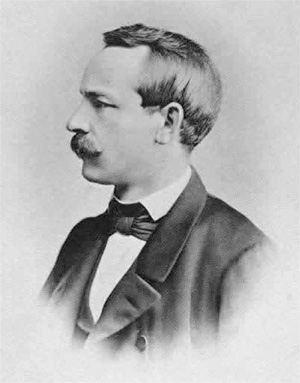
图:Forrás: http://www-gap.dcs.st-and.ac.uk/~history/BiogIndex.h… · Public domain · Wikimedia Commons
- 出生
- 1829 年 11 月 10 日,蒙绍
- 逝世
- 1900 年 3 月 15 日,斯特拉斯堡
- 国籍
- 普鲁士王国
- 学科
- 物理学、数学、博物与综合
- 职业
- 数学家、物理学家、大学教师
- 母语 / 工作语言
- 德语
- 母校
- 弗里德里希·威廉大学(博士,1856 年)、Dreikönigsgymnasium、Friedrich-Wilhelm-Gymnasium(1849 年)、柏林洪堡大学
- 工作单位
- Royal College for Vocational Studies(1869—1872)、苏黎世联邦理工学院(1862—1869)、弗里德里希·威廉大学(1859—1862)、斯特拉斯堡大学(1872—1892)
研究领域
主要贡献
代表成就
本站收录的发现与发明
以他 / 她命名
师承
博士导师1
来自 Wikidata 的「博士导师」「师从」「博士生」「学生」记录,可能不全。
学会与院士
百科正文
生平
克里斯托费尔生于蒙绍(德国西部),中学时在科隆就读文理中学,后进入柏林大学,受教于狄利克雷等教授。1856年以题为《电在均匀物体中的运动》(Bewegung der Elektrizität in homogenen Körpern)的论文获得博士学位。1859年他当上柏林大学的私人讲师。3年后他往瑞士的苏黎世联邦理工学院接替了里夏德·戴德金的位置。之后又在柏林工业学院任教,接着1872年他在斯特拉斯堡大学作教授,直到1894年退休。1900年在斯特拉斯堡逝世,享年70岁。
工作
克里斯托费尔研究共形映射、位势论、黎曼o函数、张量分析、不变量理论、数学物理、大地测量学和声波(激波)。
他的化归定理解决了二次微分形式的局部等价问题。
影响
以他为名的有克里斯托费尔符号,令张量分析可以清楚表达,一直使用到现在。
以上内容摘自维基百科「埃尔温·布鲁诺·克里斯托费尔」,按 CC BY-SA 4.0 使用,去掉了参考文献、外部链接等尾部小节,公式改写成了纯文本。全文、配图和出处见原文。
英文维基百科补充中文条目比较短,下面是英文条目「Elwin Bruno Christoffel」的原文
Elwin Bruno Christoffel (German: [kʁɪˈstɔfl̩]; 10 November 1829 – 15 March 1900) was a German mathematician and physicist. He introduced fundamental concepts of differential geometry, opening the way for the development of tensor calculus, which would later provide the mathematical basis for general relativity.
Life
Christoffel was born on 10 November 1829 in Montjoie (now Monschau) in Prussia in a family of cloth merchants. He was initially educated at home in languages and mathematics, then attended the Jesuit Gymnasium and the Friedrich-Wilhelms Gymnasium in Cologne. In 1850 he went to the University of Berlin, where he studied mathematics with Gustav Dirichlet (who had a strong influence over him) among others, as well as attending courses in physics and chemistry. He received his doctorate in Berlin in 1856 for a thesis on the motion of electricity in homogeneous bodies written under the supervision of Martin Ohm, Ernst Kummer and Heinrich Gustav Magnus.
After receiving his doctorate, Christoffel returned to Montjoie where he spent the following three years in isolation from the academic community. However, he continued to study mathematics (especially mathematical physics) from books by Bernhard Riemann, Dirichlet and Augustin-Louis Cauchy. He also continued his research, publishing two papers in differential geometry.
In 1859 Christoffel returned to Berlin, earning his habilitation and becoming a Privatdozent at the University of Berlin. In 1862 he was appointed to a chair at the Polytechnic School in Zürich left vacant by Richard Dedekind. He organised a new institute of mathematics at the young institution (it had been established only seven years earlier) that was highly appreciated. He also continued to publish research, and in 1868 he was elected a corresponding member of the Prussian Academy of Sciences and of the Istituto Lombardo in Milan. In 1869 Christoffel returned to Berlin as a professor at the Gewerbeakademie (now part of Technische Universität Berlin), with Hermann Schwarz succeeding him in Zürich.
Work
Differential geometry
Christoffel is mainly remembered for his seminal contributions to differential geometry. In a famous 1869 paper on the equivalence problem for differential forms in n variables, published in Crelle's Journal, he introduced the fundamental technique later called covariant differentiation and used it to define the Riemann–Christoffel tensor (the most common method used to express the curvature of Riemannian manifolds). In the same paper he introduced the Christoffel symbols Γ ₖᵢⱼ and Γ ᵢⱼ^(k) which express the components of the Levi-Civita connection with respect to a system of local coordinates. Christoffel's ideas were generalized and greatly developed by Gregorio Ricci-Curbastro and his student Tullio Levi-Civita, who turned them into the concept of tensors and the absolute differential calculus. The absolute differential calculus, later named tensor calculus, forms the mathematical basis of the general theory of relativity.
Complex analysis
Christoffel contributed to complex analysis, where the Schwarz–Christoffel mapping is the first nontrivial constructive application of the Riemann mapping theorem. The Schwarz–Christoffel mapping has many applications to the theory of elliptic functions and to areas of physics. In the field of elliptic functions he also published results concerning abelian integrals and theta functions.
Numerical analysis
Christoffel generalized the Gaussian quadrature method for integration and, in connection to this, he also introduced the Christoffel–Darboux formula for Legendre polynomials (he later also published the formula for general orthogonal polynomials).
Other research
Christoffel also worked on potential theory and the theory of differential equations, however much of his research in these areas went unnoticed. He published two papers on the propagation of discontinuities in the solutions of partial differential equations which represent pioneering work in the theory of shock waves.
Honours
- Christoffel was elected as a corresponding member of several academies:
- Prussian Academy of Sciences (1868)
- Istituto Lombardo (1868)
- Göttingen Academy of Sciences (1869)
- Christoffel was also awarded two distinctions for his activity by the Kingdom of Prussia:
- Order of the Red Eagle 3rd Class with bow (Schleife) (1893)
- Order of the Crown 2nd Class (1895)
以上节选摘自英文维基百科「Elwin Bruno Christoffel」,按 CC BY-SA 4.0 使用,去掉了参考文献、外部链接等尾部小节,公式改写成了纯文本。篇幅所限,较长的小节只摘了开头一部分,有的小节没有收;全文、配图和出处见原文。
同一学科、同时代的科学家


同一学科的科学家
更多 ›