格物
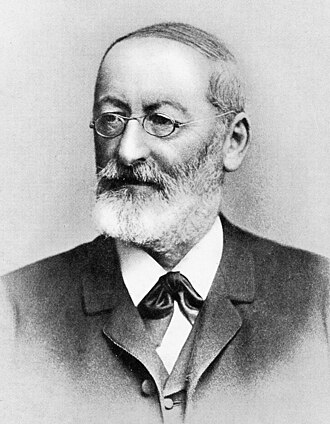
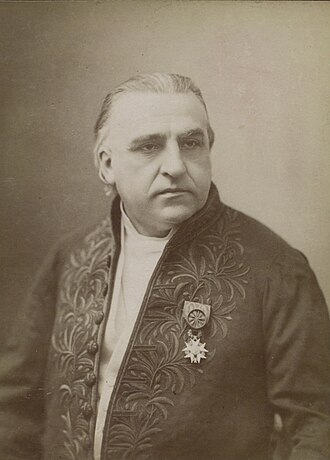
图:作者不详 · CC BY 4.0 · Wikimedia Commons
- 出生
- 1828 年 1 月 24 日,弗罗茨瓦夫
- 逝世
- 1898 年 6 月 25 日,弗罗茨瓦夫
- 国籍
- 普鲁士王国
- 学科
- 生物学
- 职业
- 微生物学家、植物学家、大学教师、细菌学家
- 母语 / 工作语言
- 德语
- 母校
- Magdalenaeum Wrocław(1844 年)、弗罗茨瓦夫大学(1846 年)、弗里德里希·威廉大学(1847 年)
- 工作单位
- 弗罗茨瓦夫大学(1851—)
研究领域
师承
师从4
博士生1
学生1
来自 Wikidata 的「博士导师」「师从」「博士生」「学生」记录,可能不全。
所获奖项(6)
- 1849荣誉成员
- 1885列文虎克奖章
- 1895林奈奖章
- 1897英国皇家学会外籍会员
- 1898honorary citizen of Breslau
- —honorary doctor of the University of Tübingen
学会与院士
百科正文
生平
费迪南德·科恩出生于普鲁士西里西亚省布雷斯劳(今波兰弗罗茨瓦夫)。他的父亲是一个商人。科恩10岁时患上了听力障碍。
16岁起,科恩在布雷斯劳大学研读植物学,但由于其犹太人的身份,他不被允许参加布雷斯劳大学最终学位的毕业考试。 而后他转学至柏林大学,并于19岁时获得植物学学位。此后,科恩在柏林持续研学植物学,并结实了许多顶尖科学家。
1849年,科恩回到布雷斯劳大学,并在此从事教学和科研,度过了整个职业生涯。1850年代,他在此研究了植物细胞的生长和分裂。1860年代,他从多方面研究了植物生理学。从1870年期,他着手开始研究细菌学,使布雷斯劳成为当时植物学、微生物学研究的中心之一。他一生发表了超过150个研究报告。
科恩首次将藻类划归为植物,同时定义了其与绿色植物的差异。此外,科恩依据细菌的外形,将细菌分为四类(“细菌形态分类”):球菌(sphericals)、短杆菌(short rods)、螺旋菌(spirals)、线状菌(threads)。
1885年,他获得列文虎克奖章。
以上内容摘自维基百科「费迪南德·科恩」,按 CC BY-SA 4.0 使用,去掉了参考文献、外部链接等尾部小节,公式改写成了纯文本。全文、配图和出处见原文。
英文维基百科补充中文条目比较短,下面是英文条目「Ferdinand Cohn」的原文
Ferdinand Julius Cohn (24 January 1828 – 25 June 1898) was a German biologist. He is one of the founders of modern bacteriology and microbiology.
Biography
Ferdinand Julius Cohn was born in the Jewish quarter of Breslau in the Prussian Province of Silesia (modern-day Wrocław, Poland). His father, Issak Cohn, was a successful merchant and manufacturer who for some time held the post of Austro-Hungarian consul. He was the elder brother of humorist and playwright Oskar Justinus Cohn and of historian and jurist Max Conrat.
He was considered a child prodigy, and could read at the age of two. He also suffered hearing impairment from a young age. He entered the Maria-Magdalenen-Gymnasium in 1835 at the age or 6 or 7, and the University of Breslau in 1842 or 1844. There he studied botany under Heinrich Göppert and Christian Nees von Esenbeck.
Cohn was refused admission to the University of Breslau's doctoral program because of his Jewish background. He thus continued his studies at the University of Berlin, where he obtained a Ph.D. in 1847 with a dissertation on the physiology of seeds. In it he advocated for the establishment of botanical gardens dedicated to the study of plant physiology, a vision that he later played a significant role in realizing.
He returned to Breslau in 1848 and, after a delay due to his Jewish heritage, was appointed as a privat-docent in 1850. He remained at that university for the rest of his career, obtaining the titled of professor in 1857 and, following the death of his mentor Göppert, was promoted to a full professorship in 1872.
Work
Cohn was a prolific writer, leaving behind over 150 papers, essays, and books.
In the 1850s he studied the growth and division of plant cells. In 1855 he produced papers on the sexuality of Sphaeroplea annulina and later Volvox globator. In the 1860s he studied plant physiology in several different aspects. From 1870 onward he mostly studied bacteria. He established the use of sterile culture mediums and rediscovered the botanical garden of Lorenz Scholz von Rosenau in Breslau.
Cohn was the first to classify algae as plants, and to define what distinguishes them from green plants. His classification of bacteria into four groups based on shape (sphericals, short rods, threads, and spirals) is still in use today. Among other things Cohn is remembered for being the first to show that Bacillus can change from a vegetative state to an endospore state when subjected to an environment deleterious to the vegetative state.
Awards
Cohn was elected a member of numerous institutions and societies, including the Leopold Carolinische Akademie, Royal Academy of Sciences of Berlin, Société de biologie de France, the Royal Microscopic Society of Great Britain, and the Natural History Society of Boston, among others including in 1889, when he was elected to honorary membership of the Manchester Literary and Philosophical Society.
He received the Leeuwenhoek Medal in 1885, and the Linnean Medal in 1895. For his efforts leading to the establishment of the Botanical Institute in Breslau in 1888, he received the title of Geheimer Regierungsrat. On the occasion of his seventieth birthday he was presented with the honorary freedom of the city of Breslau.
以上内容摘自英文维基百科「Ferdinand Cohn」,按 CC BY-SA 4.0 使用,去掉了参考文献、外部链接等尾部小节,公式改写成了纯文本。全文、配图和出处见原文。
同一学科、同时代的科学家



同一学科的科学家
更多 ›