格物
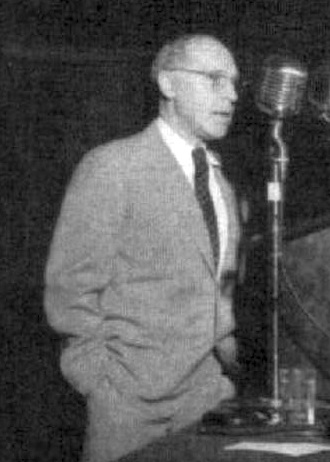
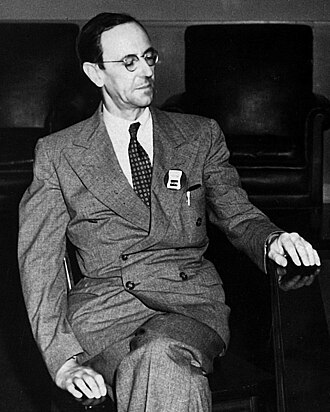
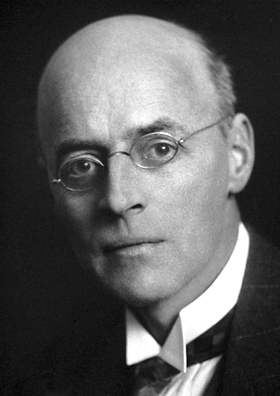
图:Alfred De Bat · Public domain · Wikimedia Commons
赫尔曼·约瑟夫·马勒1890—1967
Hermann Joseph Muller
生物学家, 美国
赫尔曼·约瑟夫·马勒,美国遗传学家及教育家。他因发现X射线诱导突变而获得1946年诺贝尔生理学或医学奖。
摘自维基百科「赫尔曼·约瑟夫·马勒」,CC BY-SA 4.0
- 出生
- 1890 年 12 月 21 日,曼哈顿
- 逝世
- 1967 年 4 月 5 日,印第安纳波利斯
- 国籍
- 美国
- 学科
- 物理学、生物学、医学、博物与综合
- 职业
- 生物学家、遗传学家、大学教师、生物物理学家
- 母语 / 工作语言
- 英语
- 母校
- 哥伦比亚大学、康奈尔大学、得克萨斯大学奥斯汀分校、莫里斯高中
- 工作单位
- 得克萨斯大学奥斯汀分校、莱斯大学、爱丁堡大学、印第安纳大学布卢明顿分校(1945—1964)、阿默斯特学院、哥伦比亚大学
研究领域
主要贡献
代表成就
本站收录的发现与发明
以他 / 她命名
师承
博士导师1
博士生6
来自 Wikidata 的「博士导师」「师从」「博士生」「学生」记录,可能不全。
所获奖项(7)
- 1932古根海姆学者奖
- 1946诺贝尔生理学或医学奖
- 1953英国皇家学会外籍会员
- 1955金伯遗传学奖
- 1958约西亚·威拉德·吉布斯讲座
- 1958达尔文-华莱士奖章
- 1963Humanist of the Year
学会与院士
百科正文
贡献
多布然斯基-马勒基因不相容解释种化过程中如何演化出合子后生殖隔离。
马勒齿轮(Muller's ratchet)说明无性生殖会累积有害突变,而有性生殖可以透过遗传重组移除这些有害突变。
以上内容摘自维基百科「赫尔曼·约瑟夫·马勒」,按 CC BY-SA 4.0 使用,去掉了参考文献、外部链接等尾部小节,公式改写成了纯文本。全文、配图和出处见原文。
英文维基百科补充中文条目比较短,下面是英文条目「Hermann Joseph Muller」的原文
Hermann Joseph Muller (December 21, 1890 – April 5, 1967) was an American geneticist who was awarded the 1946 Nobel Prize in Physiology or Medicine "for the discovery of the production of mutations by means of X-ray irradiation". Muller warned of long-term dangers of radioactive fallout from nuclear war and nuclear testing, which resulted in greater public scrutiny of these practices.
Early life
Muller was born in New York City, the son of Frances (Lyons) and Hermann Joseph Muller Sr., an artisan who worked with metals. Muller was a third-generation American whose father's ancestors were originally Catholic and came to the United States from Koblenz. His mother's family was of mixed Jewish (descended from Spanish and Portuguese Jews) and Anglican background, and had come from Britain. Among his first cousins was Alfred Kroeber (father of Ursula Le Guin) and first cousins once removed was Herbert J. Muller. As an adolescent, Muller attended a Unitarian church and considered himself a pantheist; in high school, he became an atheist. He excelled in the public schools. At 16, he entered Columbia College. From his first semester, he was interested in biology; he became an early convert of the Mendelian-chromosome theory of heredity—and the concept of genetic mutations and natural selection as the basis for evolution. He formed a biology club and also became a proponent of eugenics; the connections between biology and society would be his perennial concern. Muller earned a Bachelor of Arts degree in 1910.
Muller remained at Columbia (the pre-eminent American zoology program at the time, due to E. B. Wilson and his students) for graduate school. He became interested in the Drosophila genetics work of Thomas Hunt Morgan's fly lab after undergraduate bottle washers Alfred Sturtevant and Calvin Bridges joined his biology club.
Career
In 1914, Julian Huxley offered Muller a position at the recently founded William Marsh Rice Institute, now Rice University; he hurried to complete his Doctor of philosophy degree and moved to Houston for the beginning of the 1915–1916 academic year (his degree was issued in 1916). At Rice, Muller taught biology and continued Drosophila lab work. In 1918, he proposed an explanation for the dramatic discontinuous alterations in Oenothera lamarckiana that were the basis of Hugo de Vries's
theory of mutationism: "balanced lethals" allowed the accumulation of recessive mutations, and rare crossing over events resulted in the sudden expression of these hidden traits. In other words, de Vries's experiments were explainable by the Mendelian-chromosome theory. Muller's work was increasingly focused on mutation rate and lethal mutations. In 1918, Morgan, short-handed because many of his students and assistants were drafted for the U.S. entry into World War I, convinced Muller to return to Columbia to teach and to expand his experimental program.
At Columbia, Muller and his collaborator and longtime friend Edgar Altenburg continued the investigation of lethal mutations. The primary method for detecting such mutations was to measure the sex ratios of the offspring of female flies. They predicted the ratio would vary from 1:1 due to recessive mutations on the X chromosome, which would be expressed only in males (which lacked the functional allele on a second X chromosome).
Global policy
He was one of the signatories of the agreement to convene a convention for drafting a world constitution. As a result, for the first time in human history, a World Constituent Assembly convened to draft and adopt a Constitution for the Federation of Earth.
Personal life
Muller had a daughter, Helen J. Muller, now a professor emerita at the University of New Mexico. Her daughter, Mala Htun, was also a professor at the University of New Mexico until her death in January 2025. His son, David E. Muller, professor emeritus of mathematics and computer science at the University of Illinois and at New Mexico State University, died in 2008 in Las Cruces, New Mexico. David's mother was Jessie Jacobs Muller Offermann (1890–1954), Hermann's first wife. Helen's mother was Dorothea Kantorowicz Muller (1909–1986), Hermann's second wife, who came to the U.S. in 1940 as a German Jewish refugee. He had a brief affair with Milly Bennett.
Notable former students
- Raissa L. Berg
- Elof Axel Carlson
- H. Bentley Glass
- C. P. Oliver
- Wilson Stone
- Former postdoctoral fellows
- George D. Snell
- Worked in lab as undergraduates
- Carl Sagan
以上节选摘自英文维基百科「Hermann Joseph Muller」,按 CC BY-SA 4.0 使用,去掉了参考文献、外部链接等尾部小节,公式改写成了纯文本。篇幅所限,较长的小节只摘了开头一部分,有的小节没有收;全文、配图和出处见原文。
同一学科、同时代的科学家



同一学科的科学家
更多 ›