 格物
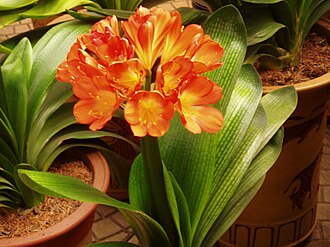
- 学名
- Clivia
- 分类等级
- 属
- 上级类群
- 石蒜科
- 大类
- 被子植物
- 命名
- 约翰·林德利,1828 年
- 数据库
- NCBI 分类 · GBIF
下级类群(1)
- 大花君子兰 Clivia miniata 种
百科正文
物种
具茎君子兰Clivia caulescens R.A.Dyer
垂筒君子兰Clivia ×cyrtanthiflora (Lindl. ex K.Koch & Fintelm) T.Moore
细叶君子兰Clivia gardenii Hook.
君子兰Clivia miniata (Lindl.) Verschaff.
奇异君子兰Clivia mirabilis Rourke
云雾君子兰Clivia ×nimbicola Swanev., Truter & A.E.van Wyk
垂笑君子兰Clivia nobilis Lindl.
粗壮君子兰Clivia robusta B.G.Murray, Ran, de Lange, Hammett, Truter & Swanev.
以上内容摘自维基百科「君子兰属」,按 CC BY-SA 4.0 使用,去掉了参考文献、外部链接等尾部小节,公式改写成了纯文本。全文、配图和出处见原文。
英文维基百科补充中文条目比较短,下面是英文条目「Clivia」的原文
Clivia is a genus of monocot flowering plants native to southern Africa. They are from the family Amaryllidaceae, subfamily Amaryllidoideae. Common names are Natal lily or bush lily.
They are herbaceous or evergreen perennial plants, with green, strap-like leaves. Individual flowers are more or less bell-shaped, occurring in umbels on a stalk above the foliage; colors typically range from yellow through orange to red. Many cultivars exist, some with variegated leaf patterns.
Description
Species of Clivia are found only in South Africa and Eswatini. They are typically forest undergrowth plants, adapted to low light (with the exception of C. mirabilis from the Western Cape).
Clivia shares common features with the other members of the subfamily Amaryllidoideae. Individual flowers have three sepals and three petals, all very similar (although the sepals are typically narrower than the petals) and collectively called tepals. In Clivia the tepals are fused at the base to form a tube, although this may be very short. The flower varies in shape from an open cup to a narrow hanging tube. In the species the flowers are mainly in shades of yellow through orange to red. The flowers are arranged in umbels (i.e. the flower-stalks or pedicels radiate from a single point); each umbel has a long stalk or peduncle. Several bracts subtend the umbels. Each flower has six stamens and an inferior ovary (i.e. one which is below the tepals) made up of three locules. The stamens have long filaments and anthers which are free to move on their filaments. The style is longer than the tepals, ending in a short three-part stigma.
Flowering time varies. Typically C. miniata, C. nobilis and C. caulescens flower in late winter and spring; in cultivation, C.
Taxonomy
It was published by John Lindley in 1828 with Clivia nobilis Lindl. as the type species. It was named in honor of Charlotte Percy (née Clive), Duchess of Northumberland (1787–1866), who was for a time the governess of the future Queen Victoria.
Evolution and phylogeny
Six genera have been placed in the tribe Haemantheae; all are found in Africa. Molecular phylogenetic analysis carried out in 2004 showed that the tribe is monophyletic (i.e. it contains all the descendants of a single common ancestor). Four species of Clivia were included in the analysis:
The bulbless Clivia and Cryptostephanus appear to occupy a basal position within the clade. Meerow and Clayton suggest that a forest understorey habitat, associated with the absence of bulbs and the presence of fruits which are berries, may have been a factor in the evolutionary divergence of the Haemantheae clade from the rest of the subfamily Amaryllidoideae.
Species
As of December 2025, six species are recognized by Plants of the World Online:
Clivia caulescens R.A.Dyer
Clivia gardenii Hook.
Clivia miniata (Lindl.) Bosse
Clivia mirabilis Rourke
Clivia nobilis Lindl.
Clivia robusta B.G.Murray, Ran, de Lange, Hammett, Truter & Swanev.
C. mirabilis was only named in 2000, and C. robusta even later, in 2004. Thus older sources frequently state that there are only four or five species.
Natural hybrids
Clivia × nimbicola Swanev., Truter & A.E.van Wyk = C. caulescens × C. miniata
Cultivation
Of the species, Clivia miniata is the most widely cultivated; cultivars with flowers ranging from deep red-orange to pale yellow have been bred by growers. Yellow plants can belong to one of two different groups which breed true for colour, producing seedlings with unpigmented stems and all yellow flowers when mature. When yellows from different groups are crossed, seedlings with pigmented stems occur and the resulting flowers are orange.
C. miniata, C. gardenii, C. robusta and C. caulescens seedlings flower after four to five years. C. nobilis will flower after seven or eight years. It is reported that C. mirabilis also takes about six years to flower.
Care
In cultivation, it is recommended that plants are watered regularly in summer, although not overwatered, with a resting period from autumn till late winter, when the plants are kept almost dry at 46–50 °F (8–10 °C). Plants can be repotted yearly or every other year in all-purpose potting medium or coconut husks.
Propagation is by seed or by offsets removed when repotting. Seeds are sown on the top of moist material in high humidity.
Pests and diseases include scale insects, mealy bug, amaryllis borer, and rot.
Toxicity
Some species of Clivia, including Clivia miniata, produce small amounts of the alkaloid lycorine. Lycorine is toxic in sufficient quantities, particularly in pets and small children.
以上节选摘自英文维基百科「Clivia」,按 CC BY-SA 4.0 使用,去掉了参考文献、外部链接等尾部小节,公式改写成了纯文本。篇幅所限,较长的小节只摘了开头一部分,有的小节没有收;全文、配图和出处见原文。