 格物
- 学名
- Amaryllis
- 分类等级
- 属
- 上级类群
- 石蒜科
- 大类
- 被子植物
- 命名
- 卡尔·林奈,1753 年
- 数据库
- NCBI 分类 · GBIF
下级类群(2)
- 南非孤挺花 Amaryllis belladonna 种
- Amaryllis paradisicola 种
百科正文
其分类上有时会与朱顶红属(Hippeastrum)混淆,甚至有时朱顶红属会作为其异名使用。
以上内容摘自维基百科「孤挺花屬」,按 CC BY-SA 4.0 使用,去掉了参考文献、外部链接等尾部小节,公式改写成了纯文本。全文、配图和出处见原文。
英文维基百科补充中文条目比较短,下面是英文条目「Amaryllis」的原文
Amaryllis is the only genus in the subtribe Amaryllidinae (tribe Amaryllideae). It is a small genus of flowering bulbs, with two species. The better known of the two, Amaryllis belladonna, is a native of the Western Cape region of South Africa, particularly the rocky southwest area between the Olifants River Valley and Knysna.
For many years there was confusion among botanists over the generic names Amaryllis and Hippeastrum, one result of which is that the common name 'amaryllis' is mainly used for cultivars of the genus Hippeastrum, widely sold in the winter months for their ability to bloom indoors.
Plants of the genus Amaryllis are known as belladonna lily, Jersey lily, naked lady, amarillo, Easter lily in Southern Australia or, in South Africa, March lily due to its propensity to flower around March. This is one of numerous genera with the common name 'lily' due to their flower shape and growth habit. However, they are only distantly related to the true lily, Lilium. In the Victorian language of flowers, amaryllis means "love, beauty, and determination", and can also represent hope and achievement.
Description
Amaryllis is a bulbous plant, with each bulb being 5–10 cm (2.0–3.9 in) in diameter. It has several strap-shaped, hysteranthous, green leaves with midrib, 30–50 cm (12–20 in) long and 2–3 cm (0.79–1.18 in) broad, arranged in two rows.
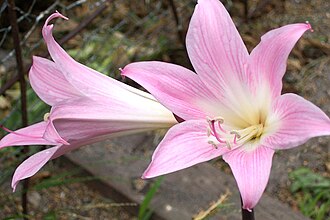
Each bulb produces one or two leafless, stout, persistent and erect stems 30–60 cm (12–24 in) tall, each of which bears at the top a cluster of two to twelve zygomorphic, funnel-shaped flowers without a tube.
Taxonomy
The single genus is in subtribe Amaryllidinae, in the tribe Amaryllideae. The taxonomy of the genus has been controversial. In 1753 Carl Linnaeus created the name Amaryllis belladonna, the type species of the genus Amaryllis. At the time both South African and South American plants were placed in the same genus; subsequently they were separated into two different genera. The key question is whether Linnaeus's type was a South African plant or a South American plant.
Habitat
In areas of its native habitat with mountainous fynbos, flowering tends to be suppressed until after bush fires as dense overhead vegetation prevents growth. In more open sandy areas of the Western Cape, the plant flowers annually. Plants tend to be very localized in dense concentrations due to the seeds' large size and heavy weight. Strong winds shake loose the seeds, which fall to ground and immediately start to germinate, aided by the first winter rains.
Ecology
The leaves are produced in the autumn or early spring in warm climates depending on the onset of rain and eventually die down by late spring. The bulb is then dormant until late summer. The plant is not frost-tolerant, nor does it do well in tropical environments since they require a dry resting period between leaf growth and flower spike production.
One or two leafless stems arise from the bulb in the dry ground in late summer (March in its native habitat and August in USDA zone 7).
Cultivation
Amaryllis belladonna was introduced into cultivation at the beginning of the eighteenth century. It reproduces slowly by either bulb division or seeds and has gradually naturalized from plantings in urban and suburban areas throughout the lower elevations and coastal areas in much of the West Coast of the US since these environments mimic their native South African habitat. Hardiness zones 6–8. It is also naturalized in Australia.
There is an Amaryllis belladonna hybrid which was bred in the 1800s in Australia.
Toxicity
Amaryllis belladonna is toxic to humans and to domestic animals, including dogs, cats, and horses. In animals, poisoning usually follows ingestion of the plant, particularly the bulbs. The toxic effects are associated with alkaloids, especially lycorine; several phenanthridine alkaloids have been identified in its leaves, stems, and bulbs, with the bulbs consistently described as the most hazardous part of the plant. In humans, ingestion is reported to cause vomiting, diarrhea, abdominal pain, hypersalivation, and tremors.
以上节选摘自英文维基百科「Amaryllis」,按 CC BY-SA 4.0 使用,去掉了参考文献、外部链接等尾部小节,公式改写成了纯文本。篇幅所限,较长的小节只摘了开头一部分,有的小节没有收;全文、配图和出处见原文。