格物

图:Stéphane Magnenat · CC BY-SA 3.0 · Wikimedia Commons
生命之树 › 真核生物 › 动物界 › 真后生动物亚界 › 两侧对称动物 › 后口动物总门 › 脊索动物门 › 脊椎动物亚门 › 有颌下门 › 肉鳍鱼总纲 › 四足形类 › 希望螈目 › 四足总纲 › 哺乳动物 › 兽型类 › 全兽类 › 兽亚纲 › 有胎盘类 › 北方真兽高目 › 灵长总目 › 啮齿目 › 松鼠形亚目 › 松鼠科 › 非洲地松鼠亚科 › 地松鼠族 › 旱獭属
西伯利亚旱獭种
Marmota sibirica
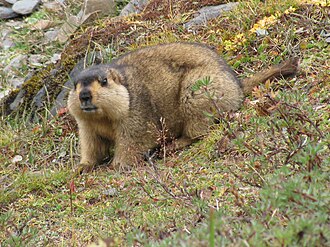
蒙古旱獭,又称西伯利亚旱獭 、荅剌不花,是旱獭属的一种啮齿动物,分布于中国(内蒙古和黑龙江)、蒙古西部和北部及俄罗斯的西南部。在蒙古的阿尔泰山中,它与灰旱獭的分布范围重叠。其下有两个亚种,即M. s. sibirica和M. s. caliginosus。
摘自维基百科「蒙古旱獺」,CC BY-SA 4.0
- 学名
- Marmota sibirica
- 分类等级
- 种
- 英文名
- Tarbagan marmot
- 上级类群
- 旱獭属
- 大类
- 哺乳动物
- 命名
- 古斯塔夫·拉德,1862 年
- 保护状况(IUCN)
- 濒危 (保育状况)
- 栖息地
- 草原
- 数据库
- NCBI 分类 · GBIF · IUCN 红色名录
百科正文
与人类的关系
蒙古人有食用蒙古旱獭的习惯,当地有一道叫做“boodog”的菜就是用旱獭肉和皮制作的。蒙古人一般在秋天捕猎旱獭,这时候的蒙古旱獭为了准备冬眠都吃得很肥。
蒙古旱獭常携带鼠疫杆菌,可通过蒙古旱獭角叶蚤(学名:Ceratophyllus silantievi)叮咬或食用蒙古旱獭肉而传染给人类。曾有人因生食蒙古旱獭肉而罹患肺鼠疫丧命。清末东北大鼠疫就与蒙古旱獭有关。
以上内容摘自维基百科「蒙古旱獺」,按 CC BY-SA 4.0 使用,去掉了参考文献、外部链接等尾部小节,公式改写成了纯文本。全文、配图和出处见原文。
英文维基百科补充中文条目比较短,下面是英文条目「Tarbagan marmot」的原文
The tarbagan marmot (Marmota sibirica) is a species of rodent in the family Sciuridae. It is found in China (Inner Mongolia and Heilongjiang), northern and western Mongolia, and Russia (southwest Siberia, Tuva, Transbaikalia). In the Mongolian Altai Mountains, its range overlaps with that of the gray marmot. The species was classified as endangered by the IUCN in 2008.
Two subspecies are recognized, M. s. sibirica and M. s. caliginosus.
Etymology
The word "tarbagan" comes from Russian тарбаган (tarbagan), which originates from Proto-Mongolic and denotes specific rodent species; it is related to "targa", the word for beaver in the Ulch and Nanai languages. Other names for the tarbagan marmot include Siberian marmot and Mongolian marmot.
Description and ecology
The tarbagan marmot is medium-sized compared to other marmots, with a 0.25 head-to-body ratio. During the summer, its hair is between 11–20 mm and grows up to 30 mm during winter months. Its fur has two separate slate bands, followed by a white band, and its cheeks are yellow. Its zygomatic arches are slightly expanded compared to other marmot species. Populations in western Mongolia tend to have wider skulls compared to other tarbagan marmots. Males tend to weigh more than females and are larger, both having an average weight of 6–8 kg. The tarabagan marmot is one of the two only marmot species to inhabit lowland areas, the other being the groundhog. The tarbagan marmot is herbivorous, like all other marmots, and consumes steppe grasses.
It is mainly found throughout Mongolia, with its range extending west to the Altai Mountains, east to Inner Mongolia, north to Transbaikal, and south to the Dzungarian Basin, in the Gobi Desert.
As a disease carrier
Epizootics occur in tarbagan marmots in northeastern China and Mongolia, such as the Manchurian plague of 1910–1911. The plague in marmots is of the pneumonic form, spread by coughing. The diseases can jump from marmots to humans through the bite of the tarbagan flea (Ceratophyllus silantievi), or through consumption of tarbagan meat. Marmot epizootics are known to co-occur with human epidemics in the same area. Human plague epidemics in this area are largely pneumonic, the most deadly form of plague. In 2019, a Mongolian couple died of plague after eating raw marmot meat.
As a game animal
The tarbagan marmot has been eaten for centuries in the native cuisine of Mongolia, and in particular in a local dish called boodog. The meat is cooked by inserting hot stones, preheated in a fire, into the abdominal cavity of a deboned marmot. The skin is then tied up to make a bag, within which the meat cooks. Hunting of marmots for food is typically done in autumn, when the animals are heavier, since they are preparing for hibernation.
The Russian explorer Richard Maack, who encountered tarbagans in the Ingoda Valley in Siberia, described the tarbagan hunt as follows:
Hunting the tarbagan is quite difficult. It is not easy to approach to a tarbagan within a rifle shot; besides, the wary animal never goes far from its burrow, and, if it is not killed right away, always manage to hide in the burrow. In that case one needs to dig it out, which involves a lot of labor, as tarbagans' burrows are quite deep.
Benefits to the environment
The tarbagan marmot is known to be an ecosystem engineer as it provides various resources to other organisms. Within the landscape, tarbagan marmot burrows provide a network of basking sites for thermoregulation, feeding areas, and refuges for other species, possibly leading to a more suitable habitat and increased survivability. In addition, for raptors and carnivorous species like gray wolves and golden eagles, tarbagan marmots are a significant source of food.
以上内容摘自英文维基百科「Tarbagan marmot」,按 CC BY-SA 4.0 使用,去掉了参考文献、外部链接等尾部小节,公式改写成了纯文本。全文、配图和出处见原文。