格物
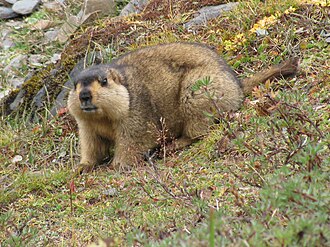
图:Christopher Fynn · CC BY-SA 3.0 · Wikimedia Commons
生命之树 › 真核生物 › 动物界 › 真后生动物亚界 › 两侧对称动物 › 后口动物总门 › 脊索动物门 › 脊椎动物亚门 › 有颌下门 › 肉鳍鱼总纲 › 四足形类 › 希望螈目 › 四足总纲 › 哺乳动物 › 兽型类 › 全兽类 › 兽亚纲 › 有胎盘类 › 北方真兽高目 › 灵长总目 › 啮齿目 › 松鼠形亚目 › 松鼠科 › 非洲地松鼠亚科 › 地松鼠族 › 旱獭属
喜马拉雅旱獭种
Marmota himalayana
喜马拉雅旱獭,俗称雪猪,是一种分布于青藏高原及周边山区(喜马拉雅山、喀喇昆仑山、昆仑山、阿尔金山、祁连山、邛崃山、横断山脉等)的旱獭,在西藏、青海、新疆、甘肃、四川、云南以及印巴北部(包括克什米尔)、尼泊尔、不丹都能找到它的踪迹。本种在唐代称为土拨鼠(《本草拾遗》)、鼧鼥鼠(《通典》)、𪕅鼥鼠(《新唐书》)。
摘自维基百科「喜馬拉雅旱獺」,CC BY-SA 4.0
- 学名
- Marmota himalayana
- 分类等级
- 种
- 英文名
- Himalayan marmot
- 上级类群
- 旱獭属
- 大类
- 哺乳动物
- 命名
- 布赖恩·霍顿·霍奇森,1841 年
- 保护状况(IUCN)
- 无危物种
- 栖息地
- 灌丛
- 数据库
- NCBI 分类 · GBIF · IUCN 红色名录
百科正文
亚种
喜马拉雅旱獭有以下亚种:
喜马拉雅旱獭(指名亚种)M. h. himalayanus
四川旱獭(四川亚种)M. h. robusta (Milne-Edwards, 1871)
形态与习性
体形肥大,体长50厘米,颈部粗短,耳壳短小。四肢短粗,尾短而扁平。体背棕黄色,广泛栖息于青藏高原,山麓平原和山地阳坡下缘为其高密度集聚区,过家族生活,个体接触密切。洞穴有主洞(越冬)、副洞(夏用)、避敌洞。主洞构造复杂,深而多口。有冬眠性,出蛰后昼间活动。以禾本科、莎草科及豆科根、茎、叶为食,亦食小动物。出蛰后交配,年产1胎,每胎产2-9只,3岁性成熟。
与人类的关系
藏民通常不会伤害土拨鼠,外地游客也常常投喂,所以许多地区的喜马拉雅旱獭并不怕人。不过,喜马拉雅旱獭是鼠疫杆菌的自然宿主,其体外寄生虫是鼠疫的传播者,因此喜马拉雅旱獭是亚洲鼠疫预防的重点监控对象。
以上内容摘自维基百科「喜馬拉雅旱獺」,按 CC BY-SA 4.0 使用,去掉了参考文献、外部链接等尾部小节,公式改写成了纯文本。全文、配图和出处见原文。
英文维基百科补充中文条目比较短,下面是英文条目「Himalayan marmot」的原文
The Himalayan marmot (Marmota himalayana) is a marmot species that inhabits alpine grasslands throughout the Himalayas and on the Tibetan Plateau. It is IUCN Red Listed as Least Concern because of its wide range and possibly large population.
Taxonomy
Arctomys himalayanus was the scientific name proposed by Brian Houghton Hodgson in 1841 who described marmot skins from the Himalayas. In the 19th century, several Himalayan marmot specimens were described and proposed as subspecies. Two genetically distinct subspecies are recognized today:
M. h. himalayana
M. h. robusta (Milne-Edwards, 1871) – Szechwan marmot
The Himalayan marmot is very closely related to the Tarbagan marmot (M. sibirica) and somewhat more distantly to the black-capped marmot (M. camtschatica). These three form a species group, with their next nearest relatives being the bobak species group, which includes the bobak marmot (M. bobak) itself, as well as the grey marmot (M. baibacina) and forest-steppe marmot (M. kastschenkoi). In the past, the relatively short-furred and short-tailed marmots of the Palearctic region, i.e. Himalayan, Tarbagan, grey and forest-steppe, were all regarded as subspecies of the bobak marmot.
Characteristics
The Himalayan marmot has a dense woolly fur that is rufous grey on the back and rufous yellowish on ears, belly and limbs. The bridge of its nose and end of tail is dark brown. It is one of the largest marmots in the world, being about the size of a large housecat; their average body weight ranges from 4 to 9.2 kg (8.8 to 20.3 lb), with weights lowest post-hibernation in spring and highest prior to it in autumn. In the autumn, average weight is reportedly more than 7 kg (15 lb) in both sexes. The total length is about 45 to 67 cm (18 to 26 in), with a tail length of 12 to 15 cm (4.7 to 5.9 in).
Distribution and habitat
The Himalayan marmot occurs in the Himalayas and Tibetan Plateau at altitudes of 3,000–5,500 m (9,800–18,000 ft) in northeastern Pakistan, northern India, Nepal, Bhutan and China. In India, it can be seen in high-altitude regions of Ladakh and Kashmir. In China, it has been recorded in Xinjiang, Qinghai, Gansu, Tibet, western Sichuan and Yunnan provinces. In the west its distribution reaches that of the long-tailed marmot (M. caudata), but the two are not known to hybridise. The Himalayan marmot lives in short grass steppes or alpine habitats, typically above the tree line but below the permanent snow limit.
Ecology and behaviour
The Himalayan marmot lives in colonies and excavates deep burrows that colony members share during hibernation. The species hibernates from the late autumn to the early spring, on average for 7½ months. The burrows are between 2 and 10 m (6 ft 7 in – 32 ft 10 in) deep, provided that the upper soil layer is sufficiently light and deep such as fluvioglacial, deluvial and alluvial deposits. Where soil conditions are ideal on alluvial terraces, marmot colonies comprise up to 30 families, with up to 10 families living in an area of 1 km2 (0.39 sq mi). The marmot eats plants growing on pastures, in particular the soft and juicy parts of grassy plant species like Carex, Agrostis, Deschampsia, Koeleria and flowering species like Euphrasia, Gentiana, Halenia, Polygonum, Primula, Ranunculus, Saussurea, Taraxacum, and Iris potaninii.
In Ladakh, Himalayan marmots interact with humans who feed them. This have led to greater lesser survival instinct behaviour among the marmots resulting in them being easily preyed upon by stray dogs, or other natural predators.
Reproduction
Females become sexually mature at the age of two years. After one month of gestation they give birth to litters of two to 11 young.
Predators
On the Tibetan Plateau, marmot species form part of snow leopard prey. Other predators of Himalayan marmots include Tibetan wolves, red fox, and large birds of prey like golden eagles.
In culture
It was known to the ancient Greek writers as the gold-digging ant apparently as reference to the fact that gold nuggets were found in the silts of the burrows these marmots dug. The French ethnologist Michel Peissel claimed that the story of 'gold-digging ants' reported by the Greek historian Herodotus was founded on the golden Himalayan marmot of the Deosai plateau and the habit of local tribes such as the Minaro to collect the gold dust excavated from their burrows.
A photograph of a Himalayan marmot under attack by a Tibetan fox taken by Bao Yongqing won the overall prize in the 2019 Wildlife Photographer of the Year award.
以上内容摘自英文维基百科「Himalayan marmot」,按 CC BY-SA 4.0 使用,去掉了参考文献、外部链接等尾部小节,公式改写成了纯文本。全文、配图和出处见原文。