格物
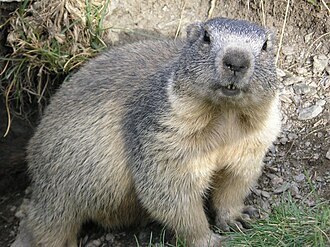
图:François Trazzi. · CC BY-SA 3.0 · Wikimedia Commons
生命之树 › 真核生物 › 动物界 › 真后生动物亚界 › 两侧对称动物 › 后口动物总门 › 脊索动物门 › 脊椎动物亚门 › 有颌下门 › 肉鳍鱼总纲 › 四足形类 › 希望螈目 › 四足总纲 › 哺乳动物 › 兽型类 › 全兽类 › 兽亚纲 › 有胎盘类 › 北方真兽高目 › 灵长总目 › 啮齿目 › 松鼠形亚目 › 松鼠科 › 非洲地松鼠亚科 › 地松鼠族 › 旱獭属
阿尔卑斯旱獭种
Marmota marmota
阿尔卑斯旱獭 是旱獭属的模式种,生活在中、南欧海拔800—3,200米(2,600—10,500英尺)的阿尔卑斯山、喀尔巴阡山、塔特拉山和亚平宁山脉地区,1948年又引入比利牛斯山地区,其实比利牛斯山本来存在阿尔卑斯旱獭,但在更新世灭绝。
摘自维基百科「阿爾卑斯旱獺」,CC BY-SA 4.0
- 学名
- Marmota marmota
- 分类等级
- 种
- 英文名
- Alpine marmot
- 上级类群
- 旱獭属
- 大类
- 哺乳动物
- 命名
- 卡尔·林奈,1758 年
- 保护状况(IUCN)
- 无危物种
- 数据库
- NCBI 分类 · GBIF · IUCN 红色名录
百科正文
特征
成年体体长43—73厘米(17—29英寸),尾巴长13—20厘米(5.1—7.9英寸),体重1.9—8千克(4.2—17.6磅),春天刚结束冬眠的体重比秋季轻得多。它有时被视为最重的松鼠科生物,但实际上同属的其他生物也可以达到这样的重量。
习性
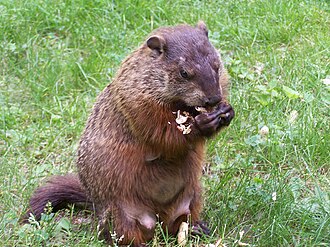
阿尔卑斯旱獭是一种杂食动物,吃草和各种昆虫、蜘蛛,每天早晚天气凉爽时出来觅食。它们不是很耐热,因此天气炎热时食欲不佳。
两岁大的阿尔卑斯旱獭就已性成熟,在春季交配,约33天产仔。占有统治地位的雌性阿尔卑斯旱獭会袭击怀孕的同类,甚至杀死幼崽。饲养的阿尔卑斯旱獭寿命在15至18年左右。
与人类的关系
欧洲人曾经相信阿尔卑斯旱獭的脂肪可以涂在皮肤上治疗风湿病,因此大规模地狩猎该物种,有时也将其作为食物捕杀。但是阿尔卑斯旱獭的整体种群数量并没有因此受到太大的威胁,只有德国等部分地区的数量有下降趋势。
以上内容摘自维基百科「阿爾卑斯旱獺」,按 CC BY-SA 4.0 使用,去掉了参考文献、外部链接等尾部小节,公式改写成了纯文本。全文、配图和出处见原文。
英文维基百科补充中文条目比较短,下面是英文条目「Alpine marmot」的原文
The alpine marmot (Marmota marmota) is a large ground-dwelling squirrel, from the genus of marmots. It is found in high numbers in mountainous areas of central and southern Europe, at heights between 800 and 3,200 m (2,600–10,500 ft) in the Alps, Carpathians, Tatras and Northern Apennines. In 1948 they were reintroduced with success in the Pyrenees, where the alpine marmot had disappeared at end of the Pleistocene epoch.
Evolution
The alpine marmot originates as an animal of Pleistocene cold steppe, exquisitely adapted to this ice-age climate. As such, alpine marmots are excellent diggers, able to penetrate soil that even a pickaxe would have difficulty with, and spend up to nine months per year in hibernation.
Since the disappearance of the Pleistocene cold steppe, the alpine marmot persists in the high altitude alpine meadow. During the colonisation of Alpine habitat, the alpine marmot has lost most of its genetic diversity through a bottleneck effect. It could not rebuild its genetic diversity ever since, as its lifestyle adapted to the Ice Age climate slowed its rate of genomic evolution. The alpine marmot is one of the least genetically diverse wild-living animals.
Description
An adult alpine marmot is between 43 and 73 cm (17–29 in) in head-and-body length and the tail measures from 13 to 20 cm (5–8 in). The body mass ranges from 1.9 to 8 kg (4.2–17.6 lb), with the animals being significantly lighter in the spring (just after hibernation) than in the autumn (just before hibernation). The alpine marmot is sometimes considered the heaviest squirrel species, although some other marmot species have a similar weight range, making it unclear exactly which is the largest. Its coat is a mixture of blonde, reddish and dark gray fur. While most of the alpine marmot's fingers have claws, its thumbs have nails.
Range and ecology
As its name suggests, the alpine marmot ranges throughout the European Alps, ranging through alpine areas of France, Italy, Switzerland, Germany, Slovenia, and Austria. They have also been introduced elsewhere with sub-populations in the Pyrenees, France's Massif Central, Jura, Vosges, Black Forest, Apennine Mountains, and the Romanian Carpathians. The Tatra marmot (M. m. latirostris Kratochvíl, 1961) represents an endemic subspecies of Alpine marmot that originated during the Quaternary period. Tatra marmots inhabit Tatry Mountains and Nízke Tatry Mountains.
Marmots are abundant in their core population; in the Romanian Carpathians, for example, the population is estimated at 1,500 individuals. Alpine marmots prefer alpine meadows and high-altitude pastures, where colonies live in deep burrow systems situated in alluvial soil or rocky areas.
Lifestyle
When creating a burrow, they use both their forepaws and hind feet to assist in the work—the forepaws scrape away the soil, which is then pushed out of the way by the hind feet. If there are any stones in the way, the alpine marmot will remove them with its teeth provided that the stones aren't too large. "Living areas" are created at the end of a burrow, and are often lined with dried hay, grass and plant stems. Any other burrow tunnels that go nowhere are used as toilet areas. Once burrows have been completed, they only host one family. They are often enlarged by the next generation, sometimes creating very complex burrows over time. Each alpine marmot will live in a group that consists of several burrows, and which has a dominant breeding pair.
Interaction with humans
Alpine marmots were once widely hunted for food and because their fat is believed to ease rheumatism when rubbed on the skin. Hunting of the alpine marmot still occurs for sport as well as for its fat. Hunting is a danger to the species if insufficiently regulated, as they reproduce relatively slowly.
In general the alpine marmot is currently not in danger of extinction, but certain sub-populations of marmot may be threatened such as those in the Jura and in Germany. A population in Rodna (Romania) is very small and threatened by poaching.
The use of trained alpine marmots by itinerants from Savoy was a not uncommon occurrence in the late 18th century. The marmot would be kept in a small box while in transit, and during a performance, the marmot would dance to the playing of an instrument, such as a hurdy-gurdy.
以上节选摘自英文维基百科「Alpine marmot」,按 CC BY-SA 4.0 使用,去掉了参考文献、外部链接等尾部小节,公式改写成了纯文本。篇幅所限,较长的小节只摘了开头一部分,有的小节没有收;全文、配图和出处见原文。