 格物
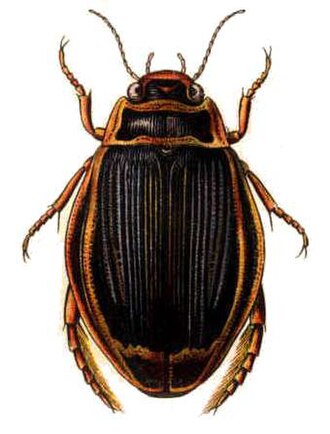
图:Edmund Reitter · Public domain · Wikimedia Commons
- 学名
- Adephaga
- 分类等级
- 亚目
- 上级类群
- 鞘翅目
- 大类
- 昆虫
- 命名
- Joseph Philippe de Clairville,1806 年
- 数据库
- NCBI 分类
下级类群(7)
百科正文
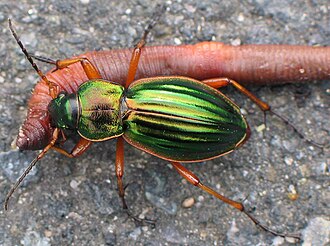
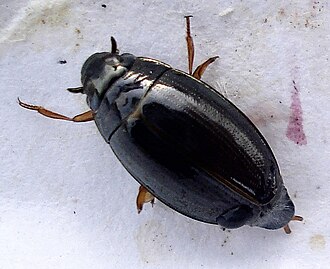
肉食亚目的特色是第一可见腹节之腹板多为后足基节窝所分开,后翅近中部处具1或2横脉(通常为m-cu横脉形成oblong cell),前胸多具侧板缝,后足转节膨大,指向中线,腿节基部靠近基节,触角似念珠状,如步行虫科、龙虱科、虎甲虫科等。
分类
传统分类
- 根据布鲁斯的昆虫分类表,肉食亚目包括下列各个总科与科:
- 步行虫总科/步甲总科 Caraboidea
- 虎甲虫科/虎甲科 Cicindelidæ
- 步行虫科/步甲科 Carabidæ
- 两栖龙虱科/两栖甲科 Amphiizoidæ
- 水步行虫科/水甲科 Hygrobiidæ
- 小头水虫科/沼梭科 Haliplidæ
- 龙虱总科Dytiscoidea
- 龙虱科 Dytiscidæ
- 豉甲总科 Gyrinoidea
- 豉虫科/豉甲科 Gyrinidæ
- Cupoidea
- Cupidæ
- 条脊甲总科 Rhysodoidea
- 背条虫科/条脊甲科 Rhysodidæ
- 短跗虫科 Jacobsoniidæ
后来豉甲总科及原来条脊甲总科的短跗虫科被并入步甲总科,短跗虫科被并入了鲣栉虫总科(Dermestoidea)。现时本亚目之下只有步甲总科一个总科。
亲缘支序学
肉食亚目物种于二叠纪后期与它们的姊妹群分离,它们的共同祖先最早可能于三叠纪初期,即2.4亿年前出现。
由于本分类很明显的出现两大群组(陆栖肉食亚目 ge- vs 水栖肉食亚目 hydr-),其单系性备受质疑。
以上内容摘自维基百科「肉食亞目」,按 CC BY-SA 4.0 使用,去掉了参考文献、外部链接等尾部小节,公式改写成了纯文本。全文、配图和出处见原文。
英文维基百科补充中文条目比较短,下面是英文条目「Adephaga」的原文
The Adephaga (from Greek ἀδηφάγος, adephagos, "gluttonous") are a suborder of beetles, and with more than 40,000 recorded species in 10 families, the second-largest of the four beetle suborders. Members of this suborder are collectively known as adephagans. The largest family is Carabidae (ground beetles) which comprises most of the suborder with over 40,000 species. Adephaga also includes a variety of aquatic beetles, such as predaceous diving beetles and whirligig beetles.
Anatomy
Adephagans have simple antennae with no pectination or clubs. The galeae of the maxillae usually consist of two segments. Adult adephagans have visible notopleural sutures. The first visible abdominal sternum is completely separated by the hind coxae, which is one of the most easily recognizable traits of adephagans. Five segments are on each foot.
Wings
The transverse fold of the hind wing is near the wing tip. The median nervure ends at this fold, where it is joined by a cross nervure.
Internal organs
Adephagans have four Malpighian tubules. Unlike the genetical structures of other beetles, yolk chambers alternate with egg chambers in the ovarian tubes of adephagans. The coiled, tubular testes consist of a single follicle, and the ovaries are polytrophic.
Chemical glands
All families of adephagan have paired pygidial glands located posterodorsally in the abdomen, which are used for secreting chemicals. The glands consist of complex invaginations of the cuticle lined with epidermal cells contiguous with the integument. The glands have no connection with the rectum and open on the eighth abdominal tergum.
Secretions pass from the secretory lobes, which are aggregations of secretory cells, through a tube to a reservoir lined with muscles. This reservoir then narrows to a tube leading to an opening valve. The secretory lobes differ structurally from one taxon to another; it may be elongated or oval, branched basally or apically, or unbranched.
Delivery of glandular compounds
Secretion can occur in multiple manners:
Oozing: if the gland is not muscle-lined, the discharge is limited in amount.
Spraying: if the gland is muscle-lined, which is typically the case of carabids, the substances are ejected more or less forcefully.
Crepitation: boiling noxious chemical spray ejected with a popping sound. Crepitation is only associated with the Brachininae carabids and several related species. See bombardier beetle for a detailed description.
The secretions differ in the chemical constituents, according to the taxa. Gyrinids, for instance, secrete norsesquiterpenes such as gyrinidal, gyrinidione, or gyrinidone. Dytiscids discharge aromatic aldehydes, esters, and acids, especially benzoic acid.
Distribution and habitat
Habitats range from caves to rainforest canopy and alpine habitats. The body forms of some are structurally modified for adaptation to habitats: members of the family Gyrinidae live at the air-water interface, Rhysodinae live in heartwood, and Paussinae carabids inhabit ant nests.
Feeding
Most species are predators. Other less-typical forms of feeding include: eating algae (family Haliplidae), seed-feeding (harpaline carabids), fungus-feeding (rhysodine carabids), and snail-feeding (licinine and cychrine carabids). Some species are ectoparasitoids of insects (brachinine and lebiine carabids) or of millipedes (peleciine carabids).
Reproduction and larval stage
Some species are ovoviviparous, such as pseudomorphine carabids.
The larvae are active, with well-chitinized cuticle, often with elongated cerci and five-segmented legs, the foot-segment carrying two claws. Larvae have a fused labrum and no mandibular molae.
Phylogeny
Adephagans diverged from their sister group in the Late Permian, the most recent common ancestor of living adephagans probably existing in the early Triassic, around 240 million years ago. Both aquatic and terrestrial representatives of the suborder appear in fossil records of the late Triassic. The Jurassic fauna consisted of trachypachids, carabids, gyrinids, and haliplid-like forms. The familial and tribal diversification of the group spans the Mesozoic, with a few tribes radiating explosively during the Tertiary.
The adephagans were formerly grouped into the Geadephaga with the two terrestrial families Carabidae and Trachypachidae and the Hydradephaga, for the aquatic families. However this is no longer used as the Hydradephaga are not a monophyletic group.
以上节选摘自英文维基百科「Adephaga」,按 CC BY-SA 4.0 使用,去掉了参考文献、外部链接等尾部小节,公式改写成了纯文本。篇幅所限,较长的小节只摘了开头一部分,有的小节没有收;全文、配图和出处见原文。