 格物
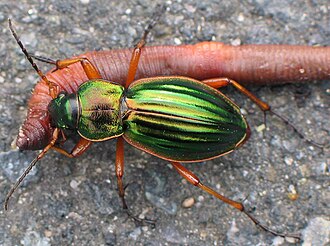
图:Soebe · CC BY-SA 3.0 · Wikimedia Commons
- 学名
- Carabidae
- 分类等级
- 科
- 上级类群
- 肉食亚目
- 大类
- 昆虫
- 命名
- 皮埃尔·安德烈·拉特雷耶,1802 年
- 主要食物
- 幼虫、腹足纲
- 用途
- 生物虫害防治
- 数据库
- NCBI 分类 · GBIF
下级类群(13)

百科正文
外形叙述及其生态系
步行虫科的外形及颜色极为多样化,不过大部分是闪亮的黑色或带有金属光泽,而且有脊状翼盖(鞘翅)。有些物种的鞘翅无法分开(特别是较大型的物种),因此这类的步行虫多数无法飞行。其中Mormolyce属因为其酷似小提琴的特殊鞘翅外形,也称为提琴虫(violin beetle)。除了非常原始的flanged bombardier beetle外,所有步行虫都在腿上有凹槽,其中有梳毛可以清洁昆虫的触角。
生态系
步行虫科常见的栖地是在树干下、原木下、或是在池塘及河流边的石头或砂旁边。大部分的步行虫科是肉食性,会主动猎食的无脊椎动物猎物。有些步行虫科会快速奔跑捕杀猎物,像虎甲虫(Cicindelinae)可以维持时速9公里的速度,在考虑其相对体长的情形下,他们是陆地上跑得最快的动物。大部分的步行虫科是夜行动物,虎甲昼夜都会捕食,身上有鲜明的颜色,虎甲有大眼睛,靠视力捕食。步行虫科中的Promecognathus laevissimus会捕食黄斑马陆,由于他们可以对抗氰化氢-这种对大部分步行虫有毒的物质。星步甲属的步行虫物种主要以毒蛾亚科、带蛾科、灯蛾亚科的毛虫为食;这些毛虫拥有螫毛,因此大部分食虫动物并不会捕捉这些毛虫。在 1905 年代时,大量来自欧洲的疆星步行虫被人工引进至新西兰进行生物防治,用以消灭当地的舞毒蛾。
以上内容摘自维基百科「步行蟲科」,按 CC BY-SA 4.0 使用,去掉了参考文献、外部链接等尾部小节,公式改写成了纯文本。全文、配图和出处见原文。
英文维基百科补充中文条目比较短,下面是英文条目「Ground beetle」的原文
Ground beetles are a large, cosmopolitan family of beetles, known as Carabidae, with more than 40,000 species worldwide, around 2,000 of which are found in North America and 2,700 in Europe. As of 2015, it is one of the 10 most species-rich animal families. They belong to the suborder Adephaga. Members of the family are primarily carnivorous, but some members are herbivorous or omnivorous.
Description and ecology
Although their body shapes and coloring vary somewhat, most are shiny black or metallic and have ridged wing covers (elytra). The elytra are fused in some species, particularly the large Carabinae, rendering the beetles unable to fly. The species Mormolyce phyllodes is known as violin beetle due to their peculiarly shaped elytra. All carabids except the quite primitive flanged bombardier beetles (Paussinae) have a groove on their fore leg tibiae bearing a comb of hairs used for cleaning their antennae.
Defensive secretions
Typical for the ancient beetle suborder Adephaga to which they belong, they have paired pygidial glands in the lower back of the abdomen. These are well developed in ground beetles, and produce noxious or even caustic secretions used to deter would-be predators. In some, commonly known as bombardier beetles, these secretions are mixed with volatile compounds and ejected by a small combustion, producing a loud popping sound and a cloud of hot and acrid gas that can injure small mammals, such as shrews, and is liable to kill invertebrate predators outright.
This ability has evolved independently twice, as it seems, in the flanged bombardier beetles (Paussinae), which are among the most ancient ground beetles, and in the typical bombardier beetles (Brachininae), which are part of a more "modern" lineage.
Relationship with humans
As predators of invertebrates, including many pests, most ground beetles are considered beneficial organisms. The caterpillar hunters (Calosoma) are famous for their habit of devouring prey in quantity, eagerly feeding on tussock moth (Lymantriinae) caterpillars, processionary caterpillars (Thaumetopoeinae) and woolly worms (Arctiinae), which, due to their urticating hairs, are avoided by most insectivores. Large numbers of the forest caterpillar hunter (C. sycophanta), native to Europe, were shipped to New England for biological control of the gypsy moth (Lymantria dispar) as early as 1905.
A few species are nuisance pests. Zabrus is one of the few herbivorous ground beetle genera, and on rare occasions Zabrus tenebrioides, for example, occurs abundantly enough to cause some damage to grain crops. Large species, usually the Carabinae, can become a nuisance if present in large numbers, particularly during outdoor activities such as camping; they void their defensive secretions when threatened, and in hiding among provisions, their presence may spoil food. Since ground beetles are generally reluctant or even unable to fly, mechanically blocking their potential routes of entry is usually easy.
Evolution and systematics
The Adephaga are documented since the end of the Permian, about 250 million years ago (Mya). Ground beetles evolved in the latter Triassic, having separated from their closest relatives by 200 Mya. The family diversified throughout the Jurassic, and the more advanced lineages, such as the Harpalinae, underwent a vigorous radiation starting in the Cretaceous. The closest living relatives of the ground beetles are the false ground beetles (Trachypachidae) and the tiger beetles (Cicindelidae). They are sometimes even included in the Carabidae as subfamilies or as tribes incertae sedis, but more preferably they are united with the ground beetles in the superfamily Caraboidea, or Geadephaga.
Phylogeny
Much research has been done on elucidating the phylogeny of the ground beetles and adjusting systematics and taxonomy accordingly. While no completely firm consensus exists, a few points are generally accepted: The ground beetles seemingly consist of a number of more basal lineages and the extremely diverse Harpalinae, which contain over half the described species and into which several formerly independent families had to be subsumed.
Subfamilies
The taxonomy used here is primarily based on the Catalogue of Life and the Carabcat Database.
以上节选摘自英文维基百科「Ground beetle」,按 CC BY-SA 4.0 使用,去掉了参考文献、外部链接等尾部小节,公式改写成了纯文本。篇幅所限,较长的小节只摘了开头一部分,有的小节没有收;全文、配图和出处见原文。