 格物
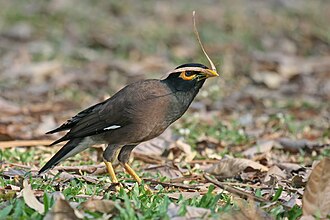
图:Muhammad Mahdi Karim Facebook The making of this document wa… · GFDL 1.2 · Wikimedia Commons
- 学名
- Acridotheres
- 分类等级
- 属
- 上级类群
- 椋鸟科
- 大类
- 鸟类
- 命名
- 路易·皮埃尔·维埃约,1816 年
- 数据库
- NCBI 分类 · GBIF
下级类群(10)

百科正文
中文的“八哥”是对八哥叫声的描述。“八”为其叫声的拟声词,而“哥”实为“歌”,通“歌”,本意为会叭叭叫的鸟。
分类
- 该属包含以下几个种:
- 林八哥 Acridotheres grandis
- 八哥 Acridotheres cristatellus
- 爪哇八哥 Acridotheres javanicus
- 淡腹八哥 Acridotheres cinereus
- 丛林八哥 Acridotheres fuscus
- 白领八哥 Acridotheres albocinctus
- 岸八哥 Acridotheres ginginianus
- 家八哥 Acridotheres tristis
- 黑袖椋鸟 Acridotheres melanopterus
- 红嘴椋鸟 Acridotheres burmannicus
丝光椋鸟和灰椋鸟有时也被划归该属。
以上内容摘自维基百科「八哥屬」,按 CC BY-SA 4.0 使用,去掉了参考文献、外部链接等尾部小节,公式改写成了纯文本。全文、配图和出处见原文。
英文维基百科补充中文条目比较短,下面是英文条目「Acridotheres」的原文
Acridotheres is a genus of starlings, the "typical" mynas, which are tropical members of the family Sturnidae.
Taxonomy
The genus Acridotheres was introduced in 1816 by the French ornithologist Louis Vieillot. The type species was subsequently designated as Paradisea tristis Linnaeus, the common myna. The name Acridotheres combines the Ancient Greek akridos meaning "locust" with -thēras meaning "-hunter".
Despite being called "mynas", species in the genus Acridotheres are more closely related to a group of mainly terrestrial starlings from Eurasia, such as the common starling, and also African ones like the Lamprotornis glossy-starlings. Among these, they are among the larger and duller species; they seem to be one of the major groups to evolve most recently. Apparently, they all arose from ancestors which arrived from Central Asia and adapted to more humid conditions in the Tropics. They presumably were isolated in about their current range when the evolutionary radiation to which they belonged - including the wattled starling and the Sturnia species - was fragmented by desertification at the start of the Early Pliocene, as Earth turned towards the last ice age 5 million years ago.
Distribution
This genus has representatives in tropical southern Asia from Iran east to southern China and Indonesia. Two species have been introduced widely elsewhere. The common myna has been introduced to South Africa, Israel, Hawaii, North America, Australia and New Zealand, and the crested myna to the Vancouver region of British Columbia.
Description
The Acridotheres mynas are generally dark or dull birds with fluted calls like most starlings; the sexes are similar. They walk and hop, and may share adaptations along with the Sturnus starlings that have modifications to the skull and its muscles for open bill probing or prying. They resemble the hill mynas (Gracula) with which they often co-occur, in having large white or buff wing patches which are obvious in flight and in some also naked areas on the head, but differ in that only the head plumage is glossy, and the underparts tend to be paler. The naked head patches are different in arrangement. Acridotheres mynas are also much more terrestrial than Gracula.
Several species have frontal crests which become covered with pollen when the birds take nectar from flowers, and may play a role in pollination.
Behaviour
The Acridotheres mynas have bowing courtship displays and lay unmarked pale blue eggs, whereas Gracula has no visual display.
Like most starlings, the Acridotheres mynas are fairly omnivorous, eating fruit, nectar and insects.
Species
The cladogram below showing the relationships of the species within the genus is based on a molecular phylogenetic study published in 2008. The Burmese myna (Acridotheres burmannicus) was not included in the study.
以上内容摘自英文维基百科「Acridotheres」,按 CC BY-SA 4.0 使用,去掉了参考文献、外部链接等尾部小节,公式改写成了纯文本。全文、配图和出处见原文。