 格物
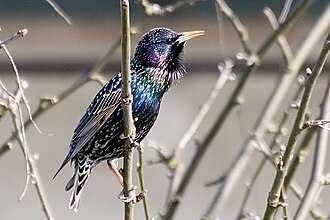
图:Anbucco at German Wikipedia (Original text: Andi Buchner) · Public domain · Wikimedia Commons
- 学名
- Sturnus
- 分类等级
- 属
- 上级类群
- 椋鸟科
- 大类
- 鸟类
- 命名
- 卡尔·林奈,1758 年
- 数据库
- NCBI 分类 · GBIF
下级类群(2)
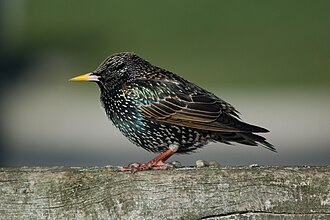
- 紫翅椋鸟 Sturnus vulgaris 种
- Sturnus unicolor 种
百科正文
命名历史
本属物种为瑞典自然学家卡尔·林奈于1758年描述。其模式种根据《国际动物命名规约》中的“林奈重名关系”(Linnaean tautonymy)被指定为紫翅椋鸟。其属名Sturnus来自同名拉丁语,即指椋鸟。
下属物种
- 本属包含以下物种:
- 紫翅椋鸟 Sturnus vulgaris Linnaeus, 1758
- 纯色椋鸟 Sturnus unicolor Temminck, 1820
以上内容摘自维基百科「椋鳥屬」,按 CC BY-SA 4.0 使用,去掉了参考文献、外部链接等尾部小节,公式改写成了纯文本。全文、配图和出处见原文。
英文维基百科补充中文条目比较短,下面是英文条目「Sturnus」的原文
Sturnus is a genus of starlings. As discussed below, the taxonomy of this group is complex, and other authorities differ considerably in which species they place in this genus, and in the species boundaries within Sturnus. The genus name Sturnus is Latin for "starling".
This genus has representatives across most of Eurasia and one species, the common or European starling, has been introduced to North America, South Africa, Australia and New Zealand. The more northerly breeding species are completely or partially migratory, wintering in warmer regions.
The Sturnus starlings are terrestrial species; they walk rather than hop, and have modifications to the skull and its muscles for open-bill probing. The latter adaptation has facilitated the spread of this genus from humid tropical southern Asia to cooler regions of Europe and Asia.
Starlings nest in holes in trees or buildings. They are omnivorous and mostly feed on the ground; they specialise in taking invertebrates from just below the surface. This is facilitated by the head adaptations mentioned above, which enable the birds to probe with the bill open, closing it to secure prey items. The plumages within this group are variable, but all the species have the starling's familiar triangular wing shape. They are capable of imitating many sounds and they have been recorded mimicking sounds such as that of a squeaky door.
Taxonomy and systematics
The genus Sturnus was introduced in 1758 by the Swedish naturalist Carl Linnaeus in the tenth edition of his Systema Naturae. The genus name Sturnus is Latin for "starling". Of the four species included by Linnaeus, the common starling (Sturnus vulgaris) is considered the type species.
The common and spotless starlings are particularly closely related, and interbreed to some extent where their ranges overlap in southwestern France and northeastern Spain. The non-migratory spotless starling may be descended from a population of ancestral S. vulgaris that survived in an Iberian refugium during an Ice Age retreat.
Mating system
A mating system is much more than just reproduction. It includes all the benefits and costs that the female weighs when choosing a mate and the competition that males, and sometimes females, go through when trying to win a mate. The genus Sturnus uses three major mechanisms in their complex mating system: parental care, differential allocation, and (arguably) the sexy son hypothesis.
Parental care
Male Sturnus unicolor individuals face a choice when it comes to the mating season. They can either invest in parental care, through helping feed the young, provide shelter, etc. and be monogynous or they can control many nests at one time, increase the number of matings they engage in and be polygynous. To add to this, much of the time their choice is biological. Sturnus unicolor males are more likely to be polygynous and be less involved in parental care if they have higher levels of testosterone. In addition, females of the Sturnus vulgaris species see a decrease in their fitness if the male is polygynous because there is no assistance in nestling feeding. Offspring success per nest, however, is significantly higher if there is parental care from the male, but males see greater overall fitness when they are polygynous. This is the trade off and the cost/benefit balance that each individual must go through.
Differential allocation
To try and make the male stay faithful to her, a female will act aggressively towards another female that solicits his attention. If the male looks like he is going to leave, she will perform aggressive acts towards a prospecting female, in an attempt to have the male stay. Males respond to this behaviour, and the resident female's aggressive acts towards prospecting females do play a role in whether the male stays monogamous. The female then responds to whether or not the male sticks around to invest in parental care. If the father stays monogamous, she will allocate more maternal steroid hormones to the eggs she lays later. Doing so negates the effects of hatching asynchrony. When the female is alone, she has difficulty finding enough resources to fully take care of all the offspring. Therefore, if the male is monogamous, she allows all the young to hatch at a similar time, and at a similar nutritional state.
Former species
Formerly, some authorities also considered the following species (or subspecies) as species within the genus Sturnus:
Straw-headed bulbul (as Sturnus zeylanicus)
以上节选摘自英文维基百科「Sturnus」,按 CC BY-SA 4.0 使用,去掉了参考文献、外部链接等尾部小节,公式改写成了纯文本。篇幅所限,较长的小节只摘了开头一部分,有的小节没有收;全文、配图和出处见原文。