格物
生命之树 › 真核生物 › 动物界 › 真后生动物亚界 › 两侧对称动物 › 后口动物总门 › 脊索动物门 › 脊椎动物亚门 › 有颌下门 › 肉鳍鱼总纲 › 四足形类 › 希望螈目 › 四足总纲 › 爬行动物 › 坚尾龙类 › 鸟纲 › 今鸟亚纲 › 今颚下纲 › 新鸟总目 › 雀形目
椋鸟科科
Sturnidae
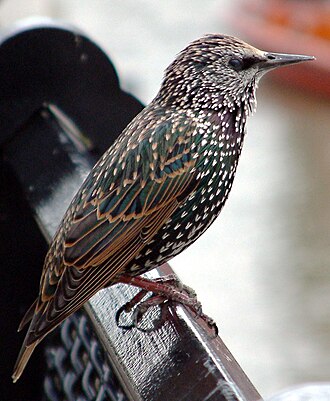
椋鸟科是鸟纲雀形目中的一科,约有31属115种。这个科的鸟是一种小到中型的雀类,大多为地栖性杂食动物,叫声变化多端。英文名字叫做“Starling”,是从拉丁文“Sturnidae”翻译而来的。主要分布在欧亚大陆中部和南部,非洲和南洋群岛。
摘自维基百科「椋鸟科」,CC BY-SA 4.0
- 学名
- Sturnidae
- 分类等级
- 科
- 上级类群
- 雀形目
- 大类
- 鸟类
- 命名
- 康斯坦丁·萨米埃尔·拉菲内克-施马尔茨,1815 年
- 数据库
- NCBI 分类 · GBIF
下级类群(15)
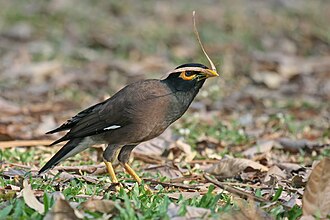
- 椋鸟属 Sturnus 属
- 八哥属 Acridotheres 属
- 鹩哥属 Gracula 属
- 丽椋鸟属 Lamprotornis 属
- 辉椋鸟属 Aplonis 属
- 王椋鸟属 Basilornis 属
- Onychognathus 属
- Mino 属
- Streptocitta 属
- Rhabdornis 属
- 亚洲椋鸟属 Sturnia 属
- Poeoptera 属
- 北椋鸟属 Agropsar 属
- 斑椋鸟属 Gracupica 属
- 丝光椋鸟属 Spodiopsar 属
百科正文
椋鸟大量从北欧迁移到温暖的罗马。因此在罗马有驱鸟队播放声音驱赶椋鸟。
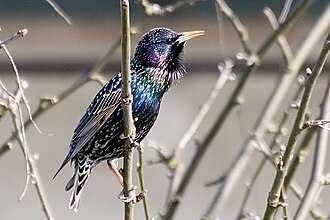
许多这种雀类都有深色带有金属光泽的羽毛。大多会在缝隙之中筑窝,会产下蓝色或白色的鸟蛋。
它们的叫声多变,可模仿环境的声音,例如车子警报器声音或人声。八哥和了哥即是典型例子。它们大多时候友善。因为可以辨别不同人的声音而成为人类语言进化的学习对象。
体型
椋鸟是中等大小的雀形目鸟类。当中身体最短的物种是Poeoptera kenricki,高15厘米(6英寸),而重量最轻的物种是Poeoptera femoralis,重34克(1.2盎司)。
分布地
椋鸟的分布可从北极圈到赤道。实际上,他们通常不占据的唯一栖息地是最干燥的沙质沙漠。该物种自然也不在美洲和澳大利亚大部分地区。但在欧洲,非洲和亚洲的大多数地区都有他们的存在。 Aplonis属也广泛分布在太平洋岛屿上,甚至到达波利尼西亚,美拉尼西亚和密克罗尼西亚。此外,Mino (bird)是唯一种到达所罗门群岛的椋鸟。
社交
椋鸟是一个具有高度社交的群居性鸟类。有时他们一群里还包括其他的种类的鸟类。在非繁殖季节,一些栖息地还会有成千上万的椋鸟。
以上内容摘自维基百科「椋鸟科」,按 CC BY-SA 4.0 使用,去掉了参考文献、外部链接等尾部小节,公式改写成了纯文本。全文、配图和出处见原文。
英文维基百科补充中文条目比较短,下面是英文条目「Starling」的原文
Starlings are small to medium-sized passerine (perching) birds known for the often dark, glossy iridescent sheen of their plumage; their complex vocalizations including mimicking; and their distinctive, often elaborate swarming behavior, known as murmuration.
All members of the family Sturnidae, commonly called sturnids, are known collectively as starlings. The Sturnidae are named for the genus Sturnus, which in turn comes from the Latin word for starling, sturnus. The family contains 128 species which are divided into 36 genera. Many Asian species, particularly the larger ones, are called mynas, and many African species are known as glossy starlings because of their iridescent plumage. Starlings are native to Europe, Asia, and Africa, as well as northern Australia and the islands of the tropical Pacific. Several European and Asian species have been introduced to these areas, as well as North America, Hawaii, and New Zealand, where they generally compete for habitats with native birds and are considered to be invasive species. The starling species familiar to most people in Europe and North America is the common starling, and throughout much of Asia and the Pacific.
Having strong feet, their flight is strong and direct, and they are very gregarious. Their preferred habitat is fairly open country, they eat insects and fruit, and most species nest in holes and lay blue or white eggs. Several species live around human habitation and are effectively omnivores. Many species search for prey such as grubs by "open-bill probing", that is, forcefully opening the bill after inserting it into a crevice, thus expanding the hole and exposing the prey; this behaviour is referred to as zirkeln (pronounced [ˈtsɪʁkl̩n]), after the German word Zirkel for a pair of compasses.
Starlings have diverse and complex vocalizations and have been known to embed sounds from their surroundings into their own calls, including car alarms and human speech patterns. The birds can recognize particular individuals by their calls and have been the subject of research into the evolution of human language.
Description
Starlings are medium-sized passerines. The shortest-bodied species is Kenrick's starling (Poeoptera kenricki), at 15 cm (6 in), but the lightest-weight species is Abbott's starling (Poeoptera femoralis), which is 34 g (1+1⁄4 oz). The largest starling, going on standard measurements and perhaps weight, is the Nias hill myna (Gracula robusta). This species can measure up to 36 cm (14 in), and in domestication they can weigh up to 400 g (14 oz). Rivaling the prior species in bulk if not dimensions, the mynas of the genus Mino are also large, especially the yellow-faced (M.
Distribution, habitat and movements
Starlings inhabit a wide range of habitats from the Arctic Circle to the Equator. The only habitats they do not typically occupy are very dry sandy deserts. The family is naturally absent from the Americas and from large parts of Australia, but it is present over the majority of Europe, Africa, and Asia. The genus Aplonis has also spread widely across the islands of the Pacific, reaching Polynesia, Melanesia, and Micronesia (in addition one species in the genus Mino has reached the Solomon Islands). Also, a species of this genus is the only starling found in northern Australia.
Behavior
Starlings imitate a variety of avian species and have a repertoire of about 15–20 distinct imitations. They also imitate a few sounds other than those of wild birds. The calls of abundant species or calls that are simple in frequency structure and show little amplitude modulation are preferentially imitated. Dialects of mimicked sounds can be local.
The Starling's sociality is particularly evident in their roosting behavior; in the nonbreeding season, some roosts can number in the thousands.
Systematics
The starling family Sturnidae was introduced (as Sturnidia) by French polymath Constantine Samuel Rafinesque in 1815.
The starlings belong to the superfamily Muscicapoidea, together with thrushes, flycatchers and chats, as well as dippers, which are quite distant relatives, and Mimidae (thrashers and mockingbirds). The latter are apparently the Sturnidae's closest living relatives, replace them in the Americas, and have a rather similar but more solitary lifestyle.
以上节选摘自英文维基百科「Starling」,按 CC BY-SA 4.0 使用,去掉了参考文献、外部链接等尾部小节,公式改写成了纯文本。篇幅所限,较长的小节只摘了开头一部分,有的小节没有收;全文、配图和出处见原文。