 格物
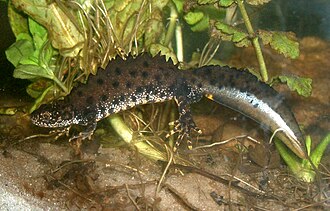
图:Rainer Theuer. · Public domain · Wikimedia Commons
- 学名
- Triturus cristatus
- 分类等级
- 种
- 上级类群
- 欧螈属
- 大类
- 两栖动物
- 命名
- 约瑟夫斯·尼古劳斯·劳伦蒂,1768 年
- 保护状况(IUCN)
- 无危物种
- 异名
- Triton lobatus meridionalis
- 数据库
- NCBI 分类 · GBIF · IUCN 红色名录
分类阶元
- 域真核生物
- 未标等级无定形生物 Amorphea
- 演化支后鞭毛生物 Opisthokonta
- 总界动物总界 Holozoa
- 未标等级蜷丝生物 Filozoa
- 未标等级领鞭毛动物 Choanozoa
- 界动物界 Animalia
- 亚界真后生动物亚界 Eumetazoa
- 未标等级副同源异形基因动物 Parahoxozoa
- 亚界两侧对称动物 Bilateria
- 总门后口动物总门 Deuterostomia
- 门脊索动物门 Chordata
- 亚门脊椎动物亚门 Vertebrata
- 下门有颌下门 Gnathostomata
- 未标等级正真口类 Euteleostomi
- 总纲肉鳍鱼总纲 Sarcopterygii
- 未标等级扇鳍鱼类 Rhipidistia
- 亚纲四足形类 Tetrapodomorpha
- 未标等级始四足目 Eotetrapodiformes
- 下纲希望螈目 Elpistostegalia
- 未标等级坚头类 Stegocephalia
- 总纲四足总纲 Tetrapoda
- 未标等级蛙形类 Batrachomorpha
- 纲两栖动物 Amphibia
- 目有尾目 Caudata
- 科蝾螈科 Salamandridae
- 属欧螈属 Triturus
- 种北冠毛蝾螈 Triturus cristatus
百科正文
大冠蝾螈一年中的大部分时间都在陆地上度过,主要生活在低的森林地区,在春季进入水中繁殖。雌性能产大约200个卵,孵化后,幼体需要两到四个月变态为陆生体。它以各种无脊椎动物为食。
以上内容摘自维基百科「大冠蝾螈」,按 CC BY-SA 4.0 使用,去掉了参考文献、外部链接等尾部小节,公式改写成了纯文本。全文、配图和出处见原文。
英文维基百科补充中文条目比较短,下面是英文条目「Northern crested newt」的原文
The northern crested newt, great crested newt or warty newt (Triturus cristatus) is a newt species native to Great Britain, northern and central continental Europe and parts of Western Siberia. It is a large newt, with females growing up to 16 cm (6.3 in) long. Its back and sides are dark brown, while the belly is yellow to orange with dark blotches. During the breeding season, males develop a conspicuous jagged crest on their back and tail.
The northern crested newt spends most of the year on land, primarily in wooded areas of the lowlands. In spring, it moves to aquatic breeding sites, mainly larger fish-free ponds. Males court females with a ritualised display and deposit a spermatophore on the ground, which the female then picks up with her cloaca. After fertilisation, a female lays around 200 eggs, folding them into water plants. The larvae develop over two to four months before metamorphosing into terrestrial juveniles (efts). Both larvae and land-dwelling newts mainly feed on different invertebrates.
Several former subspecies of the northern crested newt are now recognised as separate species within the genus Triturus. Its closest relative is the Danube crested newt (T. dobrogicus). It sometimes forms hybrids with some of its relatives, including the marbled newt (T. marmoratus). Although it is currently the most widespread Triturus species, the northern crested newt was probably confined to small refugial areas in the Carpathians during the Last Glacial Maximum.
While the International Union for Conservation of Nature lists the northern crested newt as a species of Least Concern, its populations have been declining. The main threat is habitat destruction, for example, through urban sprawl. The species is also listed as a European Protected Species.
以上节选摘自英文维基百科「Northern crested newt」,按 CC BY-SA 4.0 使用,去掉了参考文献、外部链接等尾部小节,公式改写成了纯文本。篇幅所限,较长的小节只摘了开头一部分,有的小节没有收;全文、配图和出处见原文。