格物
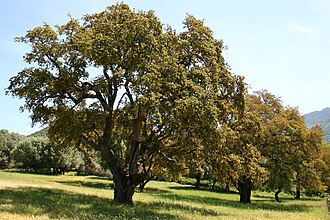
图:Jean-Pol GRANDMONT · CC BY 3.0 · Wikimedia Commons
- 学名
- Quercus suber
- 分类等级
- 种
- 上级类群
- 栎属
- 大类
- 被子植物
- 命名
- 卡尔·林奈,1753 年
- 保护状况(IUCN)
- 无危物种
- 异名
- Quercus cintrana、Quercus corticosa、Quercus suberosa
- 数据库
- NCBI 分类 · GBIF · IUCN 红色名录
百科正文
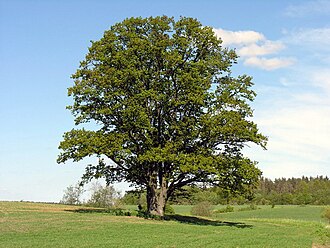
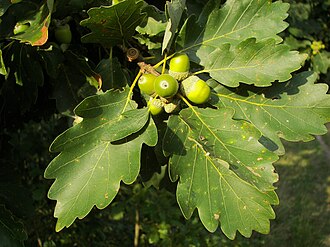
软木橡树最高可生长到20米,但在一般自然环境却少有如此高大。叶长约4~7厘米边缘微裂或有锯齿状,叶面暗绿色叶背则呈现泛白色,叶于支末端呈自然垂落状。种子约2~3公分长,与一般橡树子不同在于壳斗呈现流苏杯状。
生态环境
天然软木橡树林是可提供多样生态的环境。例如,北非西北角摩洛哥一带的软木橡树林则是濒临绝种的巴巴里猕猴很好的栖息地,另外在欧洲葡萄牙及西班牙一带软木橡树林保护了濒临绝种的伊比利亚猞猁。相较于其它树木,软木橡树厚重的软木树皮在森林火灾时能适当阻绝火焰对树木本身的伤害,使软木橡树于火灾结束后仍能树冠及支末快速长出新的树叶。
以上内容摘自维基百科「西班牙栓皮栎」,按 CC BY-SA 4.0 使用,去掉了参考文献、外部链接等尾部小节,公式改写成了纯文本。全文、配图和出处见原文。
英文维基百科补充中文条目比较短,下面是英文条目「Quercus suber」的原文
Quercus suber, commonly called the cork oak, is a medium-sized, evergreen oak tree in the section Quercus sect. Cerris. It is the primary source of cork for wine bottle stoppers and other uses, such as cork flooring and as the cores of cricket balls. It is native to southwest Europe and northwest Africa. In the Mediterranean basin the tree is an ancient species with fossil remnants dating back to the Tertiary period. It can survive for as long as two centuries. Typically, once it reaches 25 years old, its thick bark can be harvested for cork every 9 to 12 years without causing harm to the tree.
It endures drought and makes little demand on the soil quality and is regarded as a defence against desertification. Cork oak woodlands are home to a multitude of animal and plant species. Since cork for sealing bottles is increasingly being displaced by other materials, these forests are at risk as part of the cultural landscape and as a result animal species such as the Iberian lynx and imperial eagles are threatened with extinction.
Description
General appearance and bark
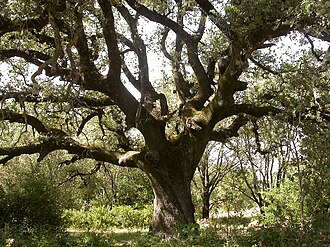
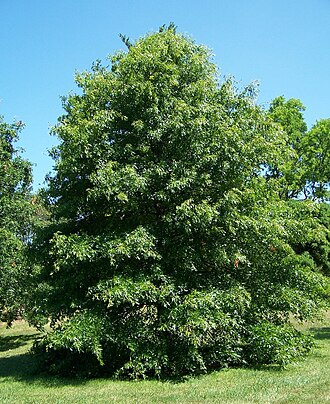
The cork oak grows as an evergreen tree, reaching an average height of 10 to 15 metres (33 to 49 feet) or in rare cases up to 25 m and a trunk diameter (DBH) of 50 to 100 centimetres (20 to 39 inches). It forms a dense and asymmetrical crown that starts at a height of 2–3 m (6+1⁄2–10 ft) and spreads widely in free-standing trees. The crown can be divided into several separate, rounded partial crowns.
The young twigs are densely hairy light gray or whitish. Older branches are strong and knotty. Older trees only form short shoots between 7 and 15 cm (3 and 6 in) in length.
Taxonomy
Quercus suber is a species of the section Cerris to which, for example, the following species also belong:
- Valonia oak (Quercus macrolepis)
- Turkey oak (Quercus cerris)
- Quercus × crenata
- Macedonian oak (Quercus trojana)
Characteristic for the section are the hairless pericarp and the usually two-year ripening time of the fruits. The cork oak is an exception because the fruits can ripen in both the first and the second year.
In the species Quercus suber two subspecies are distinguished:
Quercus suber subsp. suber: Nominal taxon
Distribution and habitat
The cork oak occupies the area around the western Mediterranean basin. In Portugal, natural and cultivated stands cover an area of 750,000 ha (1,900,000 acres). There are natural populations of the nominate form at altitudes between 150 and 300 m (490 and 980 ft) above sea level, while the subspecies occidentalis is found along the Atlantic coast.
Ecology
The cork oak forest is one of the major plant communities of the Mediterranean woodlands and forests ecoregion. In natural populations, the cork oak grows together with the holm oaks (Quercus ilex, Quercus rotundifolia), the Portuguese oak (Quercus faginea), the Pyrenean oak (Quercus pyrenaica), Mirbeck's oak (Quercus canariensis), the maritime pine (Pinus pinaster), the stone pine (Pinus pinea), the strawberry tree (Arbutus unedo) and the olive tree (Olea europaea), in cooler locations also with the sweet chestnut (Castanea sativa).
Uses
The cork oak is grown for the production of cork in several Mediterranean countries. The centers of cork production are in southern Portugal (accounting for 50% of the total production) and southern Spain, where low trees with large crowns and strong branches are grown in large areas, which provide the highest yield of cork. These mostly extensively managed habitats are called montados in Portugal and dehesas in Spain. They are considered to be extremely valuable from the point of view of biodiversity and cultural heritage.
Culture
The cork oak is featured in the city arms of several cities in Portugal, such as the city of Reguengos de Monsaraz, which shows a freshly harvested cork tree.
In 2007, a 2 euro commemorative coin with the motif of a cork oak was issued in Portugal in memory of the Portuguese Presidency of the European Union.
以上节选摘自英文维基百科「Quercus suber」,按 CC BY-SA 4.0 使用,去掉了参考文献、外部链接等尾部小节,公式改写成了纯文本。篇幅所限,较长的小节只摘了开头一部分,有的小节没有收;全文、配图和出处见原文。